

Key Takeaways
- Zangbeto means 'people of the night' in the Gun (Ogu) language — the traditional night-watch society of the Gun people of coastal Benin and Togo, appearing as towering rotating haystacks of raffia grass two metres high.
- According to Vodun belief and demonstrated in public ceremonies, no human being is inside a Zangbeto costume — cult members have publicly assembled and disassembled the structure before audiences to reveal that it stands empty before the spirit enters.
- Historically, Zangbeto held genuine legal authority: their judgments on community disputes carried weight in coastal Beninese society, and they enforced community law regarding theft and anti-social behaviour.
- French colonial authorities banned the Zangbeto as 'superstition' — they went underground and emerged stronger at independence, a pattern of resilience shared with Vodun practice broadly.
- A modern tension persists: tourists photograph Zangbeto in violation of sacred protocol, and the entities can publicly 'curse' violators — the encounter between tourist camera and sacred law plays out at every festival.
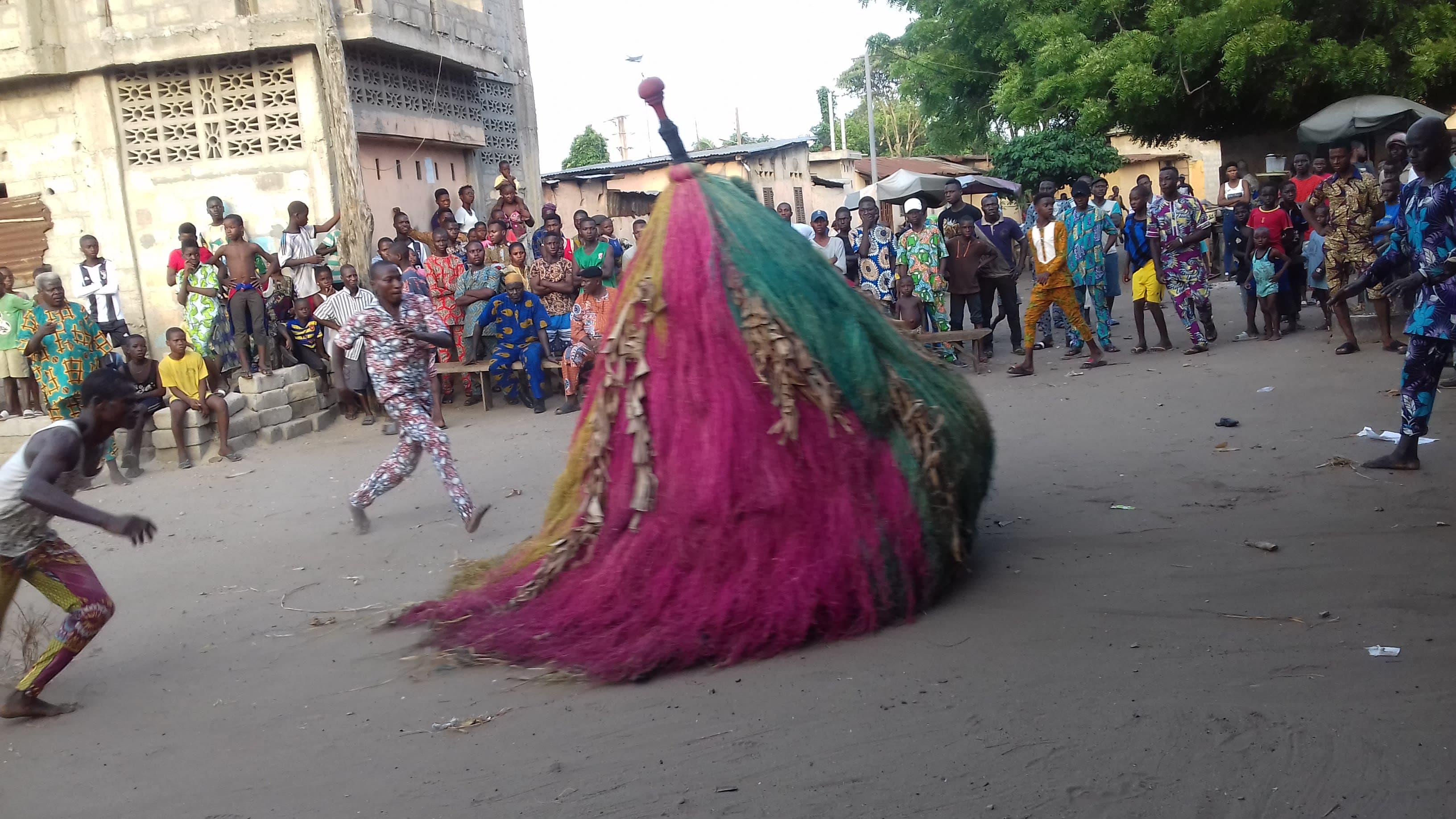
It is past ten o'clock in Ouidah and the market lanes have gone quiet. Then, from the far end of a narrow street, a sound arrives first: cymbals and drums in a rhythm that doesn't resemble music so much as an announcement. People near the doorways step inside. Children are pulled back from windows. And then it appears - a tower of spinning raffia, dyed in reds and greens and yellows, two metres high, turning on its own axis like something driven by a force that has nothing to do with human legs.
No face. No eyes. No voice that a mouth could produce.
A Zangbeto.
Whatever you thought you knew about the division between the living and the dead, the natural and the supernatural, the enforced and the sacred - this thing in front of you doesn't operate by those categories. It sees without eyes. It moves without feet. It judges without words. And in the morning, the person who stole from a neighbour's yard, or the family whose dispute had lasted three seasons - they'll know that it noticed.
The night people
Zangbeto are Vodun entities belonging to the tradition of the Gun people (also called Ogu or Egun) - an ethnic group present across coastal Benin, Togo, and western Nigeria. In Ouidah, they've been part of the spiritual and social landscape for centuries.
The Gun people aren't a small or marginal group. They account for roughly 6% of the total population of the Republic of Benin and approximately 15% of the indigenous population of Lagos State in Nigeria - a significant diaspora presence that extends the Zangbeto tradition well beyond Ouidah's walls. Their traditional economy has always been tied to the coast: fishing, coconut farming, pottery, and weaving - livelihoods that require a deep reading of tides, weather, and the boundary between land and sea. This relationship with the liminal, with edges and thresholds, is built into the Zangbeto's spiritual architecture.
The word Zangbeto comes from the Gun language with a precision the translation flattens: zan means night, gbeto means man - so "people of the night," or more literally, "those who belong to the dark." Not guardians in any soft sense. But inhabitants of the hours when ordinary sight fails, when the rules that govern daylight society require a different kind of enforcement.
Some oral traditions are even more specific about their origins: the Zangbeto, they say, are sea spirits who first emerged from the Atlantic clothed in raffia grass to serve the community. They are understood to represent the wild non-human forces that inhabited the earth before people arrived - the spirits of nature, of night, of the spaces between the settled and the untamed. Their relationship to the ocean - the same ocean that carried enslaved people out and the same one that the diaspora still faces - isn't accidental. The water is always present in the Vodun cosmology of coastal Benin.
Their physical form is immediately recognizable: towering costumes of dyed raffia - reds, greens, yellows, purples, browns - layered over a thin wooden frame, shaped like a haystack or dome, standing two metres or more. The fibres aren't chosen arbitrarily: they symbolize the link between the human world and the spirit of the bush, the untamed world beyond the boundary of the village where different rules apply.
Traditional police, spiritual justice
Before the state. Before gendarmeries. Before written law. There was the Zangbeto.
Historically, the Zangbeto were the night police of Gun communities - a traditional security institution charged with the maintenance of law and order. They patrolled after dark, deterring thieves, resolving disputes, enforcing community norms, and protecting neighbourhoods from what the community considered social evil, including witchcraft, theft, and behaviour that threatened communal cohesion.
Their authority wasn't merely informal or ceremonial. Zangbeto judgments on community disputes carried genuine legal weight in coastal Beninese society. They could name a thief, arbitrate a land conflict, impose a fine, or declare a household under spiritual protection. The mechanism of enforcement was their supernatural reputation: who would dare challenge, reason with, or attempt to bribe an entity that wasn't human, that saw in the dark through means that bypass ordinary vision, and that operated according to a justice older than any written code?
This was both theology and pragmatics. The community didn't need to believe the Zangbeto was a spirit to behave as though it might be. The ambiguity itself was the power.
French colonial authorities, arriving in the 1890s and formally establishing control over the region by 1894, banned the Zangbeto along with much of Vodun practice. They called it superstition. They understood it - correctly - as a source of parallel social authority that operated outside their administrative control. The Zangbeto went underground. At Beninese independence in 1960, and more openly after the fall of the Marxist-Leninist regime in 1990, they re-emerged. Stronger, as suppressed things often do.
Today, the Zangbeto have lost their formal policing role in a state that has modern law enforcement. But they have retained all their spiritual authority. They appear at births, funerals, and royal enthronements. They patrol during the Vodun Days in January. And sometimes they simply appear at night, without warning, in the streets of a neighbourhood that hasn't done what it was supposed to do.
The Vodúnsɛntó: those who enter the society
The Zangbeto doesn't manage itself. Behind the spinning raffia structure stands a secret society - the Vodún sɛntó - whose members are its human guardians. Understanding the Vodúnsɛntó is to understand the full depth of what the Zangbeto institution actually is.
Initiation into the Vodúnsɛntó isn't requested - it is called. Candidates are identified, often from boyhood, by senior members who observe specific qualities: discipline, discretion, physical control, and what the tradition describes as a natural receptivity to spiritual force. The initiation process itself is secret; its duration varies. What is documented from ethnographic accounts is that it focuses on three disciplines:
- Secrecy: The initiate learns that what is known about the Zangbeto by outsiders is a fraction of what is known by members. The protection of that gap is the initiate's most important responsibility.
- Physical control: The manipulation of the raffia structure requires extraordinary coordination and endurance - the spinning, the directional changes, the stillness - performed in conditions of near-total darkness, in heat, for extended periods.
- Spiritual preparation: The initiate is understood to become, during the ceremony, a vessel for an energy that isn't their own. Initiation training prepares them to receive that force without losing themselves to it.
Once initiated, a member of the Vodúnsɛntó carries knowledge that can't be purchased, transferred, or revealed. The secrecy isn't merely social - in the Vodun understanding, revealing the inner workings of the Zangbeto constitutes a spiritual violation that carries consequences measurable in health, fortune, and the integrity of the community's protective field.
The initiated are indistinguishable from their neighbours in daily life. They are fishermen, traders, farmers, students. It's only when the drums begin and the night arrives that the other identity becomes relevant.
The mystery of the empty costume
The question every visitor eventually asks: is there anyone inside?
Vodun tradition is unequivocal: no. The spirit inhabits the raffia structure directly. The costume is a vessel, not a disguise. This isn't a metaphor - it's the theological foundation that gives the Zangbeto its social and legal weight.
To demonstrate this, cult members perform a specific ritual proof at certain ceremonies: they publicly assemble the entire structure from scratch in front of the assembled audience - from putting the thin wooden frame together to layering the raffia leaves over it. The audience watches every step. Then the spirit is invoked and the structure begins to move. Afterward, it is disassembled again, before the same audience, to show it stands empty.
This demonstration isn't theatrical trickery. It's an invitation to encounter the limits of ordinary seeing - a test of what the audience is willing to know. In some documented ceremonies, the structure has been lifted and inverted to reveal:
- Nothing at all - an empty interior
- A small animal - a cat, a bird, sometimes a live crocodile - that hadn't been visibly present moments before
- Objects that appeared inside during the ceremony without any observable mechanism of entry
These aren't explained by the tradition. They're presented as evidence. The dead chicken, in one documented performance, disappeared inside the spinning Zangbeto and was never recovered. In another, a live crocodile was produced, placed on the ground, and ran toward the crowd before being retrieved. Whether these are spiritual manifestations or feats of trained attention and perception, the Zangbeto doesn't say - and the tradition holds that demanding an explanation is itself a form of disrespect.
The costume as sacred object
The Zangbeto costume isn't a prop. It's a sacred construction that takes days to prepare and requires ritual protection throughout.
The raffia fibres are dyed in specific colours that carry meaning within the Gun spiritual system. Some Zangbeto costumes are associated with specific families, neighbourhoods, or lineages - each with distinct characteristics, chants, and rhythms. In Ouidah, several quarters maintain their own Zangbeto, each as distinct as a family crest.
The costume is assembled and disassembled by initiated members of the Vodun sɛntó - the secret society that manages the Zangbeto. Only these men carry the full knowledge. Revealing the secret of what occurs beneath the costume - or attempting to document it - is considered one of the gravest acts of sacrilege in Ouidah. The spiritual consequence is real, the community's social consequence equally so.
Costumes are sometimes crowned with horns, masks, or specific ritual objects depending on the function of that particular Zangbeto appearance. A Zangbeto appearing at a funeral carries different attributes than one patrolling on the eve of the Vodun Days.
Related institutions across West Africa
The Zangbeto belongs to a wider family of West African nocturnal secret societies with overlapping functions - spiritual policing, community justice, initiation, and the governance of the boundary between the visible and invisible:
- Oro (Yoruba, Nigeria): The voice of the Oro heard at night empties the streets - its sound represents ancestral authority over the living. Women are forbidden from seeing it.
- Poro (Sierra Leone, Liberia, Côte d'Ivoire): A powerful men's secret society governing initiation, law, and inter-community relations across multiple ethnic groups.
- Gelede (Yoruba-Fon, Benin-Nigeria): Masks honouring female spiritual power - "the Mothers" - performed to maintain social harmony and placate forces that could destabilize the community.
- Egungun (Yoruba-Fon, Ouidah): Ancestor-masquerade tradition where the dead physically return through textile constructions, serving parallel functions of ancestral justice and guidance.
These aren't the same institution, but they share a governing logic: the night is the time when ordinary social rules require supernatural enforcement, and that enforcement must operate through means that ordinary human authority can't replicate or corrupt.
The diaspora connection
The Vodun tradition - of which the Zangbeto is one institution - traveled across the Atlantic with the enslaved people who passed through Ouidah's Slave Route. The specific practices of ancestral justice and nocturnal spiritual protection didn't simply disappear in the Middle Passage. They transformed.
In Haiti, the Vodou tradition preserves a direct spiritual lineage from coastal Benin. The concept of the lwa - spiritual entities that inhabit and speak through human vessels - mirrors the Zangbeto's understanding of the spirit entering the costume. The Haitian Zandor, a warrior spirit associated with protection and justice, carries phonetic and functional echoes of the Zangbeto lineage.
In Brazil, Candomblé houses founded by Ogun-descended communities preserve the logic of ancestral night-time protection through specific ritual practices around the deity Ogun - god of iron, justice, and the boundary between the human and wild worlds - whose attributes overlap directly with those of the Zangbeto's domain.
In Cuba, the Palo Monte tradition works with nocturnal spirit forces for protection and justice in ways that trace to the same coastal Benin communities through the Slave Route.
The Zangbeto never crossed the ocean in a ship. But the logic that produced the Zangbeto - the belief that justice requires a form that ordinary human authority can't replicate, that the night must be governed by something the daylight world can't contain - crossed in the bodies of enslaved people and survived in the spiritual systems they built on the other side.
Testimonials
Kofi, 38, ethnographer from Accra:
"I study West African spiritual institutions across the diaspora. The Zangbeto is the clearest demonstration I've seen of what the tradition calls 'the power of concealment' — the idea that the most potent authority is the one whose mechanism you cannot identify. Colonial administrators tried to ban it because they understood this. They couldn't legislate against an enforcement power they couldn't locate. That's not primitive. That's sophisticated governance."
Amélie, 29, journalist from Cotonou:
"I grew up knowing about the Zangbeto but always at a distance — my family is Catholic, and we treated it as something belonging to a different part of the city. Then I had to cover the Vodun Days for a national newspaper. The first time I heard the drums at eleven at night and turned a corner into a Zangbeto, I understood why children run. Not from fear exactly. From something closer to awe. The vocabulary for it is spiritual whether you're a believer or not."
Chief Dossou, 61, Zangbeto society elder, Ouidah:
"People want to know the secret. I tell them: the secret is not inside the costume. The secret is in what you are willing to see when you look at it. If you come to photograph, you see something to photograph. If you come to understand, you see something else. The Zangbeto does not reveal itself to anyone who comes with a camera instead of an open hand. That is not stubbornness. That is the oldest protocol of justice we have."
The camera and the curse
A specific modern tension has entered the world of the Zangbeto: the tourist smartphone.
Photographing a Zangbeto without permission is considered a violation of sacred protocol. Attempting to photograph or film what lies inside the costume - during the moment of assembly or disassembly, or during the demonstration of emptiness - is treated as a serious act of sacrilege. The Zangbeto can, and do, publicly pronounce ritual curses on violators. These aren't theatrical gestures - they assert the Zangbeto's jurisdiction over the ceremonial space and, within the community, carry real social and spiritual weight.
The guidance for visitors is simple: watch, don't record without asking, and understand that the Zangbeto has no obligation to be documented by a world that once sent ships to this shore.
Guides from OuidahOrigins are familiar with the protocol of each specific Zangbeto society and can arrange appropriate introductions that allow photography where it is permitted and explain where the boundaries lie.
The future of the tradition
The Zangbeto face several pressures that no ceremony can fully resolve.
Urban expansion has compressed the spaces in which the tradition operates. The dark alleyways where the Zangbeto patrol are increasingly lit by streetlights and surveilled by security cameras. The symbolic night - the undivided, unmonitored darkness that gave the institution its authority - is contracting.
Generational change raises the question of who will be initiated into the secret society to carry the tradition forward. The initiation process requires time, commitment, and submission to protocols that the economy of modern Beninese life makes difficult. Several Zangbeto societies in Ouidah have fewer active members today than they did a generation ago.
Global attention - through festivals, documentaries, and viral social media clips of the mysterious spinning costume - has created a paradox: the Zangbeto is more internationally known than at any point in its history. While locally it faces challenges of transmission and relevance that no amount of global visibility can address.
The tradition's survival depends not on being seen by the outside world but on being transmitted within it.
Visiting information
Where: The Zangbeto appear throughout Ouidah, particularly in the older Gun-descended quarters of the city. There's no fixed venue - encounters are organic, rooted in community need and ceremonial calendars.
Coordinates: approximately 6.35500°N, 2.08600°E (central Ouidah)
When:
- Most reliably: Evening of January 9th during the Vodun Days, when Zangbeto patrol the city as spiritual police marking the opening of the sacred period
- Also: Major life ceremonies - births, funerals, royal enthronements - throughout the year
- Unexpectedly: At night, without warning, in any quarter of the city at any time
Protocol:
- Stand still when one approaches - don't run, don't reach out
- Step back and give it a clear path
- Ask before raising any camera or phone - and accept that the answer may be no
- Don't attempt to follow or track where it goes
Guided access: A knowledgeable local guide can facilitate introductions to Zangbeto society elders before a ceremony, explain the specific characteristics of individual Zangbeto in different neighbourhoods, and ensure you approach with the protocol that makes a real encounter - rather than a tourist performance - possible.
What few people know
In documented ceremonies at Grand Popo and in the Ouidah region, Zangbeto cult members have publicly demonstrated the assembly process - building the entire structure from wooden frame to full raffia costume in front of the audience, explicitly to show that nothing is hidden inside at the start. The spirit enters only after the construction is complete and the ritual invocation is performed.
This reversal of the usual magic-show logic - in which the trick is hidden, not shown - is the most theologically precise thing the Zangbeto does. It isn't claiming to trick you. It is claiming that what you witness, having eliminated the possibility of deception, is something else entirely.
Beyond the empty costume, the Zangbeto is credited with other documented spiritual abilities. In multiple recorded ceremonies, a Zangbeto has been observed to swallow shards of glass without injury - splinters placed visibly inside the structure before the spirit enters, recovered after. In other ceremonies, a live crocodile has been produced from inside the spinning structure and released toward the audience before being retrieved. These demonstrations aren't claimed as illusion. They're presented as evidence of the force that operates through the costume when the spirit is present.
What that force is - the tradition doesn't explain. It demonstrates.
Concierge access
The Zangbeto's most meaningful encounters don't happen at public festivals alone. Private ceremonies - births, funerals, community gatherings - are where the institution operates in its full social function, not as spectacle but as justice.
If you want to attend a ceremony beyond the Vodun Days crowds, meet with a Zangbeto society elder, or understand the specific lineages of the Ouidah Zangbeto societies that operate in different neighbourhoods - these are introductions that OuidahOrigins can arrange for visitors who approach with the right intentions.
The tradition doesn't advertise. It doesn't need to.
Further reading
- Wikipedia: Zangbeto - Origins, structure, and function of the Gun night guardian tradition.
- TheCollector: Zangbeto — Voodoo's Whirling Spirit Dance - Detailed overview of the ceremony and its spiritual context.
- Cultures of West Africa: Benin Zangbeto Masquerades - In-depth cultural analysis of the Zangbeto tradition.
- Wikipedia: West African Vodún - Broader context of the Vodun tradition in which the Zangbeto operates.
- Wikipedia: Haitian Vodou - The diaspora tradition that preserves related ancestor-justice functions.
- Related articles: The Egungun · Vodoun Days · The Sacred Forest · The Slave Route
Editorial transparency
This content was developed with the assistance of our AI agents.
Frequently Asked Questions
Lire aussi

The Days of Vodoun
Every January, Ouidah transforms into the spiritual capital of Vodoun. A vibrant gathering where the gods come to life in the community, beyond just a festival.
The Sacred Forest of Kpassè
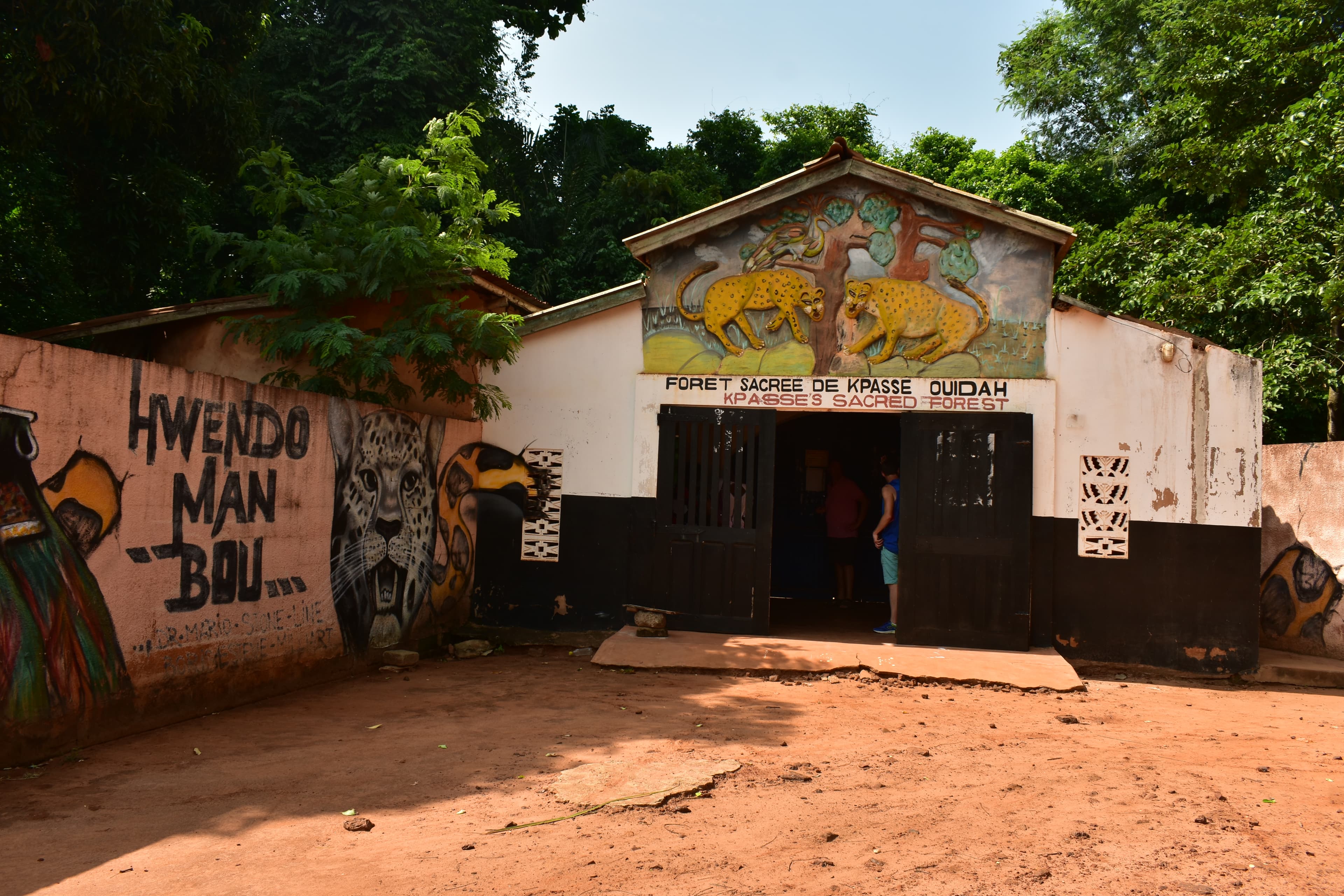
Entering the sacred forest of Kpassè reveals an ancient world. Each tree becomes a witness, each shadow a potential presence. This living sanctuary transcends time and space.
Reading paths
The Slave Route
From the Atlantic slave trade to contemporary memory
Vodoun & Diaspora
How an African religion crossed the Atlantic
- Step 1· 12 minLe Temple des Pythons
Les origines du vodoun à Ouidah