Key Takeaways
- Egungun are not costumes but embodied ancestors in Yoruba tradition — 'Egungun' means 'powers concealed' or 'supernatural power concealed,' and the masked figure IS the ancestor, not a representation; touching the costume means touching the ancestor, requiring ritual protection signaled by the ajá bell.
- Egungun costumes are extraordinary multi-generational textile constructions built from local handwoven aso ofi alongside imported velvet, damask, silk, and lace — each panel added by a different family member across decades, the oldest costumes literally carrying the physical memory of a lineage.
- The Egungun cannot speak in a human voice; a hidden device called the ìyàwó agba distorts speech into the ancestors' sound — what the Egungun pronounces carries the force of law in Yoruba communities.
- The Egungun ceremony was suppressed by both French colonial authorities and evangelical missionaries in Ouidah — its survival across the Atlantic proves what could not be destroyed by force was preserved by memory.
- The main center of Egungun worship in Brazil is the island of Itaparica in Bahia — Baba Egungun there trace their spiritual lineage directly to Ouidah, making the connection between these two sites one of the most intact transatlantic religious lineages in the world.
It begins with sound before it begins with sight.
The drums shift - a register you haven't heard all evening, something lower and more insistent. The people around you stop talking. A child is moved to stand behind his mother. And then through the doorway of the compound, into the lit courtyard, comes something that defies the categories your eyes were taught to use.
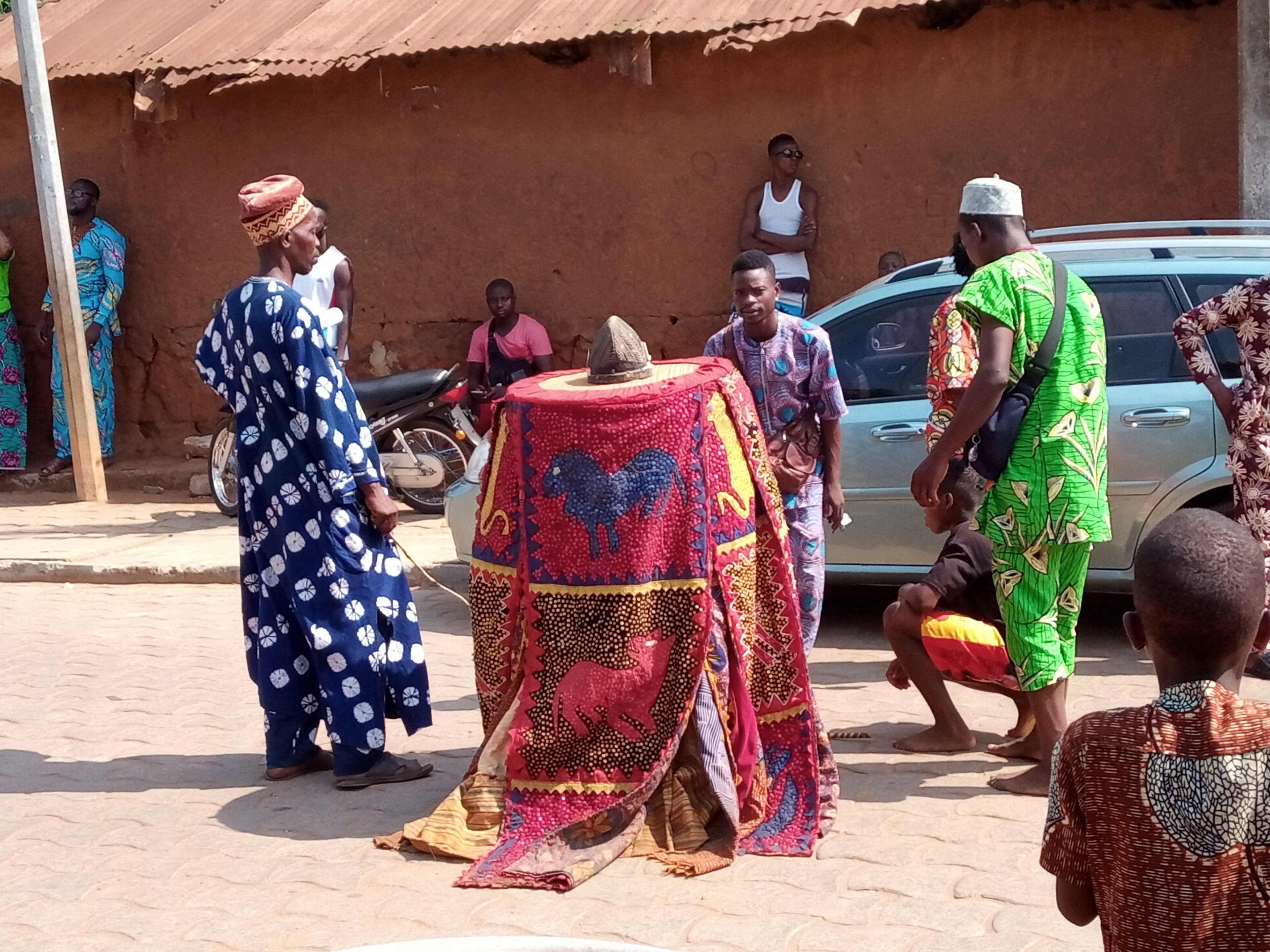
It is layered, towering, made of cloth - velvet and silk and handwoven strips of local cotton all suspended from a wooden frame balanced on a head you can't see. It moves with the certainty of something that doesn't need to look where it is going. From beneath the layers comes a voice that isn't a human voice: resonant, distorted, unmistakably purposeful. The ajá bell rings ahead of it, and the crowd parts without being asked.
This is an Egungun. And the family that called it here hasn't come to watch a performance. They have come to speak with their dead. (How a visitor should behave in that moment is the subject of the vodun ceremony etiquette guide.)
The Egungun Ouidah ancestor masquerade: what it really is
Most visitors who encounter an Egungun for the first time reach for the word "masquerade." It is technically accurate and almost entirely wrong.
A masquerade implies a performer beneath a disguise. The Egungun operates on an entirely different theological premise: the costume isn't a disguise but a vessel. The ancestor's spirit is genuinely present during the ceremony. The person inside is considered ritually transformed - no longer themselves in any socially legible sense, no longer subject to the laws that govern the living. They are a medium in the original meaning of the word: something that exists between two states, neither fully one nor fully the other.
The word Egungun tells you what this is precisely. It means "powers concealed" - or in some translations, "supernatural power concealed." Not hidden power, but power that, by its nature, can't be directly perceived. The concealment is the theology. What moves in the cloth isn't the man inside. The man inside is incidental to the ceremony. What moves is the ancestor.
This distinction matters for everything that follows: how you approach the Egungun, what you can ask of it, why its pronouncements carry legal weight, and why - even in a city like Ouidah where Vodun is native air - encountering an Egungun still stops a conversation.
The deep history
Origins in the Oyo Empire
The Egungun tradition is one of the oldest continuously practiced spiritual institutions in the Yoruba world. Its origins are traced to the Oyo Empire in what is now southwestern Nigeria, possibly as early as the 14th century BCE in some oral accounts, though scholarly consensus places the formal institutionalization of the cult somewhere in the 17th century CE, during the height of Oyo's political power.
According to one oral tradition, the ancestor cult known as Baba - "father" - was introduced by Sango, the Alafin (king) of the Oyo Empire, who codified what had been local family-based ancestor practices into a more organized and politically significant institution. Over time, Baba evolved into Egungun, expanding from Oyo's capital across the entire Yoruba cultural sphere and beyond its borders into communities that, like Ouidah, weren't Yoruba in origin but absorbed Yoruba populations through trade, migration, and the Atlantic slave trade.
The Yoruba in Ouidah
Ouidah was - and is - a multiethnic city. The dominant populations are Fon and Xweda, but the Yoruba presence on the coast is ancient and significant, and was dramatically intensified by the slave trade. When the Dahomey Kingdom raided Yoruba territories to the east throughout the 18th and 19th centuries, many captives were brought through Ouidah. Some were shipped across the Atlantic. Others remained, integrated into the city's fabric, and maintained their own spiritual institutions - including the Egungun - within it.
The Egungun masquerades in Ouidah today can be directly traced to Yoruba lineages that settled in the city's eastern quarters, some arriving as early as the 17th century, others as late as the 19th. They represent one of the most intact surviving examples of a tradition that is simultaneously Yoruba in origin and fully rooted in the specific social and spiritual world of coastal Benin.
The festival: Odun Egungun
The formal ceremonial framework for Egungun practice is the Odun Egungun - the Egungun festival - celebrated annually or biennially depending on the specific lineage. During Odun Egungun, masqueraders perform within their lineage compounds and then more publicly in marketplaces and in front of the palace or chief's residence, paying homage to individually named ancestors as well as to the collective group of lineage forebears.
Performances stage within the compound first - an intimate, family-specific encounter where specific ancestors are named and addressed. Then, in a larger public phase, the Egungun moves through the community's common spaces, cleansing, blessing, and, when necessary, adjudicating. The distinction between private and public ceremony is meaningful: the family encounter is about memory and continuity. The public encounter is about social order and justice.
The costume as archive
To understand the Egungun's spiritual weight, you must first understand what you're looking at when you see the costume.
An Egungun costume is built from layer upon layer of cloth - each layer representing the history and status of the family honoring their ancestors. The oldest costumes in Ouidah have been added to by multiple generations of initiates, each contributing a panel of fabric that reflects what was precious or meaningful in their time:
- Local handwoven aso ofi - the base textile of Yoruba ceremonial dress, sometimes months in the weaving
- Velvet (aran) imported from North Africa and Europe - one of the most prestigious fabrics in 18th and 19th-century West African court culture
- Damask, silk, and lace - fabrics that would have required significant wealth to acquire and which document the family's commercial reach
- Cotton panels from specific localities, each identifiable by weave pattern to Yoruba textile specialists
Beyond fabric, the costumes incorporate metal, beads, leather, animal skins, bones, and potent ritual materials - objects that carry specific spiritual charges. Mirrors embedded in the costume reflect the world of the living back at them and protect the ancestor from malevolent forces. Cowrie shells encode wealth and divination potential.
An ancient Egungun costume is therefore simultaneously:
- An artwork of extraordinary technical achievement
- A genealogy in textile form - each layer a generation
- A religious instrument whose power accumulates with age
The most powerful costumes in Ouidah aren't the most elaborate in appearance. They are the most accumulated - the ones where the oldest layers can't be separated from the newer ones without destroying both. An Egungun that is three generations old carries the force of three generations of prayer, grief, love, and intention woven into its structure. No new costume can replicate that. Power here isn't a quality you design in; it is one that time builds into.
What the Egungun does
The voice
The Egungun can't speak in a human voice. A hidden device called the ìyàwó agba - literally "voice changer" - transforms speech into the distinctive, resonant, inhuman sound that marks ancestral communication. This isn't theatrical effect. It's a ritual marker of ontological difference: the ancestor speaks from another register of existence, and the voice must reflect that.
What the Egungun says carries the force of law. A family conflict that has persisted for years - a disputed inheritance, a broken betrothal, an accusation of witchcraft - can be brought before the Egungun for judgment. The ancestor's pronouncement is final. In Yoruba communities in Ouidah, this isn't metaphor. Egungun judgments carry practical social weight that no civil court has the standing to override within the community's own frame of reference.
The dance
The Egungun also dances - and the dance isn't performance. It's a demonstration of force.
The spinning of the costume, the deployment of the cloth panels outward in full rotation, the speed and precision of the movement: these are manifestations of ancestral energy made visible. Anyone touched by the swirling fabric receives a blessing - or, depending on the ancestor and the person's relationship with them, something else. The contact isn't random. It is purposeful.
Different Egungun have different dances, different speeds, different qualities of movement. A knowledgeable observer can identify which ancestor is present by how the fabric moves.
The three types
There are three broad categories of Egungun in Ouidah, each with distinct functions:
-
The Dancer (Egungun Onidan): The most publicly visible type. Known for acrobatics, rapid spinning, and the full theatrical deployment of the costume's layers. This Egungun demonstrates supernatural energy - its function is partly to awe, partly to bless the community through spectacular movement.
-
The Sage (Egungun Ologbin): A quieter presence. This Egungun speaks more than it dances. It mediates disputes, offers counsel, blesses specific people who have requested specific things. The family seeking advice about a marriage, the trader needing clarity about a business relationship - they come to the Ologbin.
-
The Warrior (Egungun Onire): Carries martial attributes. Its function is protective - driving away hostile spiritual forces, cleansing spaces of malevolent energies, guarding the community against what the tradition identifies as threats from the invisible world.
The diaspora connection
The Egungun tradition crossed the Atlantic not once but many times, in the bodies and memories of enslaved Yoruba people who were taken through Ouidah and the Bight of Benin between the 17th and 19th centuries.
The most intact surviving transplant is in Brazil. The main center of Egungun worship in Brazil is the island of Itaparica in the Bahia state - a community where Baba Egungun have been active since the 19th century, performing the same function of bringing ancestors into the world of the living, using the same textile logic, the same ritual protocols, the same prohibition on revealing the costume's inner workings. The spiritual lineage from Itaparica to Ouidah isn't theoretical - it is maintained through active exchanges between religious leaders on both sides of the Atlantic.
In Cuba, the Eggun tradition in Palo Monte preserves the ancestor-contact function, though in a form more strongly shaped by the specific conditions of Cuban slavery and syncretism with Kongo traditions.
In Haiti, the Gede family of lwa - including Baron Samedi, the guardian of the dead and protector of cemeteries - embodies the same boundary-crossing function as the Egungun. The Haitian context transformed the aesthetic and cosmological frame entirely. But the underlying logic - that the dead remain active, that they can be engaged, that specific protocols govern that engagement - is the same.
What makes the Egungun's diaspora story particularly remarkable is what January 2026 demonstrated: the Benin Egungun cult maintains the heritage alive and strengthens ties with the diaspora in Brazil - an active, living relationship, not a museum piece. Brazilian religious leaders came to Ouidah for the Vodun Days festival specifically to reaffirm these connections. The thread held across five centuries.
Colonial suppression and survival
The French colonial administration that formally took control of Dahomey in 1894 viewed the Egungun - like the Zangbeto - as a source of parallel authority that competed with the colonial state's monopoly on justice and social order. The tradition was suppressed. Initiations were driven underground. The ajá bell disappeared from public streets.
The evangelical missionaries who arrived alongside and after the colonial administration saw it differently but arrived at the same conclusion: ancestor veneration was incompatible with Christian theology, and the Egungun was its most elaborate institutional expression. The pressure from both directions - political suppression and theological condemnation - lasted through independence in 1960 and, in attenuated form, through the Marxist-Leninist period (1972 - 1990) when Vodun broadly was treated as "superstition" incompatible with "scientific materialism."
The Egungun survived all of it. It survived in the same way it survived the Middle Passage: in human memory, transmitted through initiation, preserved in the textile archive of the costumes themselves, kept alive by families who considered its continuation more important than official approval.
When independence came and the suppression lifted, the Egungun didn't have to be rebuilt from scratch. It had never stopped.
Testimonials
Biodun, 52, Yoruba cultural historian from Lagos:
"The Egungun is the most complete answer the Yoruba tradition has to the question of death. It doesn't say 'the dead are gone' or 'the dead are watching from somewhere else.' It says: the dead are here, specifically, in this cloth, in this courtyard, speaking to you right now in their own voice. Whatever you think about the theology, the social consequence of that belief — families who feel accountable to the dead, communities where the dead participate in justice — is real and measurable."
Clémentine, 41, Candomblé priestess from Itaparica, Brazil:
"I came to Ouidah for the first time in 2019, through the Voyage de Retour program. When I saw the Egungun in the streets during the Vodun Days, I recognized them instantly. Not because I had seen pictures. Because the way they moved, the quality of attention they commanded — I had felt it every time the Baba Egungun came to our terreiro in Itaparica. The Atlantic separated the two practices for three hundred years. When I stood in front of the Ouidah Egungun, I understood that the separation had been only geographic."
Olawale, 34, Egungun initiate, Ouidah:
"People ask me what I experience inside the costume. I can't answer that. Not because I'm keeping a secret — because the language doesn't exist. In Yoruba we have a saying: 'The one who has not died cannot know the face of death.' I haven't died. But for the duration of the ceremony, something enters that is not me. When it leaves, I am myself again. What happened between those two states is not mine to describe."
The future of the tradition
Transmission under pressure
The Egungun initiation process is demanding: it requires time away from economic activity, submission to elders, and commitment to secrecy in a world where secrecy is increasingly difficult to maintain. Younger Yoruba men in Ouidah are navigating economic pressures - urban jobs, migration to Cotonou, the pull of both Christian and Muslim alternatives - that make the years required for initiation less available.
Several of the most knowledgeable Egungun practitioners in Ouidah are in their sixties and seventies. The question of who is training beneath them - who will carry the specific textile knowledge, the specific ritual vocabulary, the specific family histories embedded in the oldest costumes - doesn't have a comfortable answer.
The photography problem
The Egungun faces the same camera-phone challenge as every sacred institution in Ouidah. But with a specific addition: the prohibition on photographing the moment when the costume is put on or taken off isn't merely a privacy concern. In the Egungun theology, to photograph that threshold - the moment when the ancestor enters or leaves - is to create a permanent record of a boundary that shouldn't be documented. It isn't that the ceremony will be "spoiled." It is that the act itself is understood as a violation of the protocol that makes the ceremony possible.
Guides who work with OuidahOrigins are familiar with exactly where these lines are, and can ensure visitors approach with the understanding that makes a genuine encounter possible.
Visiting information
Where: Throughout Ouidah, particularly in Yoruba-descended neighborhoods in the eastern quarters of the city. Coordinates approximately 6.36100°N, 2.08800°E.
When:
- January 10th (Vodun Days): The most reliably accessible date for visitors, when Egungun make public appearances as part of the festival procession.
- August - October: The main Egungun season in Ouidah, when family ceremonies are most frequent.
- Night appearances: Possible any time of year, without warning or schedule. An unexpected encounter is one of the more remarkable experiences the city offers.
Protocol:
- Never touch the costume or attempt to touch it
- Move back when you hear the ajá bell
- Don't photograph without explicit permission - and accept no as a complete answer
- Observe respectfully: you're witnessing a family's communication with their dead
Access: There is no Egungun temple or venue. Encounters happen in compounds, market squares, and streets - organic, dictated by family need and ceremonial calendar, not tourism schedules. A local guide with community connections is essential for anything beyond chance encounters.
What few people know
The Egungun costumes in Ouidah aren't stored in any museum or cultural institution. They are kept in family compounds, in specific rooms that only initiates may enter, managed by lineages who understand that the costume isn't an object but a presence. A costume that isn't properly cared for - that isn't fed, not spoken to, not maintained with the correct ritual attention - is understood to become unpredictable in the same way an ancestor who is ignored becomes unpredictable.
Some of the oldest costumes in Ouidah have been in continuous ritual use since the 18th century. They aren't relics. They are active. The layers of fabric accumulate not just memory but, in the tradition's understanding, force - spiritual potential that builds across generations of faithful use. The oldest costumes are, in this sense, the most powerful. And they're also the most fragile: the oldest layers of cloth are irreplaceable, and the humidity of the West African coast is their patient adversary.
Concierge access
The Egungun's most meaningful encounters don't happen in public festival contexts alone - though the Vodun Days parade is spectacular. The family-level ceremony, where a specific ancestor is named and addressed, where the Ologbin gives counsel on a real family matter, where the ajá bell clears a compound and the air changes - this is the ceremony that visitors who have been to Ouidah once and are returning specifically to go deeper want to attend.
If you are a researcher, a diaspora descendant, a religious practitioner from Brazil or Haiti wanting to make the connection explicit - or simply a curious visitor who wants to understand what you are actually looking at - OuidahOrigins can arrange the introductions and context that make a real encounter possible.
The Egungun doesn't come to you. You go to it, with the right preparation.
Further Reading
- Wikipedia: Egungun - Overview of the Yoruba masquerade tradition and its theological foundations.
- RISD Museum: Cloth as Metaphor in Egungun Costumes - Analysis of the textile architecture of Egungun and its symbolic language.
- Smithsonian: Egungun Masquerade Costume - A documented Beninese Egungun costume in the National Museum of African Art collection.
- Wikipedia: Candomblé - The Afro-Brazilian tradition whose Baba Egungun communities on Itaparica island trace their lineage to Ouidah.
- Wikipedia: Haitian Vodou - The diaspora tradition preserving ancestor-contact functions descended from the same Yoruba-Fon coast.
- Related articles: The Fa Oracle · The Sacred Forest · Vodoun Days · The Zangbeto
Editorial transparency
This content was developed with the assistance of our AI agents.
Frequently Asked Questions
Lire aussi
The Days of Vodoun
Every January, Ouidah transforms into the spiritual capital of Vodoun. A vibrant gathering where the gods come to life in the community, beyond just a festival.
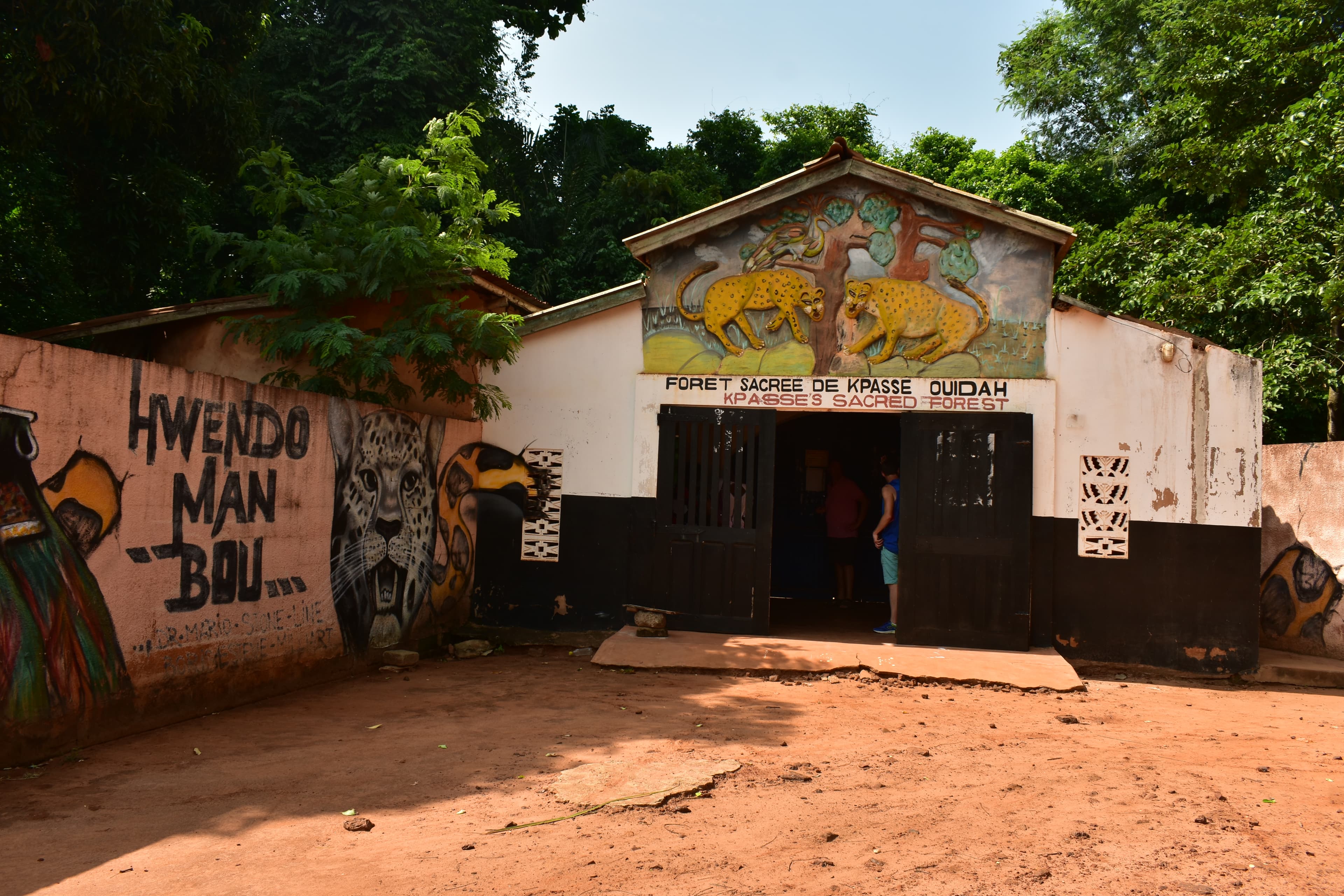
The Sacred Forest of Kpassè
Entering the sacred forest of Kpassè reveals an ancient world. Each tree becomes a witness, each shadow a potential presence. This living sanctuary transcends time and space.
Reading paths
The Slave Route
From the Atlantic slave trade to contemporary memory
Vodoun & Diaspora
How an African religion crossed the Atlantic
- Step 1· 12 minLe Temple des Pythons
Les origines du vodoun à Ouidah