

Key Takeaways
- Fa (Ifá in Yoruba) is not fortune-telling — it is a complete knowledge system encompassing philosophy, medicine, jurisprudence, and cosmology, expressed through 256 signs called du (odù in Yoruba), each carrying a corpus of stories, prescriptions, and wisdom that a trained bokonon must know by heart.
- Every person has a personal du — their own cosmic signature, identified through Fa at birth or at a key life moment. This du is not a horoscope but a permanent philosophical identity: it describes the forces at work in a person's life and the obligations those forces entail.
- The divining chain (fa-kplé) operates on a binary mathematical system — each throw produces one of two outcomes, generating across eight throws one of 256 unique patterns. The same binary logic underlies the I Ching and, millennia later, digital computing.
- UNESCO proclaimed Fa/Ifá a Masterpiece of Oral and Intangible Heritage in 2005 and inscribed it on the Representative List in 2008 — the same system that French colonial authorities had banned across Dahomey, making possession of divining chains a punishable criminal offense.
- The 256 du that a bokonon reads in Ouidah are recognized in Bahia, Havana, and Port-au-Prince — enslaved Africans carried the complete system across the Atlantic in human memory, and it survives with enough precision that the same sign in Ouidah and in Salvador da Bahia refers to the same corpus of stories.
The man doesn't look at you when he throws the chain.
He looks at the chain - a cord of eight half-nut shells, each face either open or closed, each throw producing a new configuration of the two. He throws it in the dust. He reads. He throws again. And again. Eight throws, each one generating a mark, the accumulated marks converging toward a pattern that has a name.
The name is a du. One of 256. And each du opens a universe.
You are sitting with a bokonon in Ouidah. He isn't guessing. He is reading. The difference is the difference between a fortune cookie and a doctoral dissertation - and understanding that difference is the prerequisite for understanding what the Fa oracle actually is.
What the Fa oracle really is
Let us begin with what it isn't.
The Fa oracle isn't fortune-telling. It doesn't predict the future. It doesn't claim to reveal what will happen. Any bokonon who promises to tell you what tomorrow holds is either simplifying drastically for a tourist's benefit or is a fraud.
What the Fa oracle actually is requires a longer sentence: it is a complete knowledge system - a philosophy, a medicine, a jurisprudence, a cosmology - expressed through 256 signs called du (or odù in the Yoruba tradition), each carrying a corpus of narratives, prescriptions, and accumulated wisdom that a trained bokonon must know, in full, from memory.
This is why UNESCO proclaimed Fa/Ifá a Masterpiece of Oral and Intangible Heritage of Humanity in 2005, and formally inscribed it on the Representative List in 2008. Not because divination is culturally interesting. Because this specific system is one of the most sophisticated knowledge architectures humanity has produced - a library larger than most law schools, encoded not in books but in human minds, transmitted generation to generation across centuries of suppression and diaspora.
Colonial authorities in Dahomey banned it outright. Possession of divining chains was a criminal offense. The ban failed - completely, spectacularly, and permanently. The same 256 du that the French administration tried to eradicate in the 19th century are recognized today in Bahia, Havana, Port-au-Prince, and Lagos.
That's the measure of what the Fa oracle is: the thing colonial authority tried hardest to destroy is the thing that survived most completely.
The deep history
Origins: Yoruba and Fon (17th century)
The Fa system arrived in the Ouidah region through the Yoruba people during the 17th century, entering from the east and integrating into the existing Fon spiritual framework to become the central oracular system of coastal Benin.
The Yoruba called it Ifá. The Fon called it Fá. The pronunciation shifted. The system didn't.
Ifá's origin within the Yoruba tradition is attributed to the deity Orunmila - the orisha of wisdom and divination, who was present at creation and witnessed the assignment of each person's destiny before birth. Orunmila is the intermediary between Olodumare (the supreme creator) and humanity: the being who knows the path each life was meant to take, and who communicates that knowledge through the 256 odù and the corpus of stories they carry.
In Fon cosmological adaptation, Fa became the voice of Mawu - the supreme female creative principle - expressing itself through consultation. The theological frame shifted from Yoruba to Fon. The 256 du remained structurally identical.
This theological adaptability - the system's capacity to be absorbed into different cosmological frameworks while preserving its internal architecture - is one of the reasons Fa survived the Atlantic crossing. It wasn't fragile. It wasn't dependent on any single institutional structure or physical site. It existed in minds and in the mathematical logic of its own operation.
The binary architecture
The Fa system's intellectual depth becomes clearest when you examine its mathematical structure.
The divining chain (fa-kplé) consists of eight half-nut shells linked by a cord. Each shell can fall with its open face up or its closed face down. Each throw produces one of two outcomes. Eight throws, each binary, generate a unique pattern. Two to the power of eight equals 256 - the total number of du in the system.
This is binary mathematics. The same binary logic that underlies the I Ching (the Chinese divination system organized around broken and unbroken lines). The same binary logic that underlies digital computing (0 and 1). The Yoruba developed this mathematical architecture independently, centuries before European mathematicians formalized binary notation.
Each of the 256 du isn't merely a sign. It's a literary and philosophical universe. Each du has:
- A corpus of ese - narrative stories featuring deities, animals, and humans in archetypal situations
- Specific prescriptions for action: which offerings to make, which behaviors to adopt or avoid, which deities to propitiate
- A body of proverbs carrying condensed philosophical wisdom
- Medical and botanical knowledge - which plants address which conditions, under which conditions of harvesting
- Historical memory - events from the lives of ancestors and the histories of communities
A bokonon who has completed his training carries all 256 of these universes in his memory - thousands of stories, their interlinking cross-references, their specific ritual requirements. The closest Western equivalent isn't a priest or a therapist. It's a combination of jurist, physician, philosopher, and oral historian, with a memorized literary corpus larger than most professional libraries.
Colonial suppression (late 19th–20th century)
French colonial authorities understood Fa with unusual precision. They recognized it not as superstition but as exactly what it was: a complete alternative epistemology, an independent system of justice, medicine, and community governance that operated entirely outside colonial control.
The response was systematic. Across Dahomey, Fa consultations were banned. Possession of divining chains was made a criminal offense. Bokonons were imprisoned. The same campaign targeted the Sacred Forest of Kpassè, the Zangbeto, and the Egungun - every institution of Vodun community governance was simultaneously under attack. The explicit goal was to sever the intellectual and spiritual infrastructure of Vodun communities - to destroy the living library that held the system together.
They failed.
Bokonons transmitted the 256 du in secret, from master to apprentice, across generations - in houses, in fields, in the spaces colonial authority couldn't see into. The system went underground and survived more intact than almost anything else the colonial period tried to suppress.
When Benin achieved independence in 1960, Fa emerged publicly again - 256 odù, thousands of stories, the whole vast library preserved in human memory against the systematic efforts of a colonial state to erase it.
The UNESCO inscription in 2008 was the formal international acknowledgment of what the community had always known: this isn't superstition. This is one of humanity's great intellectual achievements.
The Fa in Ouidah today
The bokonon
In Ouidah, a bokonon isn't a priest in the hierarchical sense of a Catholic father or a mosque imam. He is something more specific: a specialist of context.
His function isn't to intercede between the human and the divine. It is to read the conditions - the forces, the tensions, the alignments - at work in a specific situation and to translate that reading into actionable guidance. The bokonon doesn't predict the future. He contextualizes the present.
Becoming a bokonon requires years of apprenticeship with a master - typically beginning in youth, often within a family lineage of practitioners. The apprentice learns the 256 du not as categories but as living texts: he memorizes thousands of ese stories in their completeness, internalizes the relationships between du and the pantheon of Vodun deities whose shrines fill the Sacred Forest of Kpassè, and masters the ritual protocols - the specific offerings, the sacred objects, the protective measures - that accompany each reading.
The training is closer to a multi-year doctoral program in comparative literature, medicine, and theology simultaneously than to any Western model of religious initiation. There's no shortcut and no credential except the depth of the knowledge held.
In Ouidah, bokonons are present throughout the city - often identifiable by the tools of their practice at the entrance to their space: a divining chain hanging on a hook, a staff of specific design. Some operate from fixed locations; others are known through neighborhood networks and family recommendation. They aren't marginal figures. They're embedded in the social fabric of the city: respected authority figures who intervene in family disputes, advise on marriages, accompany births and deaths, and serve as the community's most trusted consultants on the full range of human questions.
What a consultation looks like
A client arrives - often after asking within their community which bokonon to see for their particular question. The bokonon receives them with the calm of someone who has heard every kind of human difficulty. The space is usually modest: a mat, a small table, the tools of the practice.
The bokonon casts the fa-kplé eight times. Each throw is read, each mark noted. The accumulated pattern identifies the du. Then the work begins.
The bokonon recites the ese - the stories that correspond to this du and that speak to the client's situation. He doesn't interpret these stories in a direct, literal way. The ese work more like parables: they describe archetypal situations whose resolution illuminates the client's specific dilemma. The bokonon moves between recitation and interpretation, between the ancient text and the present circumstance.
At the end: prescriptions. Specific offerings to prepare. Behavioral changes to adopt. Protective amulets to create. Deities to propitiate. Some prescriptions are simple and immediate; others require sustained practice over weeks or months.
The consultation is a complete therapeutic and philosophical encounter. It isn't mystical in the sense of being vague or non-specific. It is highly specific - adapted to the particular client, the particular question, the particular du that emerges from the throws. The bokonon's knowledge makes the specificity possible.
The social role
Fa consultation isn't a niche or marginal practice in Ouidah. It is structurally embedded in the community's decision-making at every level.
Before a marriage is arranged, the families consult the Fa - both to read the compatibility of the du of the individuals involved and to identify what the ceremony will require to be properly protected. Before a birth, the mother's Fa is consulted to understand what the child is bringing into the world. Before a journey, a business decision, a lawsuit, a medical treatment. When a person falls ill and conventional medicine doesn't resolve the condition, the Fa is consulted to understand what spiritual dimension the illness may carry.
Bokonons also serve as judges in community disputes - particularly those that official courts can't resolve or that the parties prefer to handle outside the state system. A Fa judgment on a land dispute or a family conflict has genuine social weight: not because the community is superstitious, but because the bokonon's role as a neutral reader of impartial forces gives him a specific authority that no human judge can claim in the same way. The Egungun - the Yoruba ancestor masks - share this judicial function in the city's Yoruba quarters; the two institutions, Fon and Yoruba, divide the city's spiritual governance between them.
The diaspora connection
The survival of Fa across the Atlantic is one of the most extraordinary facts in the history of human knowledge.
Enslaved Africans arrived in the Americas with nothing - no books, no physical tools, no institutions. They had been stripped of everything except what existed inside their bodies: language, stories, memory, and the mathematical architecture of the 256 du.
The people who carried this knowledge had walked the Slave Route, crossed the Door of No Return, and survived the Middle Passage with nothing but memory. They reconstructed the system in the Americas with enough precision that the same odù recognized in Ouidah are recognized in Salvador da Bahia (where Fa became the basis of Candomblé Ketu), in Havana (where it became Lucumí/Santería, the most widely practiced Afro-Cuban religion), and in Port-au-Prince (where elements of the system inform Haitian Vodou practice).
The same binary architecture. The same 256 patterns. The same corpus of stories, translated through successive cultural mediations but retaining their structural identity.
In Brazil, the babalawo - the Yoruba title for an Ifa priest - is still recognized in Candomblé Ketu communities. In Cuba, the ifá system is central to Santería initiation - the same divining chain, the same mathematical logic. In Haiti, the Vodou system has its own consultation mechanisms, but the influence of the original Fa architecture is visible in the organization of the lwa into families and the principle that every person has a specific lwa patron - an echo of the personal du.
This diaspora survival isn't metaphorical. It is technical. The transmission was precise enough to preserve a mathematical system across five centuries, two continents, and the catastrophic rupture of the Middle Passage. That precision is only possible because the system was designed to live in human memory rather than in texts or objects - and human memory, it turns out, is harder to destroy than either.
The knowledge dimension
What distinguishes Fa from every other divination system in the world is its literary and philosophical scale.
Most divination systems offer a finite set of symbols, positions, or patterns - each with a fixed meaning. The I Ching has 64 hexagrams. Tarot has 78 cards. The meaning of each symbol is broadly stable across consultations.
Fa has 256 du - each of which isn't a symbol with a fixed meaning but a library. Each du carries dozens of ese stories, each story containing multiple narrative threads, each thread applicable to different types of situations. The bokonon doesn't look up the answer to the client's question. He reads the client's situation through the lens of a body of narrative that illuminates it from dozens of angles simultaneously.
The bokonon doesn't tell you what will happen. He shows you where you are - in the full cosmological, ancestral, and personal context of your life - and the stories show you what people in analogous positions have done, what worked and what didn't, and what the forces at work in your situation are likely to require from you.
This isn't mysticism in the sense of vagueness. It is profound precision - the precision of someone who has spent years learning to read a situation not through a single lens but through 256 simultaneously.
How to consult the Fa
Finding a bokonon
Bokonons are present throughout Ouidah but aren't always immediately visible to visitors. The most reliable approach is through recommendation - asking within the community, through a local guide, or through OuidahOrigins' Concierge service.
A cold visit to a bokonon encountered by chance is unlikely to produce a meaningful consultation. The relationship between a client and a bokonon typically begins through a trusted introduction - someone who can vouch for both the practitioner's integrity and the client's seriousness.
What to bring to a consultation
- An open question, not a closed one. The Fa is better asked "how should I approach this situation" than "will this thing happen."
- Patience. A meaningful consultation takes time. Don't schedule it before another appointment.
- Cash - the appropriate amount is agreed in advance.
- Willingness to receive a prescription even if it isn't what you expected. The Fa doesn't confirm what you have already decided.
Practical details
- Language: Fon. Some bokonons work with French-speaking intermediaries; others don't. A guide who speaks Fon is strongly recommended.
- Cost: 5,000 - 15,000 CFA for a standard consultation. An initial du identification is more extensive and more expensive.
- Duration: A standard consultation: 1 - 2 hours. A full du identification: a full day.
- Location: Throughout Ouidah; ask locally or through our Concierge.
What few visitors know
Every person has a personal du
The most fundamental application of the Fa system - and the least visible to outside observers - is the identification of the personal du.
Every person, in Vodun cosmology, is born with a du - their own cosmic signature, established before birth and readable through Fa consultation. The personal du isn't a prediction of what will happen in a person's life. It's a description of the fundamental forces at work in that life: the nature of the person's relationship with each deity, the types of challenges they are likely to encounter, the offerings they must make to maintain alignment with their destiny, the behaviors they must practice or avoid.
People in Ouidah who know their personal du - and many do, identified at birth or at a significant life transition - carry it as a fundamental piece of self-knowledge. It shapes how they approach major decisions, which bokonon they consult, what ceremonies they observe. It isn't a constraint but a map: a description of the terrain of a specific life, laid down before the life began.
For diaspora visitors who come to Ouidah and undergo a first Fa consultation to identify their personal du, the experience is often described as disorienting in the most productive way - the sense of being seen with unusual precision, through a framework entirely unlike anything Western culture offers.
The binary system and digital logic
The mathematical architecture of the Fa system - eight binary throws generating 256 unique patterns - is the same binary logic that underlies digital computing.
When Fa divination was formalized in the Yoruba tradition, possibly a thousand or more years ago, its architects developed a system of knowledge organization based on the simplest possible binary distinction (open/closed, yes/no, 0/1), applied repeatedly to generate the maximum possible variety. Two to the eighth power: 256. The same mathematical principle underlies the byte - eight bits, 256 possible values.
Some scholars have noted this parallel and used it to argue that Fa represents one of humanity's earliest systematic applications of binary logic to information organization. The comparison isn't trivial. It suggests that the architects of the Fa system were, among other things, mathematicians of the first order - working in a domain (systematic knowledge organization) that the West didn't formalize until the 17th century.
Colonial authorities banned this system as superstition. The same mathematical logic they tried to criminalize in West Africa would, a century later, make modern computing possible.
The Fa and the Haitian revolution
In 1791, the revolution that would end French colonial rule in Saint-Domingue - and create the first Black republic in history - was launched. Toussaint Louverture, Jean-Jacques Dessalines, and the revolutionary leadership coordinated the largest and most successful enslaved people's revolt in history.
Among the tools of that coordination, historians have documented the use of African spiritual and divinatory practices - including Fa-based consultation - as coded communication systems that the French colonial administration couldn't intercept or decode. The same divination system that French colonial authorities tried to suppress in Dahomey became, in Haiti, a tool of liberation.
The bokonon who reads the Fa in Ouidah today is the institutional descendant of the tradition that colonial authorities tried to ban in both places, and that survived both suppressions.
If you want to go deeper
The Fa oracle isn't a site you can visit. It's a practice you can encounter - if you approach it with the seriousness it requires and the introduction that makes a genuine consultation possible.
OuidahOrigins' Concierge service facilitates introductions to established bokonons in Ouidah's religious community - practitioners whose work is embedded in the city's social fabric and whose consultations are grounded in the full depth of the tradition. We can also arrange for visitors to observe (not participate in) ceremonial Fa readings during the Vodoun Days season, giving a broader view of how the system operates in collective rather than individual context.
The Fa oracle is the cognitive backbone of Vodun practice in Ouidah. The Sacred Forest of Kpassè is where the deities the Fa reads for are housed. The Vodoun Days are when the Fa's counsel governs the city's ceremonial calendar. The Egungun and the Zangbeto - the other great Vodun institutions of the city - all operate within a cosmological framework the Fa defines.
Sources & further reading
- Ifa Divination System — UNESCO Intangible Cultural Heritage - Official UNESCO inscription and documentation.
- Ifá — Wikipedia - broad overview of the Ifá/Fa system, its tools, 256 odù, and diaspora presence.
- An Introduction to Fa Divination of Benin — Smithsonian Folklife Festival - Scholarly introduction to Fa practice specifically in Benin.
- The Fa Oracle of Benin — Sinchi Foundation - Documentation of the Fa system's role in Beninese society.
- West African Vodun — Wikipedia - The broader spiritual tradition Fa anchors.
- Haitian Vodou — Wikipedia - The diaspora tradition that carries elements of the Fa system across the Atlantic.
- Santería — Wikipedia - The Cuban diaspora tradition where Ifá survives as Lucumí.
Editorial transparency
This content was developed with the assistance of our AI agents.
Frequently Asked Questions
Lire aussi

The Days of Vodoun
Every January, Ouidah transforms into the spiritual capital of Vodoun. A vibrant gathering where the gods come to life in the community, beyond just a festival.
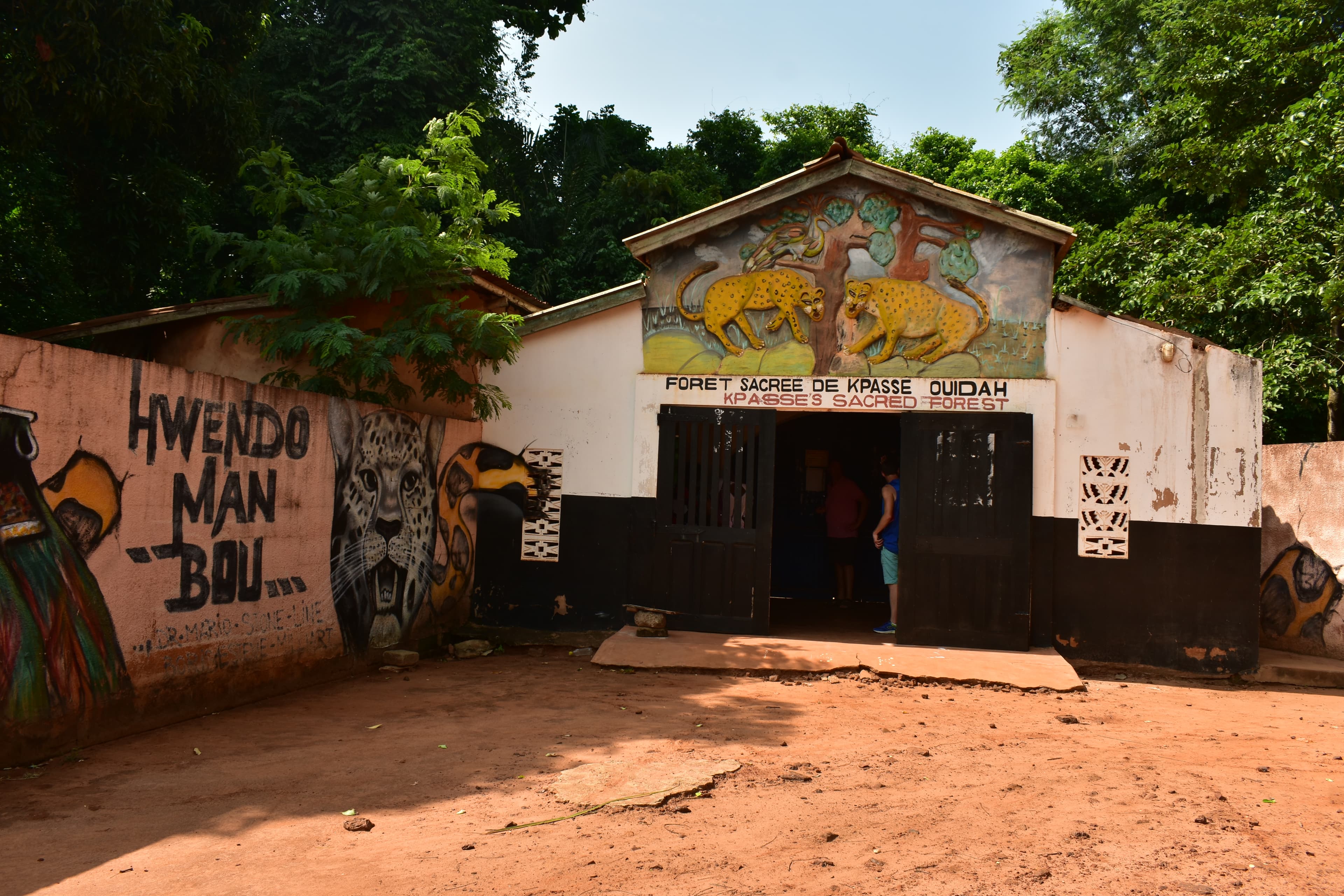
The Sacred Forest of Kpassè
Entering the sacred forest of Kpassè reveals an ancient world. Each tree becomes a witness, each shadow a potential presence. This living sanctuary transcends time and space.
Reading paths
The Slave Route
From the Atlantic slave trade to contemporary memory
Vodoun & Diaspora
How an African religion crossed the Atlantic
- Step 1· 12 minLe Temple des Pythons
Les origines du vodoun à Ouidah