Key Takeaways
- The Agojie — also called Mino ('our mothers' in Fon) and Ahosi ('king's wives') — were the only documented standing army of women in recorded history: a permanent professional regiment that fought in every major Dahomey campaign for over 150 years.
- Every three years, the Kingdom of Dahomey required its subjects to present their daughters to a council of sages who selected the most capable for recruitment — a systematic national conscription that included volunteers, the daughters of the poor, and girls considered rebellious or ungovernable.
- At their peak under King Ghezo (1818–1858), the Agojie numbered 4,000–6,000 soldiers — approximately one third of the total Dahomey army. Ghezo's military and commercial power were inseparable: his alliance with Francisco Félix de Souza, the Chacha of Ouidah, made both men extraordinarily wealthy.
- The Agojie participated directly in the raids that supplied Ouidah's slave trading posts. The captives they took on campaign arrived at Place Chacha, walked the Slave Route, and crossed the Door of No Return.
- The last documented Agojie was Nawi, found in the village of Kinta by a Beninese historian in 1978, who convincingly claimed to have fought against the French in 1892. She died in November 1979, aged well over 100.
In October 1892, the French Foreign Legion was fifty kilometers from Abomey, advancing on the capital of the Kingdom of Dahomey to complete its conquest. They had been fighting across West Africa for months. They were professional soldiers, veterans of colonial campaigns on three continents.
Then they encountered the Agojie.
The accounts they left were never seriously disputed. An army equipped with Winchester rifles and heavy blades, advancing without hesitation, showing neither fear nor the impulse to retreat. General Alfred Dodds, commanding the French expeditionary force, wrote in his dispatches: the female soldiers were "more dangerous than the male soldiers."
His men were shaken. Not by the fact that they were facing women. By the fact that these women fought better than anyone they had encountered.
The Agojie amazons Dahomey: what they really were
Let us be precise before we are poetic.
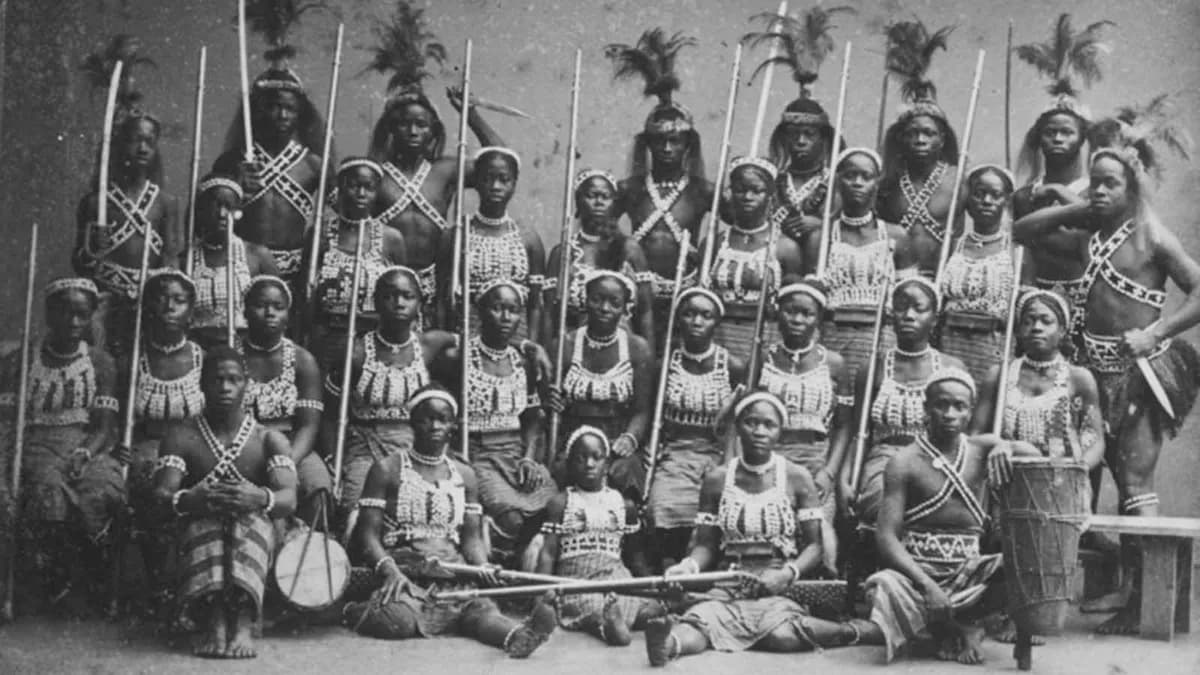
The Agojie - also called Mino ("our mothers" in Fon) and Ahosi ("wives of the king") - were the only documented standing army of women in recorded human history. Not a militia called up in an emergency. Not an auxiliary corps. Not a ceremonial guard. A permanent, professional, full-time military regiment that fought in every major campaign of the Kingdom of Dahomey for more than 150 years.
This is confirmed by European military dispatches, French colonial records, oral tradition, and the bas-reliefs carved into the walls of the Abomey palaces during the Agojie's own lifetime - primary sources that show these women as their own kingdom chose to see them: armed, organized, triumphant.
They are historically significant for what they were. They're also significant for what they require of us: the capacity to honor extraordinary achievement while refusing to look away from the system it served. The Agojie were soldiers of the Kingdom of Dahomey - a state that ran one of the most active slave-trading operations in the Atlantic world. Their raids supplied the captives who arrived at Place Chacha in Ouidah, walked the Slave Route, and crossed the Door of No Return. The courage and the atrocities were part of the same life.
If you have walked the Slave Route through Ouidah, you have walked through the geography the Agojie helped fill. That's the connection between the two cities - not metaphorical, but operational.
The deep history
The Gbeto: where it began (early 18th century)
The Agojie evolved from a corps of female palace guards known as the gbeto - elephant hunters. Women who had demonstrated extraordinary physical courage in hunting the most dangerous animal on the West African savannah. Under King Agaja around 1720 - 1730, these women were formalized into a standing fighting regiment.
Agaja gave them a name that would echo for two centuries: Mino, "our mothers" in Fon. It was simultaneously an honorific of deep reverence and a calculated instrument of psychological warfare. These were women who had surrendered family, domesticity, and the protections of ordinary life for absolute service to the kingdom. Opponents across a battlefield would face fighters for whom retreat wasn't an option - women who had surrendered everything civilian life offered and had only the regiment in return.
The recruitment system
The Agojie weren't simply volunteers. Their recruitment operated through a formal, systematic national process.
Every three years, the Kingdom of Dahomey required its subjects to present their daughters to a council of sages tasked with selecting the most capable for military service. This wasn't an open call for volunteers. It was a national conscription cycle with the force of royal authority behind it.
Recruits included enslaved girls captured as young as ten years old, the daughters of poor families who saw military service as a path to status and rights, and - notably - girls considered rebellious or ungovernable in civilian life. Girls who couldn't be domesticated, who wouldn't submit to ordinary social authority, who displayed a willfulness that made them unsuitable for conventional domestic life: these were the ones the council wanted most.
The Agojie were built, systematically, from Dahomey's most ungovernable women. That may be part of what made them what they became.
The peak under Ghezo — and the Ouidah connection (1818–1858)
The Agojie reached their height under King Ghezo, whose reign coincided with the apex of both the slave trade and Dahomey's military expansion. Ghezo had seized the throne from his brother in 1818 - a coup financed by Francisco Félix de Souza, the Brazilian-born merchant who had built the most efficient slave trading network on the Bight of Benin from his base in Ouidah.
The alliance was explicit and transactional: de Souza provided financing, weapons, and Atlantic commercial connections. Ghezo provided the kingdom, the military, and the captives. The arrangement made both men extraordinarily wealthy and cemented the slave trade as the economic foundation of Dahomey's power.
Under Ghezo, the Agojie grew to between 4,000 and 6,000 soldiers - organized into specialist regiments:
- Huntresses (gbeto) - traceable to the original elephant hunters
- Riflewomen (agbalya) - equipped with muskets and later Winchester repeating rifles
- Reapers (nyekplohento) - close combat specialists with heavy blades
- Archers - ranged warfare unit
- Gunners - artillery specialists as the 19th century progressed
They were better paid than male soldiers. Better fed. Their equipment was prioritized. Kings deployed the Agojie first, not last.
The captives these regiments brought back from their campaigns didn't stay in Abomey. They were marched south to the coast - to Ouidah, to the barracoons, to the Place Chacha where de Souza's network processed them, to the beach. The Agojie's military excellence and the Slave Route's departure architecture were two ends of the same operation. Ouidah was where the Agojie's campaigns ended.
The shadow of the slave trade
Here is what must be said plainly.
The Agojie participated directly in the raids that supplied the Atlantic slave trade.
The same courage that French soldiers would describe with terrified admiration in 1892 was forged in campaigns that captured men, women, and children from neighboring villages and kingdoms. The physical excellence that made them legendary was deployed in service of the commercial system that Francisco Félix de Souza administered at Ouidah.
This is where The Woman King (2022) takes its most consequential historical liberty. The film depicts the Agojie as opponents of the slave trade. The real Agojie were soldiers of the state that ran it. Their real general-equivalent Ghezo wasn't conflicted about the trade - he was one of its most active participants. The film is powerful cinema. The history is more complex and, ultimately, more interesting.
The question the Agojie pose - how do we think about extraordinary human achievement deployed in service of an unjust system - has no clean answer. They can't be resolved into simple heroism or simple condemnation. They must be held as they were.
The wars that ended everything (1890–1892)
France declared war on the Kingdom of Dahomey in 1890. The First Franco-Dahomean War ended inconclusively. General Alfred Dodds led a second campaign in 1892 with orders to complete the conquest.
On October 26, 1892, with the French forces approximately 50 kilometers from Abomey, Dodds' column was blocked by a Dahomey force equipped with Winchester rifles and blades - composed entirely of women. The legionnaires who survived wrote afterward about "the incredible courage and audacity" of the warriors who faced them. Dodds documented what his men experienced: fighters who wouldn't retreat, who used the terrain with expertise, who showed no hesitation.
The French won - better artillery, more industrial resources, the weight of empire. The Kingdom of Dahomey fell in November 1892. The regiment was formally disbanded.
The Agojie had fought for 150 years. They were destroyed in two. The institution ended. The memory didn't.
The memory today
What remains in Benin
The most important material evidence of the Agojie exists in Abomey, the former royal capital - approximately 120 kilometers northwest of Ouidah.
The Royal Palaces of Abomey, a UNESCO World Heritage Site since 1985, preserve bas-reliefs and painted walls depicting the Agojie in battle. These are 19th-century primary sources made during the Agojie's own active period - not retrospective commemorations, but contemporaneous representations of women the artists knew, in battles that had recently occurred. To stand before them is to stand before the closest thing to a photograph of the Agojie that exists.
In Cotonou, a major public statue honors the regiment as one of Benin's defining national symbols.
In Ouidah, the Museum of History inside the Portuguese Fort contextualizes the Agojie in the framework they deserve: as the military arm of a kingdom whose commercial engine ran through this city. The museum documents the collaboration between Dahomey's military campaigns and the Atlantic trade without softening either. The Agojie appear not as separate heroes from a separate story, but as integral to the history that this particular city most powerfully embodies.
The diaspora reclamation
For many in the African diaspora, the Agojie represent something urgently needed: proof that African women weren't passive subjects of history, that they fought, commanded, and died for their world. The emotional power of that reclamation is real and legitimate.
But the honest reclamation of their legacy requires acknowledging what that world included. Erasing the slave trade from their story replaces the real Agojie with a different story about different people. The real Agojie are powerful enough to hold the truth about themselves. They don't need our editing to be worthy of remembrance.
The global surge in attention following The Woman King (2022) has had one undeniable positive consequence: it has driven thousands of people to the Royal Palaces of Abomey, to the Museum of History in Ouidah's Portuguese Fort, and to the scholarship that actually documents what the Agojie were. Many of those visitors have come hoping to find heroines of anti-slavery resistance and have instead found something more demanding - warriors whose extraordinary capability was inseparable from a system of extraordinary violence.
That encounter with complexity isn't a disappointment. It's the beginning of a more honest relationship with the history of West Africa. The Agojie's real story asks more of its audience than the film's version does. It asks for the capacity to hold, simultaneously: admiration for what they achieved, recognition of what they served, and the intellectual rigor not to flatten either into something simpler and more comfortable.
The Abomey bas-reliefs don't simplify. The Ouidah museum doesn't simplify. The real Agojie don't simplify. That's their most important legacy.
The identity of a warrior
What made someone an Agojie wasn't just selection and training. It was a theological reframing.
Mino - "our mothers." The name inverts the expected relationship between women and violence. Mothers give life, protect, nurture. To call these fighters "our mothers" was to say something precise: that this regiment was the protective force of the entire Dahomey social body, that its violence was in service of survival, that the ferocity of a mother defending her children was the emotional register in which the Agojie understood their own purpose.
The celibacy requirement completed the picture. Formally married to the king and unavailable to any other man, the Agojie were legally freed from the social obligations governing other Dahomey women: deference to fathers, subordination to husbands, domestic labor. They could own property. They moved through Dahomey's social landscape with an autonomy available to almost no civilian woman of their era.
The price was absolute: family, children, private life, ordinary old age. What they received was extraordinary - the right to be soldiers, to be taken seriously as lethal forces, to be feared.
Most of them chose it. That choice is part of what makes them remarkable.
How to encounter the Agojie
The Agojie were based in Abomey, not Ouidah. But Ouidah is where you feel the consequences of their campaigns most directly - because this is the city where the people they captured arrived, were sold, and departed across the ocean. A visit that combines both cities is the most complete encounter with this history.
In Ouidah
The Museum of History (inside the Portuguese Fort, at the start of the Slave Route) connects the Agojie's military role to the commercial infrastructure they fed. This is the right place to begin the Agojie's story when approaching it from Ouidah - it situates them in the context of what their campaigns produced.
The Slave Route itself is the Agojie connection made physical. Every station on that 3.5-kilometer walk was downstream of their operations: the barracoons held the people their raids captured, the Place Chacha processed them, the Door of No Return marked their departure. Walking the route with this in mind changes what it means.
In Abomey (120km northwest)
The Royal Palaces of Abomey - UNESCO World Heritage Site since 1985. The bas-reliefs showing Agojie in battle are the closest primary visual sources that exist. Allow a full day. The site requires a certified guide to interpret the imagery correctly.
The bas-reliefs aren't retrospective commemorations or heroic monuments built after the fact. They were created during the Agojie's active period - 19th-century representations of women the artists knew, depicting battles that had recently occurred. To stand before them is to see the Agojie as their own kingdom chose to see them: armed, organized, victorious. It's the one place in the world where the visual record was made by people who had no reason to invent, exaggerate, or sentimentalize what they were depicting.
The palaces also hold the throne of King Ghezo - the ruler under whom the Agojie reached their peak, and whose alliance with Francisco Félix de Souza in Ouidah made both men the principal architects of the trade's worst decades. The throne and the bas-reliefs of the Agojie are a few meters apart. The proximity is the history.
What few people know
The three-year national conscription
The Agojie are often framed as women who chose military life over civilian constraint. The reality was more systematic.
Every three years, the Kingdom of Dahomey required its subjects to present their daughters to a council of sages with the specific function of selecting candidates for the regiment. This wasn't an open call for volunteers. It was a national conscription cycle with royal authority behind it - families who produced capable daughters couldn't simply decline.
The rebels were sought specifically. Girls considered ungovernable, rebellious, unsuitable for domestic life - these were the ones the council wanted most. The Agojie were built, systematically, from Dahomey's most difficult women. That isn't a coincidence. It's an institutional design choice that tells you something essential about what the kingdom understood about the relationship between refusal and fighting capability.
The battle of October 26, 1892
On October 26, 1892, French Foreign Legion soldiers moving on Abomey were stopped cold.
The blocking force was equipped with Winchester repeating rifles - one of the most modern weapons available at the time - and heavy bladed weapons. It was composed entirely of women. The legionnaires who survived wrote about "the incredible courage and audacity" of the fighters who faced them.
This wasn't a skirmish. This was a professional colonial army with artillery facing an all-female regiment in its last campaign, 50 kilometers from the capital it was protecting. The Agojie knew what a French victory meant. They had fought for 150 years. They didn't yield.
The French won. The Agojie didn't break.
Nawi was found in a specific village
The last documented Agojie was Nawi. In 1978 - 86 years after the last battle - a Beninese historian found her in the village of Kinta, elderly beyond estimation, and interviewed her. She spoke in specific, convincing detail about fighting against the French in 1892: the weapons, the commanders, the terrain, the outcome she had survived.
She died in November 1979.
The institution that had numbered 6,000 at its peak, that had been the most feared fighting force in West Africa for 150 years, died with one very old woman in a village 80 kilometers from where the final battles were fought.
She was the last.
If You Want to Go Deeper
The Agojie are one of the most complex stories in the history of West Africa - requiring more than celebration or condemnation, demanding that extraordinary achievement and moral ambiguity be held in the same frame.
OuidahOrigins documents this history as part of the honest memorial world of the region: the military campaigns in Abomey, the commercial system in Ouidah, and the ocean crossing that connected both to the Americas. A combined Ouidah-Abomey itinerary - guided, with historical context - is the most complete way to encounter both halves of this story.
Plan your itinerary with our Concierge →
The Agojie served the same king who allied with Francisco Félix de Souza - the Chacha of Ouidah whose commercial network monetized their campaigns. The Slave Route they fed begins at Place Chacha. The Door of No Return is where it ended for those they captured.
Sources & Further Reading
- The Real History Behind The Woman King — Smithsonian Magazine - Scholarly analysis of the Agojie's documented history vs. the film's portrayal.
- Dahomey's Women Warriors — Smithsonian Magazine - Long-form historical feature on the Agojie with primary source references.
- Dahomey Amazons — Wikipedia - broad overview with documented sources.
- The Woman King vs. True Story — History vs. Hollywood - Detailed fact-checking of the 2022 film against historical record.
- Second Franco-Dahomean War 1892 — French Foreign Legion Records - Military documentation of the 1892 campaigns.
- Royal Palaces of Abomey — UNESCO - World Heritage documentation of the primary site preserving Agojie artifacts and bas-reliefs.
- Amazones du Dahomey — Wikipédia (FR) - French-language documentation with additional historical detail on recruitment and organization.
Editorial transparency
This content was developed with the assistance of our AI agents.
Frequently Asked Questions
Lire aussi

Amulets of the Amazons
The amulets of the Amazons of Ouidah transcend their status as museum artifacts. They testify to a struggle for restitution and an identity renaissance.
Places of Memory and Vodun
Far from being mere attractions, the memory sites in Ouidah are witnesses to a poignant history, where vodun and memory intertwine.
The Return of Cultural Treasures
The fight for the return of cultural objects from Africa raises essential questions about identity and collective memory. Ouidah, a symbol of this resilience, is at the center of this debate.
Reading paths
The Slave Route
From the Atlantic slave trade to contemporary memory
Vodoun & Diaspora
How an African religion crossed the Atlantic
- Step 1· 12 minLe Temple des Pythons
Les origines du vodoun à Ouidah