Key Takeaways
- Zomai means 'where one sees nothing' or 'the dark place' in the Fon language — a name that describes with complete precision its function as a sensory deprivation chamber in the final days before the Atlantic crossing.
- The Zomai cabin was specifically constructed to simulate the conditions of a slave ship's hold — darkness, extreme confinement, the smell and weight of other bodies — so that captives would be partially desensitized to what the Middle Passage would bring. Pre-trauma as preparation.
- Captives were systematically separated by language and ethnic group inside the Zomai — Fon with Ewe, Yoruba with Hausa — making collective resistance impossible. No shared language meant no coordinated action.
- 'Zomai' (where one sees nothing) and 'Zomachi' (the fire that never dies) are linked by proximity — geographic and sonic — but carry opposite meanings. The Afro-Brazilian returnees who named their memorial flame 'Zomachi' were deliberately inverting the meaning of the dark enclosure. Darkness became light. No return became eternal return.
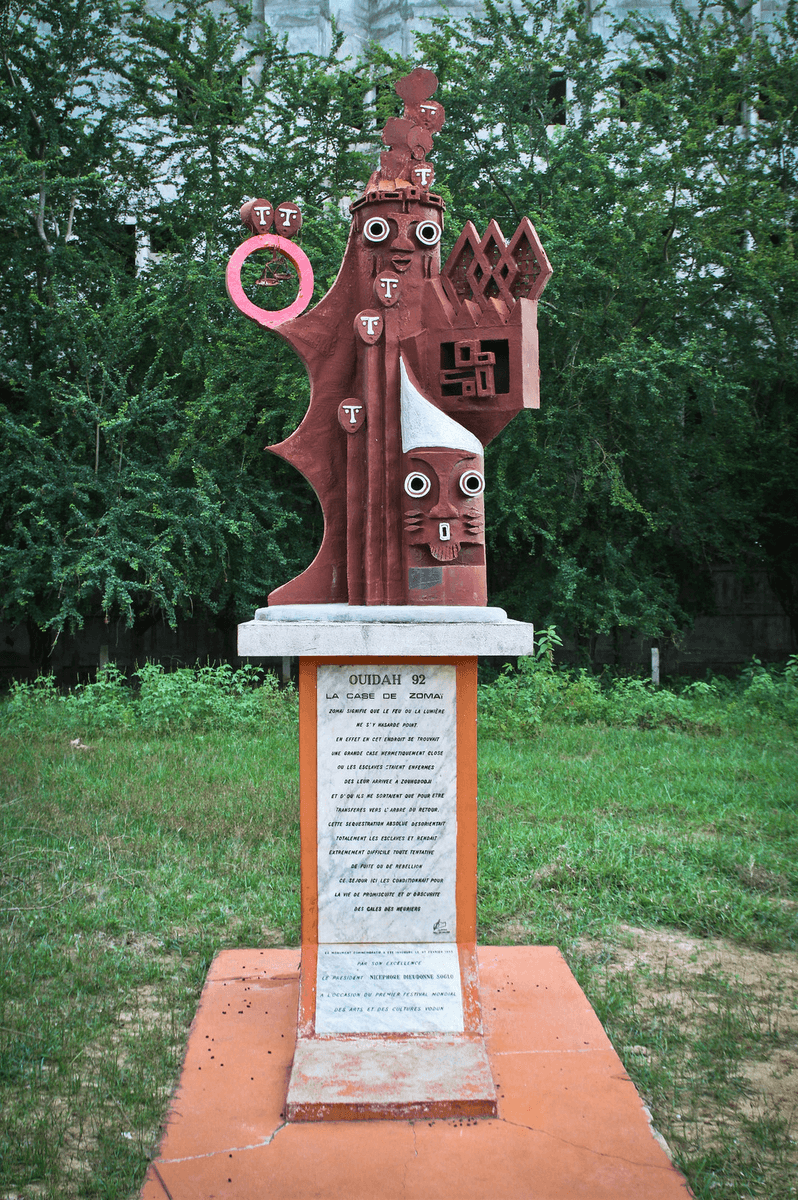
- Unlike other stations on the Slave Route, the Zomai enclosure has not been restored or museographically staged. There is only a space, trees, dense vegetation, and a plaque. This absence of staging is itself the statement.
There's a point on the Slave Route where the monuments stop explaining themselves.
The Tree of Forgetfulness has its plaque. The Door of No Return has its arch, its bas-reliefs, its egrets in flight. These sites have been given form, given interpretation, given the visual language of commemoration.
The Zomai enclosure has none of this.
There is dense vegetation that filters light even at midday. A plaque on a low structure. The physical sensation of enclosure. And a silence that the landscape enforces without any staging assistance.
Zomai. In the Fon language: "where one sees nothing." "The dark place."
This isn't a poetic name. It's a technical description.
What this place really was
The Zomai enclosure wasn't a prison in the incidental sense of a place where people were confined because there was nowhere else to put them. It was an instrument - as precisely designed for its purpose as the divining chain of the Fa oracle or the barracoons of the Portuguese Fort.
Its purpose was the final stage of systematic human erasure before the Atlantic crossing.
By the time captives reached the Zomai, they had already been processed at Place Chacha (inspected, branded, priced), forced through the Tree of Forgetfulness (spiritual identity stripped), and confined in the barracoons for days or weeks (physical resistance broken). Each station had addressed a different dimension of the person they had been. The Zomai addressed what remained: their relationship with time, light, and the coherent sense of existing in a stable world.
Take away the sun. Take away the moon. Take away the sound of birds that mark morning and the cooling air that marks evening. Confine a person in darkness so complete that they can't see their own hand, with dozens of other bodies pressing against them, for days or weeks. This is what the Zomai did.
What survives of a person under these conditions is the most fundamental layer of selfhood: something below name, below language, below social identity. What the Zomai was designed to reach was that layer - to destabilize it before the ocean crossing completed the work.
It didn't succeed. But it tried with sophisticated precision.
The deep history
The logic of pre-trauma (17th–19th century)
The most specific thing the sources tell us about the Zomai cabin is the detail that most shocked the researchers who documented it: the structure was built to simulate the conditions of a slave ship's hold.
This wasn't a coincidence or an economy of construction. It was deliberate. The designers of the slave trade's logistics understood that captives who had never experienced total confinement in darkness would respond with extreme panic and resistance when placed in the hold of a ship. That response - however understandable - was commercially inconvenient. The Zomai was the solution: expose the captives to simulated hold conditions before embarkation, so that the actual hold would be a horror they had already, in some measure, been broken into.
Pre-trauma as preparation. The most efficient cruelty the trade ever devised.
The captives who survived the Zomai and made it to the beach had already experienced, in compressed form, what the Middle Passage would bring. They had lost track of time. They had been deprived of light. They had experienced the pressure of bodies in extreme proximity in the dark. The ship's hold wasn't their first encounter with this world. It was the continuation of one they had already entered at the Zomai.
The architecture of pre-trauma
The specific construction of the Zomai cabin wasn't incidental. It was calibrated.
The confinement was designed to be complete without being lethal - the goal wasn't to kill the captives before the crossing, but to break the psychological mechanisms that might organize resistance. Darkness removes temporal reference: without the position of the sun, time becomes unmeasurable, which fragments the kind of linear planning that organized resistance requires. The pressure of other bodies in extreme proximity without the social structure to manage that proximity - without the shared rituals, the protocols of personal space, the language to negotiate - creates the conditions for despair rather than solidarity.
The designers of this space understood the difference between punishment and erasure. The Zomai wasn't designed to cause suffering as retribution. It was designed to produce a specific psychological state in the shortest possible time: the state of a person who has already lost their foothold in the world they came from, who has already been separated from the internal resources that sustained them, who has already entered - before the ship - the condition of a person whose previous life has been made inaccessible.
Separation by language
Inside the Zomai, the captives were also subjected to a second instrument of resistance-prevention: systematic separation by language and ethnic group.
A Fon speaker was placed beside an Ewe speaker beside a Yoruba speaker beside a Hausa speaker. Different languages, different spiritual traditions, different cultural references - no shared vocabulary for coordinating thought or action. The slave traders understood that the greatest risk in the confined hold of a ship was collective action, and that collective action required communication. Remove the common language, and you remove the precondition for organized resistance.
This linguistic dispersal wasn't total - captives found ways to communicate, found shared gestures and expressions, found the universals of human body language that cross linguistic boundaries. The diaspora's survival proves it. But the intention was clear, and the technique was applied systematically.
The Zomai was therefore not merely a space of physical confinement. It was a laboratory of social fragmentation - designed to isolate each individual from every other, to make collective survival strategies impossible, to produce a cargo of human beings who had already been disassembled from the communities that might have given them the strength to resist.
The name and its inversion
Zomai. "Where one sees nothing."
The word sat in the world of Ouidah for 200 years as a geographic description of a function. A place of darkness. And then, in the 1830s, something happened that turned the word's meaning inside out.
The Afro-Brazilian returnees - the Retornados - began arriving back on the Beninese coast after the Malê Revolt and the gradual abolition of slavery in Brazil. They settled near the center of Ouidah. They founded a community. And they lit a fire - an eternal flame - to are a beacon for the diaspora still expected to return across the Atlantic.
They called their community, and their flame, Zomachi: "the fire that will never be extinguished."
The sonic echo of Zomai in Zomachi isn't incidental. The returnees knew the geography. They knew the word they were playing against. By naming their flame Zomachi, they were performing a deliberate inversion: the place of absolute darkness had become, for those who survived and returned, the origin point of an eternal light.
Zomai: where one sees nothing. Zomachi: where the fire never dies. The same geography, the same sonic root, two opposed meanings - one the violence of the trade, one the persistence of the diaspora. The relationship between the Zomachi Quarter and the Zomai enclosure isn't accidental. It's a statement.
The site today
What is there — and what is not
Stand at the Zomai enclosure today and the first thing you notice is the absence of interpretation.
There is no reconstructed building. No scale model. No audio guide explaining what happened here. No visitor flow management. No gift shop at the edge of the site. No interactive screen inviting you to "experience" the darkness of the Zomai through a digital simulation.
There is a space. Dense vegetation that filters the midday sun into something green and broken. A plaque on a low structure. The sound of the route behind you, growing distant. The sense of enclosure that the vegetation enforces without walls.
This absence isn't an oversight. It's the site's most powerful characteristic - and it is increasingly rare in an age when every memorial is expected to explain itself, to provide context, to ensure the visitor leaves with a clear and digestible emotional experience.
The Zomai doesn't provide that. It asks you to stand in a space and notice what the space does to you. The answer is different for every visitor, but almost everyone reports the same quality: a weight that doesn't require explanation. A sense that the absence of light, even in an open-air space in full daylight, is somehow appropriate. That being in a space that filters and dims and encloses is the correct register for what happened here.
The memorial context (1998–2024)
Adjacent to the case Zomaï, a larger cultural complex was built in 1998 by the Institut de Développement et d'Échanges Endogènes (IDEE): the Mémorial Zomachi - Cité de la Diaspora, dedicated specifically to the Retornados - the formerly enslaved Brazilians who returned to Ouidah in the 19th century and proved that the "No Return" wasn't absolute.
The memorial's dedication was an act of historical layering: at the edge of the site of the darkest confinement on the Slave Route, a monument to those who came back. The Zomai's darkness meeting the Zomachi flame's light, in stone and architecture, at the same geographic coordinates.
In 2024, the Mémorial Zomachi complex was demolished. The reasons and future plans for the site are part of the broader transformation of Ouidah's heritage landscape currently underway - the same program that is constructing the MIME inside the Portuguese Fort. The case Zomaï itself - the original dark enclosure and its plaque - remains.
The diaspora dimension
The Zomai enclosure sits at a specific geographic and temporal position on the Slave Route: between the Tree of Return and the beach. It is, in the sequence of the route's stations, the last point before embarkation. The last point at which a person was still, however compromised, on African soil, in a comprehensible landscape, within walking distance of everything they had ever known.
After the Zomai came the beach, the pirogues, the surf, the ships. The physical rupture.
For diaspora pilgrims who walk the Slave Route in reverse on January 10th - in the ceremony of the Return of the Children - the Zomai is the station where the inversion of the journey is most physically felt. Walking into the Zomai from the beach side means walking from the ocean back into the enclosed space from which, for the original captives, there was no walking back.
Many describe it as the most psychologically destabilizing station of the reverse walk. Not because it has the most visual impact - the arch has that - but because the darkness-in-daylight of the dense vegetation creates a bodily memory of the original enclosure that no signage is needed to explain.
The body understands the Zomai before the mind catches up.
The Retornados who named their flame Zomachi understood this. The darkness of departure and the light of return aren't opposites in the geography of Ouidah. They are the same place, seen from different directions.
The spiritual dimension
The Zomai enclosure occupies a specific position in Vodun cosmology that the slavers who designed it may have understood - and that the captives who passed through it certainly understood.
In Vodun thought, darkness isn't simply the absence of light. It's a spiritual register - the register of the ancestors, of the dead, of the liminal space between the world of the living and the world of those who have crossed over. The Sacred Forest of Kpassè is dimly lit for a reason. The Zomai enclosure - with its deliberate sensory deprivation - was, whether intentionally or not, placing captives in the spiritual register of the dead before they were physically removed from the living world.
The people who walked into the Zomai were, in Vodun cosmological terms, at the threshold. Not yet dead, not yet departed - but already in the liminal zone where the boundary between the two became permeable.
The Egungun appear in darkness. The Zangbeto patrol at night. The most powerful spiritual forces in Ouidah operate in the hours and spaces where ordinary sight fails. The Zomai was the slave trade's attempt to commandeer this spiritual register for its own logistical purposes.
What it accidentally created was a space where captives entered the cosmological territory of their own ancestors - a space where, perhaps, the communication between the living and the dead that Vodun maintains was most available.
The Tree of Return was the formalized counter-ritual. The Zomai may have been, for those who held their tradition despite everything, an unexpected threshold of a different kind.
How to visit
The correct approach
The Zomai enclosure is Station 4 of the Slave Route, approximately 2 kilometers south of Place Chacha. Walk it in sequence - from the starting point at the chacha square, through the Tree of Forgetfulness, through the barracoon sites, to here. Arriving by car misses everything.
Duration: The site doesn't demand a long stay. Five minutes of genuine presence is more honest than thirty minutes of documented presence. The site works through attention, not time.
What to do: Stop. Remain still. Let the vegetation's filtering of the light work on you without managing it. Don't take photographs immediately. Let the space be what it is before you record it.
For guides
Official guides certified by the Ouidah Museum of History understand the Zomai's place in the full sequence. For the Zomai specifically - which is the least self-explanatory site on the route - a guide who can speak to the deliberate design of the darkness, the language separation, and the ship-hold simulation provides essential context for what would otherwise seem like a cleared lot with a plaque.
What few visitors know
It was built to simulate the ship's hold
The detail most accounts of the Zomai skip: the structure was specifically designed to approximate the conditions of a slave ship's hold - darkness, confinement, the press of other bodies - so that captives would have already experienced, in partial form, what the Middle Passage would bring.
This changes the nature of what the Zomai was. It wasn't simply a detention space. It was a desensitization chamber - an instrument of pre-trauma designed to make the unendurable more endurable by introducing it incrementally. The trade's most coldly efficient technology wasn't the iron shackle or the branding iron. It was this.
The architects of the Zomai understood human psychology well enough to know that incremental exposure reduces acute panic response. They applied that understanding to the systematic preparation of enslaved people for oceanic confinement. The efficiency of this - the bureaucratic precision of it - is what makes the Zomai the most intellectually disturbing site on the route.
Zomai and Zomachi are deliberate opposites
"Zomai" and "Zomachi" sound similar. They aren't the same word.
Zomai: "where one sees nothing." The dark enclosure. Zomachi: "the fire that will never be extinguished." The eternal flame of the Zomachi Quarter, kept burning by the Afro-Brazilian returnees as a beacon for the diaspora.
The Retornados who named their flame knew the geography. The sonic proximity of the two words isn't accidental - it's the linguistic record of a deliberate act of inversion. The place of absolute darkness generated, as its dialectical response, a fire that refuses to go out.
No other site on the Slave Route has this structural echo in its name. The Zomai enclosure and the Zomachi flame are, together, the most compressed statement Ouidah makes about the relationship between departure and return.
The adjacent memorial was demolished in 2024
The Mémorial Zomachi - the 1998 cultural complex built adjacent to the case Zomaï, dedicated to the Retornados - was demolished in 2024.
The complex had been one of the few sites in Ouidah explicitly dedicated to the diaspora's return rather than the trade's departures. Its demolition is part of the broader transformation of Ouidah's heritage landscape - the same program that includes the construction of the MIME inside the Portuguese Fort, expected to open in 2027.
What will replace the Mémorial Zomachi, and whether the return narrative it housed will find a new physical form in the redesigned landscape, is one of the open questions of Ouidah's ongoing memorial reckoning.
If you want to go deeper
The Zomai enclosure is the site on the Slave Route that most rewards preparation and least rewards the absence of it. Without context - the specific function of the darkness, the ship-hold simulation, the linguistic fragmentation, the word-inversion in Zomachi - the site is a clearing with a plaque. With context, it's the most honest and least mediated encounter with the trade's psychological architecture that the route offers.
OuidahOrigins' Concierge service offers guided walks of the complete Slave Route with the historical depth the Zomai requires - including the linguistic history of the two words, the story of the 1998 memorial, and the ongoing transformation of the site.
Plan your walk with our Concierge →
The Zomai is Station 4 of the Slave Route. It follows the Tree of Forgetfulness and the barracoons, and precedes the Tree of Return and the Door of No Return. The Zomachi Quarter - whose name inverts the Zomai's darkness - is ten minutes from the enclosure by foot.
Sources & Further Reading
- Mémorial Zomachi — Wikipédia (FR) - Documentation of the 1998 memorial complex and its dedication to the Retornados.
- UNESCO Slave Route Project - Full documentation of all six stations and their historical and symbolic significance.
- SlaveVoyages Database - Primary data on the volume and origin of captives who passed through Ouidah's detention infrastructure.
- La Route des Esclaves — Le Voyage du Calao - Detailed walking guide with station descriptions.
- Kingdom of Dahomey — Wikipedia - The political and military system that supplied captives to the Slave Route infrastructure.
Editorial transparency
This content was developed with the assistance of our AI agents.