Key Takeaways
- The word 'Aguda' derives from 'Ajudá' — the Portuguese name for Ouidah — reflecting the centrality of this city to the entire return movement. It was from here their ancestors had been taken; it was here they returned.
- The first major wave came after the 1835 Malê Revolt in Bahia — the largest slave uprising in the Americas — when colonial authorities deported hundreds of free Africans back to Africa regardless of their involvement. These were skilled craftsmen and traders, not paupers.
- A second, larger wave came after Brazil's abolition of slavery in 1888. Many returnees navigated Francisco de Souza's commercial networks and established themselves as architects, builders, and traders in Ouidah and Porto-Novo.
- The Cathedral of the Immaculate Conception (1903–1909) is the most enduring Aguda monument — Brazilian Catholic architecture on the Slave Route, built by the descendants of those deported from this same coast.
- Key Aguda family names — de Souza, da Silva, Martinez, Paraíso, d'Almeida — are still carried by prominent families in Ouidah, Porto-Novo, and Lagos today. Their 'Brazilian houses' remain the most photographed buildings in these cities.
Walk into the Singbomey quarter of Ouidah's Brazilian district on a Sunday morning and something stops you. A pink façade rises between the mango trees - ornamental shutters, stucco scrollwork, a courtyard you can glimpse through an iron gate. From inside, the sound of voices speaking a language that isn't French, not Fon, not Yoruba. It takes a moment to place it: Portuguese. Archaic, Bahian Portuguese, frozen in the 1850s, spoken in the interior of a house on the West African coast by the descendants of people who crossed the Atlantic twice.
This is Ouidah's most astonishing secret: a community that traveled to the other side of the world in chains and came back free - and in coming back, rebuilt the city from its foundations.
They are the Aguda. And their story is the most complete proof in Atlantic history that what was broken could be, at least in part, put back together - a story whose spiritual mirror is told in Candomblé and Vodun.
Who were the Aguda?
The Aguda were freed enslaved people and free people of colour from Brazil - men and women who had been enslaved or were the children of the enslaved, and who, once free, chose to return to Africa. Most came from Bahia, where Yoruba and Fon culture had so deeply marked colonial society that an entire subculture of African identity had survived the Middle Passage.
Their motivations were layered. Nostalgia for a continent some still remembered. The pressure of living in a post-slavery Brazil that remained structurally hostile to people of African descent. Commercial opportunity along a coast many knew through family stories. And, for some, an act of refusal: a rejection of the world that had enslaved them.
They returned not as paupers but as people with skills, savings, and connections. This matters. The Aguda were skilled craftsmen, architects, builders, traders, teachers, and photographers. They arrived with capital - economic and cultural - and they used it.
The word Aguda itself tells you where they were going. It derives from Ajudá - the Portuguese name for Ouidah. Not just "Africa." Not just "home." This city. The one the ships had left from. The one whose name they had carried across the ocean without knowing it, embedded in their community's name.
The Malê revolt and the first wave
The first major wave of returnees came after the Malê Revolt of 1835 in Bahia - the largest slave uprising in the Americas, led by Muslim Africans (primarily Yoruba and Hausa) who had maintained their language, faith, and networks across the Atlantic. The revolt terrified the colonial authorities. In its aftermath, they deported hundreds of free Africans indiscriminately, regardless of any involvement in the uprising.
These deportees landed on the Beninese coast with the Portuguese language, which gave them commercial use on a coast increasingly involved with European traders. They brought the Catholic faith. And they brought the architecture, the food, and the social customs of Bahia - transplanting them, improbably, onto the very coast from which their ancestors had been taken.
A second, larger wave followed Brazil's abolition of the slave trade in 1850, and swelled further after the complete abolition of slavery in 1888. Many of these later returnees navigated Francisco de Souza's commercial networks - some even related to him by blood - and established themselves as merchants and builders across Ouidah, Porto-Novo, and Lagos.
A presence visible in stone
The most visible Aguda legacy in Ouidah is architectural. The sobrado - the Brazilian colonial townhouse with its colourful façades, painted shutters, ornamental stucco, and interior galleries - arrived in Ouidah in the bags and memories of the returnees, and is still visible in the Singbomey quarter today.
Before their arrival, Ouidah consisted mostly of traditional mud-and-thatch compounds. The Aguda introduced masonry construction meant to last generations, lively pastel colours linking the city visually to Salvador's Pelourinho district, and internal courtyards where Vodun shrines could coexist quietly with Catholic doorways.
The Cathedral of the Immaculate Conception, built between 1903 and 1909 with Aguda patronage and labour, is the most enduring monument of this community. Standing near the Slave Route, it is one of the most architecturally remarkable buildings in West Africa: a neo-classical structure with Afro-Brazilian sensibility, built by the descendants of people who had been deported from this coast two generations earlier. There's no equivalent building anywhere in Africa - its uniqueness is itself a story.
In 1967, during major structural renovations of the Cathedral, workers uncovered a series of Vodun shrines buried deep in the foundation stones - cowrie shells, iron staffs dedicated to Gu, and ritual animal bones. The Aguda builders of 1903, while outwardly Catholic, had ensured the old spirits were present at the building's bedrock. The shrines were re-sealed. They remain there today.
The same architectural vocabulary defines Porto-Novo, Lagos, and Lomé. The "Brazilian houses" that remain the most photographed buildings in these cities are Aguda buildings.
The social structure they built
The Aguda didn't simply settle - they organized. Arriving with capital and skills into a coastal economy that was restructuring after the decline of the slave trade, they formed an identifiable commercial and intellectual elite.
Today, Aguda descendants are estimated to represent between 5 and 9% of Benin's total population - a significant demographic presence spread across Ouidah, Porto-Novo, Cotonou, Lagos, and Lomé. Their identity has proven remarkably durable across generations: the primary marker of Aguda identity remains, to this day, a Portuguese surname.
Key family names became synonymous with specific trades and civic functions. The de Souzas ran commerce and property. The da Silvas became photographers and printers - their photographic archives, some now in the Ouidah Museum of History, are among the only visual records of 19th-century coastal society. The d'Almeidas built schools. The Martinezes and Paraísos entered medicine and law.
One of the most fascinating aspects of the Aguda's social trajectory is how they positioned themselves religiously. The Catholic faith they brought from Brazil became, in the colonial and post-colonial context, a bridge to social mobility and political influence. The Aguda were perceived - and used that perception - as torch-bearers of a specific Western-adjacent cultural modernity that gave them use with both European administrators and local kingdoms simultaneously. They weren't simply returnees navigating a foreign land. They were a community with a distinct political intelligence, operating at the intersection of Atlantic cultures with an agility that few other groups on the coast possessed.
They governed through family councils that still convene today. They maintained a distinct social calendar - the Burrinha carnival, Portuguese-language Masses, feast-day celebrations - that preserved the Bahian cultural memory without erasing the Beninese one underneath it.
The question of mixed marriage
Over the 19th and 20th centuries, the boundaries of the Aguda community became more permeable through mixed marriages with the local Fon, Yoruba, and Gun populations. Children of these unions sometimes took their father's Portuguese surname even without direct Aguda ancestry - a social practice that reflected the prestige the community name carried. This means that today, Portuguese surnames in Ouidah don't map perfectly onto Aguda genealogy: some families carrying these names are biologically mixed, and some Aguda descendants have abandoned the surnames altogether through marriage.
The community's response has been pragmatic: cultural practice and oral memory, not genealogical purity, are the markers that matter. Families who know the stories - who can identify which branch of the de Souzas arrived in which year, which great-grandmother spoke Portuguese to her children in the kitchen - carry the tradition regardless of what the birth certificate says.
A culture that survives
The Aguda also left a culinary and festive mark that anyone walking Ouidah's streets today can taste.
Acarajé - deep-fried black-eyed pea fritters - arrived with the returnees. In Benin it is called acloui, and it is sold from the same type of clay pan, using the same frying technique, that the Baianas de Acarajé use in Salvador da Bahia. Same recipe. Same Atlantic crossing. 6,000 kilometres apart.
The Aguda Carnival is Ouidah's most intimate annual celebration. Unlike the commercial spectacle of Rio, it's a neighbourhood affair: brass instruments and drums, performers in 19th-century Portuguese formal wear blended with West African kente, songs in a mixture of Fon, Yoruba, and archaic Portuguese. At the centre is the Burrinha dance - a satirical performance mocking the colonial authorities who once enslaved the performers' ancestors. It is history reclaimed through joy.
The diaspora connection
The Aguda are a live node in a network that spans the Atlantic. The community they founded in Ouidah isn't an isolated relic - it is one point in a web that connects Salvador da Bahia, Lagos, Porto-Novo, Lomé, and Havana.
In Bahia, the Candomblé houses founded by returnees in the 19th century - Casa Branca do Engenho Velho, Ilê Axé Opô Afonjá - trace their spiritual lineages directly back to Ouidah. Their priests and priestesses carry Yoruba and Fon initiatic knowledge that originated here. When a mãe de santo in Salvador performs a Vodun ceremony today, she is, in some specific sense, praying in the same direction as the Aguda who crossed the Atlantic in the opposite direction in 1835.
In Cuba, the Lucumí religious tradition preserves Yoruba cosmology - including specific deity names and ritual practices - that made the same journey through the same ports. Many Cuban families with names like de Souza or da Silva have genealogical ties to the same West African returnee networks.
For Brazilians and Cubans visiting Ouidah today, encountering the Aguda community is often described as the most emotionally powerful experience the city offers. To arrive bearing the surname de Souza - a name that, in Brazil, is often burdened with its association with the slave trader - and find that same name alive here, carried by people who built hospitals and churches and schools, is to understand diaspora not as wound but as circuit.
The Beninese government has formalized this circuit through the "Voyage de Retour" program, which offers ancestral citizenship to people of African descent who can demonstrate genealogical or DNA-based connections to Benin. For Aguda descendants in Brazil, this process has a specific intensity: their connection isn't merely ethnic but often nominally traceable through Portuguese-language records - church baptisms, land transactions, family correspondence - that exist in both Bahia and Ouidah. Several Brazilian researchers have arrived in Ouidah and located, in the Ouidah Museum of History's archives, documents that directly name their ancestors. The circuit, in those moments, becomes literal: a piece of paper in one city naming a person whose blood runs in a body standing in another, 6,000 kilometres away, holding the document for the first time.
Testimonials
Adaeze, 45, professor from Lagos:
"My surname is d'Almeida. My family always said we came from the Brazilians who came back — but it felt like a vague family legend, something we repeated without really understanding. Walking into Singbomey and seeing 'D'Almeida' on a gatepost, meeting a family who could trace the same genealogy, was one of the most disorienting experiences of my life. I cried. I couldn't explain exactly why. It was something about distance suddenly collapsing."
Marcos, 32, historian from Salvador da Bahia:
"I study Afro-Brazilian return migration. But studying it and standing in it are completely different things. Ouidah is the origin point — the place the Candomblé traditions I grew up with actually come from. The Aguda community here kept the thread alive on this end. We kept it alive on the other end. Between the two of us, nothing was really lost. That realization changed how I understand my own research."
Honoré, 67, Aguda community elder, Ouidah:
"People ask if we are Brazilian or Beninese. We say: yes. Both. Completely. My great-great-grandmother was deported from Bahia after 1835 — she arrived here not knowing what she would find. She built a house. She founded a family. She prayed to Mary and to Dan in the same week. We inherited all of that. The question is not where we belong. We belong here and there, and the two have never been opposites."
The future of the community
The Aguda community faces generational pressures that no archive can fully address.
Language loss
The archaic Portuguese that once marked Aguda identity - a Bahian dialect preserved like a fossil in amber - is spoken fluently by fewer than a handful of elderly residents today. Younger Aguda generations grow up in French, speak Fon with their neighbours, and access Brazil through Instagram rather than through family prayer. The 9am Portuguese Mass at the Cathedral still happens every Sunday, but its congregation shrinks each decade.
Language isn't merely communication in this context - it is the carrier of theological and genealogical knowledge that has no direct equivalent in French or Fon. The prayers the first returnees brought from Bahia were composed in a specific Portuguese that encoded a particular understanding of the relationship between Catholic ritual and Vodun cosmology. When that Portuguese disappears, so does the capacity to hear what those prayers were actually saying beneath the surface of the words.
Architectural erosion
The sobrado houses are expensive to maintain. Without institutional support, their ornamental facades crack, their shutters rot, and their stucco peels in the salt air off the Atlantic. Several of the most historically significant houses in Singbomey have been demolished or disfigured since the 1990s. There's no formal preservation mechanism equivalent to UNESCO designation for private residences.
Porto-Novo's experience offers a cautionary parallel: the same Aguda architectural heritage in the capital has also faced erosion, though the city's historic centre has attracted more sustained international preservation attention. Ouidah, despite the global profile of its Slave Route, has received less focused architectural preservation funding for its Aguda quarter than the site's significance would suggest.
The archive problem
The Aguda community's history is preserved largely in oral transmission and private family archives - letters in 19th-century Portuguese, photographs from the da Silva studios, genealogical records maintained by family councils. These aren't digitized, not institutionally supported, and not systematically accessible to the diaspora scholars and descendants who would most benefit from them. Several key archives have been lost to humidity, to families that dissolved, to houses that were sold.
OuidahOrigins is working with community elders to document these stories before they leave living memory. If you are a researcher, a descendant, or an institution with archival preservation capacity and an interest in this heritage - the time to act is now.
The weight of the name
For younger Aguda descendants, carrying names like "de Souza" in a city that also carries the memory of the slave trade is an increasingly complicated inheritance. Several have spoken publicly about the discomfort of sharing a surname with the man who organized the deportation of hundreds of thousands of captives through these same streets. The community processes this not through erasure but through complexity - acknowledging both the builder and the broker, the cathedral and the barracoon.
Visiting the Aguda quarter
To encounter the Aguda legacy, walk the Singbomey quarter starting from the Cathedral of the Immaculate Conception. The route requires no formal guide - the houses announce themselves - but a local guide from Ouidah Origins can explain the genealogies behind specific facades and arrange introductions to community elders.
What to look for:
- Pastel-painted sobrado façades with ornamental ironwork and wooden shutters
- Family name plaques on gate posts (de Souza, da Silva, d'Almeida, Martinez, Paraíso)
- Internal courtyards visible through gates - many contain both Catholic shrines and Vodun altars
- The Casa do Brasil (1835), one of the earliest surviving Aguda houses
Best time to visit:
- Sunday morning: The 9am Portuguese Mass at the Cathedral is the most vivid weekly expression of Aguda identity still in practice.
- July - August: Smaller family festivals celebrate Aguda heritage in a more intimate register than the January Vodun Days - less spectacle, more truth.
- January Vodun Days (January 10): The Aguda participate prominently in the procession - their family altars are opened, their brass instruments join the drum circles.
Practical notes:
- No fixed entry fee. Contributions to community cultural projects are welcomed
- Photography of house exteriors is generally permitted; always ask before photographing interior shrines
- Cash only; no card payments accepted
What to bring:
- Patience - family introductions happen on Beninese time, not tourist schedules
- A willingness to sit, drink palm wine, and listen
- The surname, if you have one that connects you here
What few people know
The Aguda community's relationship to the slave trade is more layered than the simple narrative of "returned victims" suggests. Some Aguda returnees - particularly in the later waves after 1850 - arrived not only as formerly enslaved people but as active participants in the same commercial networks that had operated the trade. Several used connections to Francisco de Souza's family to establish themselves as legitimate traders, sometimes in the same supply chains that had once moved human beings.
This complexity isn't hidden in Ouidah - it is acknowledged, processed, and made part of the community's identity. The Aguda didn't return to innocence. They returned to history, in all its entanglement. What they built here - the churches, the schools, the houses, the community councils - they built inside that entanglement, not despite it.
That is, perhaps, what makes them the most honest monument in the city.
Concierge access
The Aguda community's most meaningful encounters don't happen in museums - they happen in living rooms, at Sunday Mass, around a kitchen table where palm wine is poured and a grandmother produces a letter written in 1870s Portuguese that nobody in the family can fully read anymore.
If you want to meet a community elder, attend a private family ceremony, commission a guided genealogical walk through Singbomey, or trace a surname connection across the Atlantic - these are the introductions that OuidahOrigins can arrange. The bridge is still standing. You just need to know how to ask to cross it.
Further reading
- Wikipedia: Aguda people - History of the Afro-Brazilian returnee community across West Africa.
- Wikipedia: Malê Revolt (1835) - The uprising that triggered the first wave of return migration.
- Wikipedia: Candomblé - The Afro-Brazilian religious tradition whose Ouidah lineages connect directly to the Aguda.
- SlaveVoyages Database - Primary data on the transatlantic trade through Ouidah.
- Historic Centre of Salvador (Pelourinho) — UNESCO - The Brazilian district that inspired Ouidah's sobrado architecture.
- Related articles: The Afro-Brazilian Cathedral · Francisco de Souza · The Brazilian Legacy · The Zomachi Quarter
Editorial transparency
This content was developed with the assistance of our AI agents.
Frequently Asked Questions
Lire aussi
The Agojie
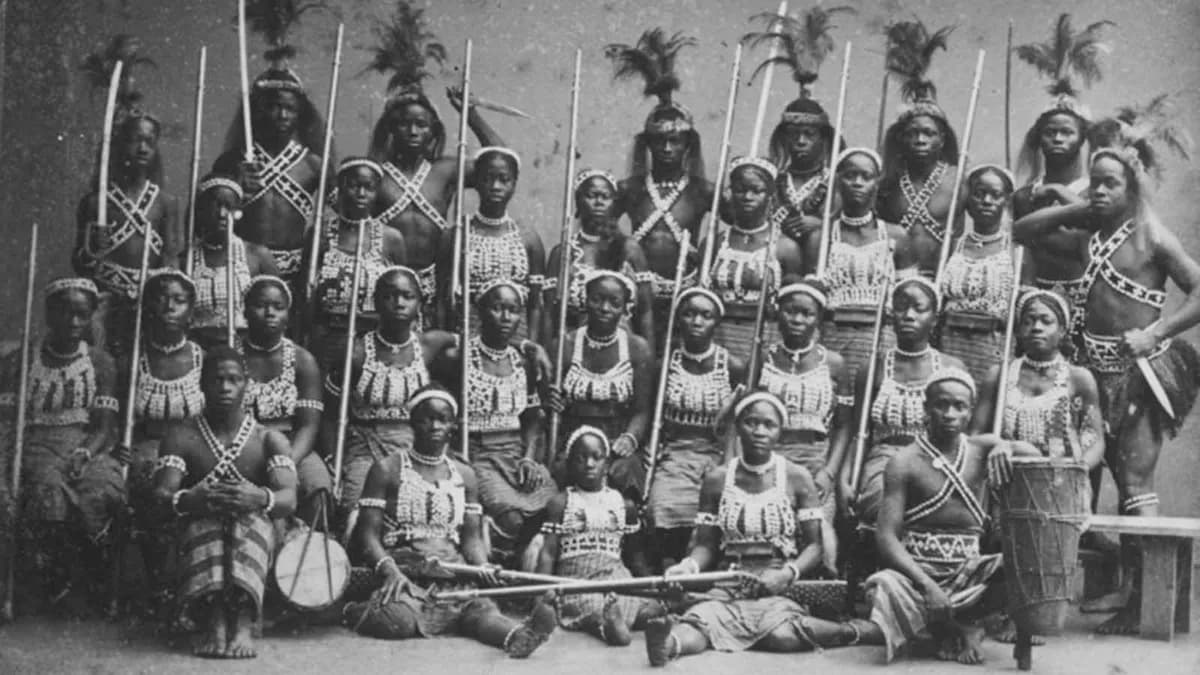
Encountering the Agojie in 1892, the French Foreign Legion met a formidable force. These women were not just warriors; they were a documented army that defied norms and shaped history.

Amulets of the Amazons
The amulets of the Amazons of Ouidah transcend their status as museum artifacts. They testify to a struggle for restitution and an identity renaissance.
Places of Memory and Vodun
Far from being mere attractions, the memory sites in Ouidah are witnesses to a poignant history, where vodun and memory intertwine.
Reading paths
The Slave Route
From the Atlantic slave trade to contemporary memory
Vodoun & Diaspora
How an African religion crossed the Atlantic
- Step 1· 12 minLe Temple des Pythons
Les origines du vodoun à Ouidah