Key Takeaways
- The Basilique de l'Immaculée Conception was built between 1903 and 1909 at the initiative of Mgr Louis Dartois, first apostolic vicar of Dahomey — with labor from both Catholic converts and Vodun devotees who helped construct the building alongside each other.
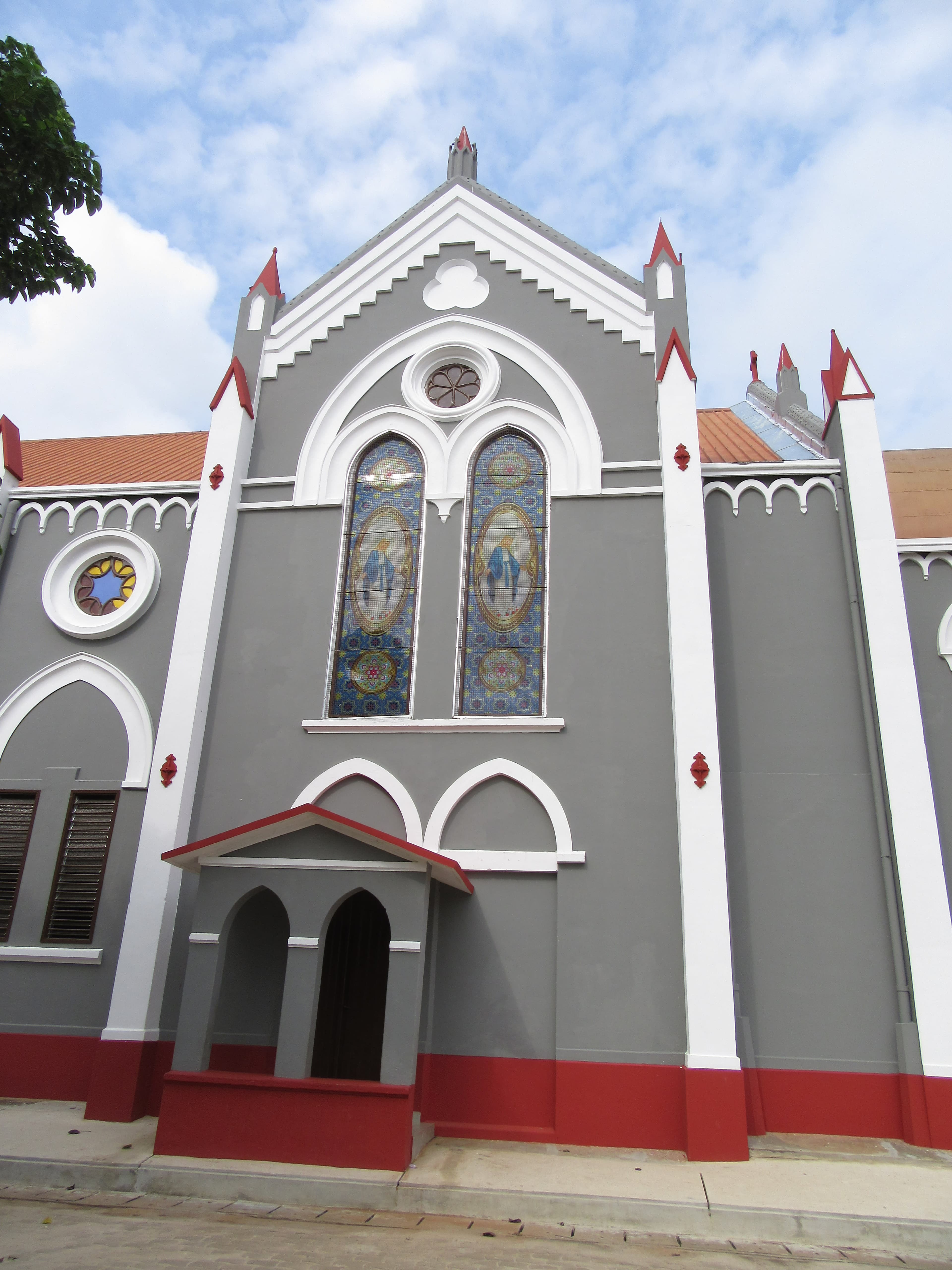
- The architecture is European neo-Gothic — a nave 58 metres long and 14 metres wide, five bays, a cross-shaped plan — with a bell tower whose planned spire was never completed due to lack of funds. It was elevated to a minor basilica by Pope John Paul II on November 9, 1989.
- At its consecration on May 9, 1909, approximately 4,000 people attended — Christians and Vodun practitioners together. This mixed congregation was not accidental. It set the tone for everything the building would become.
- The Aguda community — Afro-Brazilian returnees — became the cathedral's principal patrons. Their surnames appear on the stained-glass windows donated in the mid-20th century: de Souza, da Silva, Martinez, Paraíso.
- On August 15th, the Catholic Feast of the Assumption coincides with celebrations associated with Ezili Freda, the Vodun goddess of love and beauty — both sharing iconography of white and blue, mirrors, and floral offerings. In Ouidah, many devotees observe both on the same day.
Sunday morning in Ouidah. The bell of the Basilique de l'Immaculée Conception rings the nine o'clock hour and the sound carries across the sandy street, past the low wall of the Python Temple, and disappears into the dry-season air. From the temple courtyard, one of the resident pythons is making its way slowly across the sand in the direction of a morning sunbeam. From the basilica's open doors, the sound of a Mass being sung - in Portuguese, archaic and deliberate - drifts outward.
These two sounds coexist in Ouidah with the ease of things that have always existed side by side. The python temple and the cathedral are separated by perhaps twenty metres of dust. They face each other across that gap in what feels, to any sensitive visitor, less like coexistence and more like conversation.
This is Ouidah's most powerful architectural fact: the city's most sacred Vodun site and its most imposing Catholic structure were built looking at each other. Whatever theology either tradition professes, the urban geography says something simpler - you can't fully understand one without knowing what stands across the road.
What this building really is
Most visitors arriving at the Basilique de l'Immaculée Conception for the first time expect a colonial imposition - a European church planted in African soil to signal conquest and conversion. What they find is considerably stranger and more interesting than that.
The basilica is certainly Catholic. Its neo-Gothic architecture - pointed arches, a nave 58 metres long and 14 metres wide, five bays flooded with light through geminated windows - is unmistakably European in form, borrowed from the great church-building revival of 19th-century France. But the building's meaning can't be read from its stone alone.
It was built in 1903 with the labor of both Christians and Vodun devotees. It was consecrated in 1909 before a crowd that included Vodun practitioners as well as converts. Its principal patrons were the Aguda - Afro-Brazilians who brought to Ouidah a Catholicism already shaped by three generations of entanglement with African spirituality. And it stands in a city where the most famous sociological observation about religious identity is: "We are 90% Catholic and 100% Vodun."
The basilica isn't a contradiction in this context. It's a monument to the specific form that faith takes when it travels across an ocean, absorbs what it finds, and refuses to simplify itself.
The deep history
The decision to build (1903)
In 1903, Ouidah was still adjusting to French colonial rule, which had been formalized barely a decade earlier after the conquest of the Dahomey Kingdom. The Catholic mission had been present on the coast since the Portuguese in the 17th century, but it was Mgr Louis Dartois - appointed in 1901 as the first apostolic vicar of Dahomey - who made the decision to give the mission a permanent, monumental presence in Ouidah.
The choice of Ouidah was strategic and symbolic simultaneously. Ouidah was the city where the slave trade had been concentrated. It was the city where the Slave Route ended at the sea. It was also, and not incidentally, the city where Vodun was most organized, most publicly present, and most rooted in the social fabric. Building here was a statement.
The first stone was laid on August 30, 1903. Construction proceeded without interruption until 1905, the year of Mgr Dartois's death. His successor, Father François Steinmetz, continued the work and oversaw its completion.
The builders: a mixed congregation
What makes the basilica's construction story genuinely unusual is who built it.
In addition to the Catholic converts who formed the core of the construction workforce, local Vodun devotees - Vodounsi - participated in the work. They sent their women and children to support the construction teams, bringing water, carrying materials, feeding the workers. This wasn't conversion. It was the expression of something the city had always done: the recognition that a significant communal construction project belonged to the whole community, regardless of its specific religious purpose.
When the cathedral was consecrated on May 9, 1909, approximately 4,000 people attended the ceremony - Christians and Vodun practitioners together. The mixed crowd at the consecration wasn't a diplomatic gesture or a PR calculation. It was simply what Ouidah was. When something important happened in this city, all the traditions showed up.
The Aguda patrons
The Aguda community - freed Africans and their descendants who had returned from Brazil starting in the 1830s - didn't build the basilica, but they became its primary custodians and patrons.
The timing matters: the Aguda arrived in Ouidah in waves from the 1830s onward, establishing themselves in the Singbomey quarter, building their distinctive sobrado houses, and inserting themselves into the city's commercial and social life with considerable force. By the time Mgr Dartois laid the first stone in 1903, the Aguda were among the city's most economically prominent families - skilled traders, photographers, architects, and builders who had been in Ouidah for two and three generations.
For them, the new cathedral wasn't a French colonial imposition. It was an opportunity. A permanent Catholic monument in Ouidah would serve the Aguda community's spiritual life - which was, by this point, a genuinely Catholic life, however layered with Vodun undercurrents - and it would also anchor their social position in the city's public landscape. To have your family's name in the windows of the basilica was to have your family's name in the city's most durable institution. Several Aguda families invested accordingly.
The Aguda brought from Bahia a distinctive form of Catholicism already deeply shaped by their African origins and by the survival strategies they had developed in Brazil - where African spiritual practices were maintained under Catholic surface appearances for generations. When they returned to Ouidah, they didn't abandon that layered practice. Their Catholicism was, and remained, a faith that knew what lay beneath it.
Their investment in the basilica was material and symbolic. Stained-glass windows donated in the mid-20th century bear family names at their bases: de Souza, da Silva, Martinez, Paraíso. These are the great Aguda families - the same families whose sobrado houses define the Singbomey quarter, whose genealogies connect Ouidah to Salvador, Lagos, Porto-Novo, and Havana. For them, the basilica wasn't an alien institution. It was a building where the faith they had carried across the Atlantic and back found a permanent home in Ouidah stone.
Elevation to minor basilica (1989)
On November 9, 1989, Pope John Paul II elevated the church to the status of minor basilica - a distinction granted to churches of particular historical, artistic, or devotional importance within the Catholic tradition. The timing coincided with the papal decree Domus ecclesiae, issued the same day, which standardized the regulations for minor basilicas worldwide.
The elevation was recognition that what stood on this street in Ouidah wasn't a provincial colonial church but a site of genuine global significance - a place where the encounter between European Christianity and West African spiritual traditions had produced something that couldn't be replicated anywhere else.
The planned bell tower spire, which was supposed to crown the building and give it the vertical silhouette of the great European neo-Gothic cathedrals, was never completed - lack of funds interrupted the plan in the early years of construction and it was never resumed. The tower stands to this day without its crown, as if the building itself decided that being unfinished was a more honest statement about the things that were never resolved between the traditions it held.
Architecture and space
The basilica follows the traditional cross-shaped plan of medieval Catholic church architecture: a central nave with a shallow transept, ending in a quadrangular apse. The nave runs 58 metres long and 14 metres wide, divided into five bays by columns that carry pointed arches in the full neo-Gothic manner. Light enters through a series of geminated windows - pairs of narrow arched openings topped with circular oculi - that wash the interior in diffuse, filtered brightness.
The interior is cool even in the height of the dry season. The stone walls hold the night air through the morning, and the space has the quality of a held breath - gathered, contained, with an underlying density that visitors who have been in many African churches often remark upon.
The stained-glass windows donated by the Aguda families glow in the afternoon light: saints and scriptural scenes rendered in a French decorative style. But carrying at their bases those Portuguese surnames that tell a different story - a transatlantic story, a story of people who crossed the ocean twice and built their faith into glass.
What sits directly across the street: the Python Temple. From the basilica's front steps, you can see the temple's low white wall and the dark doorway of the courtyard. The two sacred spaces are in constant, unintentional view of each other - two very different answers to the same question about what the divine is and how to approach it, standing twenty metres apart in the same city under the same West African sun.
The 90%/100% phenomenon
Ouidah has a famous sociological saying: "We are 90% Catholic and 100% Vodun."
The arithmetic is impossible. The meaning is exact.
It means that in Ouidah, formal religious affiliation - Catholic, or Protestant, or Muslim - and Vodun practice aren't understood as mutually exclusive. They are understood as different registers of the same spiritual life: one for the official social world, one for the deeper relational world of ancestors, forces, and the invisible presences that govern daily existence.
The basilica and the python temple face each other across twenty metres of Ouidah dust as the architectural embodiment of this formula. The people who fill the basilica's pews on Sunday mornings are often the same people who, three days before, brought offerings to the python temple. They don't experience this as contradiction. They experience it as completeness.
The clearest physical illustration of this: every Sunday morning, the basilica fills for Mass. Every Friday around noon, the python temple across the street fills for its weekly ceremonies. The practitioners of each tradition see each other passing through the same sandy intersection, exchanging greetings, sometimes stopping to talk before entering their respective sacred spaces. The conversation across the street isn't just architectural.
What the French missionaries and the colonial administration never fully understood - and what the successive Catholic bishops stationed in Ouidah have gradually learned to work with rather than against - is that the Vodun practice isn't a failure to fully commit to Catholicism. It's a different category of spiritual engagement, one that addresses dimensions of experience that Catholicism as practiced here doesn't claim to address. God, in the Catholic register, provides hope, salvation, community, and moral framework. The Vodun provide something else: immediate, practical, relational contact with the forces that govern health, harvest, family, and fortune. A community that has both isn't confused. It is simply more thoroughly provided for.
Three languages
The basilica's liturgical life reflects this layering in its linguistic structure. Services have traditionally been conducted in three languages:
Portuguese - the language of the Aguda founders, carried from Bahia to Ouidah in the 1830s and maintained across generations. The 9am Mass, still held in Portuguese, is one of the last regular liturgical uses of this particular form of the language anywhere in the world - an archaic Bahian Portuguese, shaped by the creolization of the Bahian community, unlike any Portuguese spoken in Brazil or Portugal today.
French - the official national language, used for the main congregation Mass attended by the city's professionals and younger generations.
Fon - the deep language of the land. When the Mass shifts to Fon, something changes in the acoustic register of the space. The cadences begin to resemble, faintly, the cadences heard in the chants outside the Sacred Forest. The boundary between the liturgical and the ceremonial becomes permeable.
August 15th: the sacred intersection
The most intense moment in the basilica's liturgical calendar occurs on August 15th - the Catholic Feast of the Assumption of the Virgin Mary.
In Ouidah, this date is also associated with observances connected to Ezili Freda - the Vodun lwa (spirit) of love, beauty, and luxury. Ezili Freda shares significant iconographic territory with the Marian tradition: both are associated with white and blue colors, with mirrors and jewels, with floral offerings, with the power of love and feminine grace. The association between Mary and Ezili Freda is documented across the Haitian and Brazilian diaspora, where enslaved Africans mapped Vodun spirits onto Catholic saints as a survival strategy - and the mapping has outlasted the conditions that created it.
On August 15th in Ouidah, the basilica fills with devotees dressed in white lace, carrying flowers and incense. The Mass is long and emotionally charged. After it ends, the energy doesn't dissipate - it moves. Drums begin in the street outside and in the yards of the surrounding quarter. For many of those who were inside the basilica an hour earlier, the ceremony hasn't ended. It has simply changed rooms.
This isn't hypocrisy or confusion. It's the specific spiritual grammar of a community that has always held both traditions simultaneously, and has developed, over more than a century, a sophisticated understanding of how to move between them without losing either.
What few people know
The construction of the basilica wasn't simply a Catholic project imposed on a Vodun city. The Vodun community actively participated in building it - not as converts, but as neighbors who recognized a significant communal project and showed up accordingly. The principle that a building being raised in your city belongs to your city, regardless of its specific religious purpose, is one of the organizing social principles of Ouidah's multi-tradition coexistence.
This participation wasn't commemorated on any plaque or in any official church history. It is preserved in oral memory - in the knowledge that the hands that built the walls included hands that had poured libations at the python temple the week before. The building's dual spiritual character was embedded in its construction, not retrofitted by interpretation.
The unfinished bell tower carries its own significance in this context. A spire was designed and planned but never built. Some local accounts describe this incompleteness as fitting: a building that represents the incompleteness of all reconciliations, all attempts to hold two things together without fully resolving them. The tower reaches toward a height it never achieved. The ambition was there. The resolution wasn't.
The future of the basilica
The basilica underwent significant renovation in recent years, completed and reinaugurated in 2025 - its first major restoration since the original construction. The work addressed structural consolidation and beautification, and the building emerges from it as visually impressive as at any point in its history.
The deeper questions it faces are less architectural.
The Portuguese Mass - the 9am service, one of the last regular liturgical uses of a specific Bahian archaic Portuguese anywhere - depends on a dwindling number of elderly Aguda families who still know the tradition. When that generation is gone, the question of whether the Portuguese Mass continues is a question about whether Ouidah's most physically embedded act of Atlantic memory can survive without living practitioners.
The relationship between the two traditions that face each other across the sandy street isn't in crisis - but it is in evolution. Each generation negotiates the 90%/100% formula differently. Some younger Ouidah residents identify more exclusively with one tradition or the other. Some find the dual practice self-evident and unremarkable. The tension between sincere multi-tradition practice and the institutional pressures of both the Catholic Church and organized Vodun is ongoing and unresolved.
The basilica will continue to stand. What it stands for, and for whom, is a question each generation of Ouidah residents answers for themselves.
What isn't in question is its architectural significance. The 2025 restoration, which addressed decades of deferred maintenance and returned the facade to something close to its 1909 appearance, was completed with funding from the Beninese Catholic Church and international heritage organizations. The building that emerged is one of the most visually striking religious structures in West Africa - a neo-Gothic monument in a city that didn't need neo-Gothic, built by a community that absorbed it, shaped it, and made it mean something it was never designed to mean.
For the visitor arriving in Ouidah for the first time, standing at the intersection where the basilica and the python temple face each other across twenty metres of dust, the most useful frame isn't theological. It is simply this: both of these buildings are telling the truth. About what this city is. About what faith looks like when it can't afford to be simple. About what survives when everything else has been broken.
Visiting the basilica
Address: Central Ouidah, coordinates 6.36056, 2.08472 - directly opposite the Python Temple.
Architecture to look for:
- The five-bay neo-Gothic nave and its filtered light
- The Aguda family names at the base of the stained-glass windows
- The unfinished bell tower - study the roofline for the truncated structure where the spire should have been
- The entrance facing the Python Temple across the sandy street
Opening hours: The basilica is open daily for visits outside of Mass times. Entry is free. Masses are held on Sunday mornings; the Portuguese Mass typically begins at 9am.
Best times to visit:
- 9am Sunday Mass: The Portuguese-language service - one of the world's last regular liturgical uses of archaic Bahian Portuguese
- August 15th: The Assumption/Ezili Freda intersection, when the basilica's dual-faith life is most visible
- January 10th (Vodun Days): When the procession passes the basilica's steps and the two traditions occupy the same street
Practical notes:
- Entry to the basilica is free. Dress respectfully
- Photography inside requires permission from the officiants
- Guides from OuidahOrigins can provide the historical and theological context that the building itself doesn't explain
Concierge access
Understanding what the Basilique de l'Immaculée Conception actually is - not the Gothic shell but the specific human story it contains - requires being in Ouidah with someone who knows where the Aguda families still live, what the Portuguese of the 9am Mass sounds like to someone who learned it in childhood, and what it means to attend the Assumption Mass and then walk across the street to the python temple in the same afternoon.
These are introductions and contexts that OuidahOrigins can provide for visitors who want more than a photograph of a beautiful building.
Further reading
- Wikipedia: Basilique de l'Immaculée Conception de Ouidah - Historical documentation of the cathedral.
- Wikipedia: Erzulie Freda - The Vodun lwa whose feast overlaps with the Assumption on August 15th.
- Wikipedia: Aguda people - The Afro-Brazilian community that became the cathedral's principal patrons.
- HAL Archive: Religious Syncretism Ouidah - Academic research on Ouidah's unique faith landscape.
- Related articles: The Python Temple · The Brazilian Legacy · The Aguda Community · Vodoun Days
Editorial transparency
This content was developed with the assistance of our AI agents.
Frequently Asked Questions
Lire aussi
Ouidah concierge for diaspora and roots travelers
Traveling to Ouidah is not just a getaway. It's a return to your origins, a quest for authenticity, and a deep connection with your roots. Our concierge service is the key to experiencing this unique journey.
Tracing your roots and family history in Ouidah
Ouidah, a port of memory, becomes a place of healing for the diaspora. Genealogical research takes on a spiritual and political dimension, redefining identity.
A guide to the Afro-Brazilian surnames of Ouidah
Da Silva. De Souza. D'Almeida. Olympio. Behind every Aguda surname in Ouidah lies a story of enslavement, return, and identity rebuilt across two continents. This guide traces the names and what they mean.
Reading paths
The Slave Route
From the Atlantic slave trade to contemporary memory
Vodoun & Diaspora
How an African religion crossed the Atlantic
- Step 1· 12 minLe Temple des Pythons
Les origines du vodoun à Ouidah