Ouidah is a small city with a disproportionately large historical footprint. As the primary port of the Atlantic slave trade in the Kingdom of Dahomey, the spiritual centre of West African Vodun, and the crossroads of Portuguese, Afro-Brazilian, and Fon cultures, it holds layers of history that most visitors only begin to grasp over two or three days.
The sites are close together. A circuit of the main historic attractions can be done in a day. But that isn't the same as understanding them - and Ouidah rewards slower visitors.
The Slave Route and the Door of No Return
The Route des Esclaves (Slave Route) is the most important historical site in Ouidah. This 4-kilometre processional path runs from the city centre to the Atlantic Ocean - the route walked by enslaved people in the final hours before boarding ships. Along the way, sculptures and memorials mark key stations: the Tree of Forgetting (where enslaved people were made to walk in circles to be ritually stripped of memory), the mass graves, the point of no return.
It ends at the Porte du Non-Retour (Door of No Return) - an arching monument on the Atlantic beach, built in 1992 as part of UNESCO's Slave Route Project. It is simultaneously a memorial, a place of mourning, and, for African diaspora visitors, a site of profound spiritual return.
Walking the route without a guide is possible. Walking it with a knowledgeable local guide is a completely different experience. Budget 2,000 - 5,000 FCFA for a half-hour guided walk.
The Sacred Forest of Kpassè
The Forêt Sacrée de Kpassè is a grove of ancient trees on the northern edge of the city, dedicated to the Vodun spirit Kpassè. It is considered one of the oldest and most sacred Vodun sites in West Africa.
Entry: 3,000 FCFA. The visit includes a guided walk through the forest, explanation of the major sculptures and shrines, and context on the Vodun religious traditions associated with this site. Photographs are permitted in designated areas; always ask before photographing ceremonies or sacred objects.
Plan 1 to 1.5 hours for a proper visit.
The Python Temple
The Temple des Pythons houses dozens of Royal Pythons (Python regius) that are considered sacred in Ouidah's Vodun traditions. Visitors enter the temple, where the pythons rest freely. Handlers assist visitors who wish to hold them.
Entry: 2,000 - 3,000 FCFA. The experience is unusual and memorable. The pythons are calm and well-treated; the visit typically takes 30 - 45 minutes.
The Fort of Ouidah and the Historical Museum
The Fort d'Ouidah - built by the Portuguese in the 17th century as a slave-trading post - is now home to the Musée d'Histoire de Ouidah. The permanent collection covers the history of the slave trade, the Kingdom of Dahomey, and the cultural intermingling that produced Ouidah's unique character.
Entry: 2,000 FCFA. The exhibits are in French; a guide can provide context in English. Allow 1 hour.
The Afro-Brazilian heritage: Place Chacha and the Agudás houses
Place Chacha - the historic square associated with Francisco Felix de Souza, the Afro-Brazilian slave trader who became the most powerful merchant in Ouidah - is a key site for understanding the city's complex role in Atlantic history. The De Souza family chapel and family compound still stand nearby.
Throughout the city, you will encounter maisons afro-brésiliennes - distinctive houses built by Agudás returnees (formerly enslaved people and their descendants who returned from Brazil in the 19th century). Their architecture, a blend of Portuguese colonial and West African styles, is visible across several Ouidah neighbourhoods.
The Cathedral and the layering of faiths
La Cathédrale Saint-François-Xavier - the oldest Catholic cathedral in Benin, built in the 19th century - stands near the city centre. Its presence next to active Vodun temples and shrines embodies the religious layering that characterises Ouidah. A short visit is worthwhile for architecture and context, even for non-religious travellers.
The Vodun Festival (10 January)
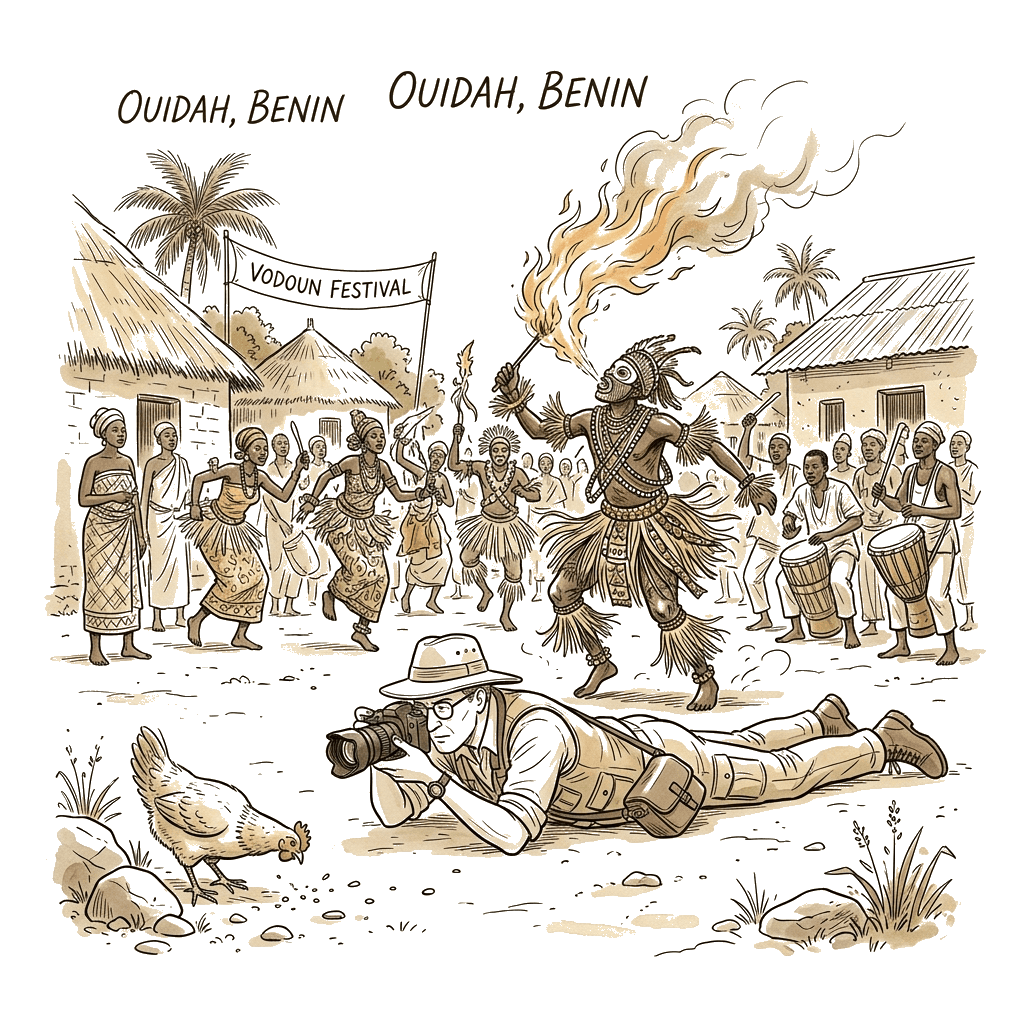
The Fête du Vodoun - a national public holiday celebrated on 10 January - is the most important annual event in Ouidah. Ceremonies, processions, and public celebrations draw practitioners and visitors from across Benin, Togo, and the global African diaspora.
This isn't a tourist performance. It's a living religious and cultural celebration. Respectful, observant visitors are welcome at public ceremonies. Some rituals are private. When in doubt, follow your guide's lead.
Day trips from Ouidah
La Bouche du Roy (Avlékété): Where the Mono River meets the Atlantic, at the western end of the lagoon system. A striking natural landscape - wide estuaries, fishing communities, pelicans, and the power of two bodies of water meeting the ocean. About 45 - 60 minutes west of Ouidah by road. A boat excursion on the lagoon is possible from here.
Ganvié: The famous stilt village on Lake Nokoué, near Cotonou, is a half-day excursion. The entire village is built on water, accessible only by pirogue. Entry and boat tour: 3,000 - 5,000 FCFA. Well-known but genuinely extraordinary. Best visited early in the morning.
Abomey: The former capital of the Kingdom of Dahomey, 2+ hours north of Ouidah. The Palais Royaux d'Abomey are a UNESCO World Heritage Site - the royal palaces of successive Dahomey kings, with remarkable bas-reliefs depicting the history of the kingdom. Worth an overnight trip rather than a rushed day visit.
Possotomé and Lake Ahémé: For those interested in lagoon culture and fishing communities, the village of Possotomé on Lake Ahémé offers boat excursions on a large inland lake with rich birdlife. Quieter and less visited than Ganvié.
Getting around Ouidah on foot
Most of Ouidah's main sites - the Route des Esclaves, the Python Temple, the Fort, the Sacred Forest, and the city centre - can be reached on foot from central accommodation. The Door of No Return is a 4-kilometre walk from the centre along the Route des Esclaves, or a short zémidjan ride.
A local guide for a full-day circuit costs 20,000 - 30,000 FCFA (€30 - 45) and is the single best investment for a first visit. Ouidah without context is a pleasant town. With it, it becomes a place that doesn't leave you easily.
FAQ
How many days do you need in Ouidah? A minimum of 2 full days to cover the main sites without rushing. Three days allows time for a day trip (La Bouche du Roy, Ganvié, or Abomey) and still have unhurried evenings in the city. If you're visiting for the Vodun Festival, plan at least 3 - 4 days.
Do I need a guide for the main sites? Not required, but strongly recommended for the Slave Route and the Sacred Forest. Context changes what you see. Entry-level interpretation is included in the Sacred Forest admission; for the Slave Route, a separate guide is worth the cost.
Is the Python Temple safe? Yes. The Royal Pythons at the temple are non-venomous and calm. Handlers are present throughout. The visit is safe for children and adults who are comfortable around non-venomous snakes.
Can I photograph the sacred sites? In most places, yes, with permission. In the Sacred Forest, photography is permitted in designated areas. At active ceremonies during the Vodun Festival, ask before photographing. Discretion and respect are the operating principles.
What is the best order for visiting the main sites? Start at the Fort of Ouidah for historical context, then walk (or take a zémidjan) to the Python Temple, then to the Sacred Forest, and finish the day at the Route des Esclaves leading to the Door of No Return. Arriving at the beach at sunset is worth the timing.
Editorial transparency
This content was developed with the assistance of our AI agents.

entrust us with your journey
beninese hospitality is not improvised; it is experienced. let us orchestrate your stay, from hidden sanctuaries to the purest flavors.