

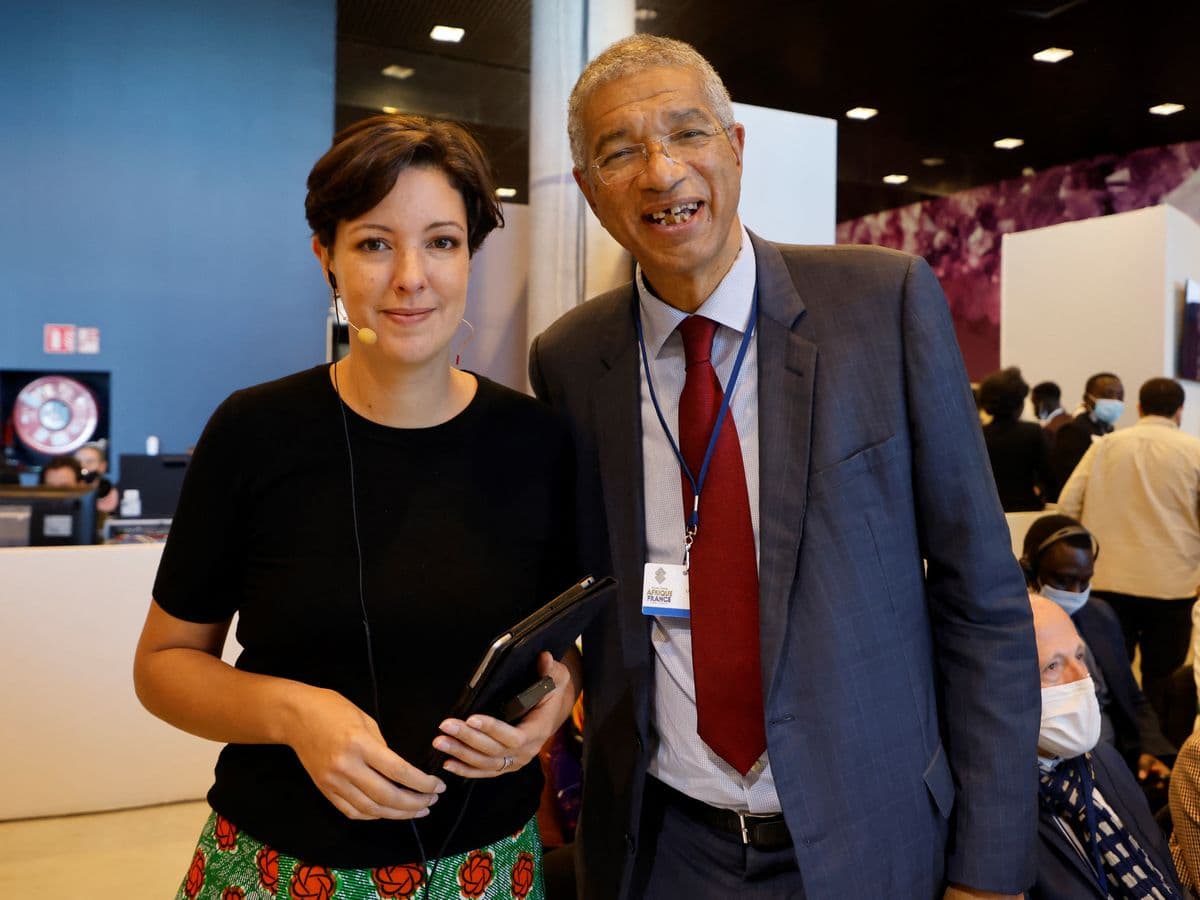
She was not supposed to win.
When Marie-Cecile Zinsou began speaking publicly about restitution, the French museum establishment listened the way an ocean liner listens to a swimmer. Polite. Distant. Certain of its own immovability. The principle of inalienability, the legal doctrine that French public collections could never be dismantled or dispersed, was treated as a law of physics. Objects that entered a French museum belonged to France forever. End of discussion.
That was before the swimmer turned out to be an oceanographer.
Today, in May 2026, the French Senate has just definitively adopted a framework law on the restitution of cultural property looted during colonization, following the National Assembly's own vote weeks earlier. And Marie-Cecile Zinsou, Franco-Beninese historian of art and president of the Fondation Zinsou, is being quoted in newspapers from Paris to Port-Louis as the face, and the voice, of a cause that, ten years ago, most European museum directors considered impossible.
"No one believed it would happen this fast," she told Benin TV after the Senate vote. "Not even me."
A family mission: the Fondation Zinsou before the debate had a name
To understand Marie-Cecile Zinsou restitution activism, you have to understand the institution that preceded it. Before she was fighting French museums, she was building a Beninese one.
The Fondation Zinsou was created in 2005 in Cotonou by her father, the Beninese diplomat and businessman Lionel Zinsou, with a simple premise: Benin deserved a world-class art space, funded privately, programmed without compromise, and open to the public free of charge. Marie-Cecile, then in her early twenties, was studying art history in Paris. She came back to run it.
The Foundation opened its first space in Cotonou. Then a museum in Ouidah, housed in a restored colonial villa. Then a network of mini-libraries across the country. By the time the restitution debate exploded onto the international stage with Emmanuel Macron's 2017 Ouagadougou speech, the Fondation Zinsou had already been doing the quiet, unglamorous work of cultural infrastructure for over a decade.
This is the first thing the SERP profiles miss about Marie-Cecile Zinsou restitution work: she was not an activist who discovered restitution. She was a museum builder who realized, early, that no museum in Benin could be complete while the country's greatest artworks were locked in European storerooms.
The Foundation gave her credibility, and independence. She did not need a government salary. She did not need a French institution's approval. She could speak, and she did.
"Restituer, c'est rapatrier l'imaginaire"
The quote has become her signature. In an interview with L'Express Mauritius, she distilled the argument into a single line: "Restituer, ce n'est pas deplacer 25 statues. C'est rapatrier l'imaginaire tout entier."
She meant something specific.
The objects taken from Benin during the colonial period, the royal statues of Abomey, the bochio of kings Ghezo, Glele, and Behanzin, the ceremonial weapons, the divination trays, were not merely art. In the Fon and Yoruba worldviews, these objects were alive. They held spiritual agency. Their removal was not theft in the material sense alone. It was an amputation of the collective imagination, a severing of the relationship between a people and the objects that allowed them to think about themselves.
When Marie-Cecile Zinsou restitution rhetoric insists on the word imaginaire, she is doing something more radical than demanding objects back. She is demanding that African nations recover the right to define what those objects mean. For over a century, European curators decided what was art, what was artifact, what was ethnographic, what was worthy of display. The restitution movement, in her framing, is not just logistical. It is epistemological.
"We have every capacity to manage our own heritage," she told Agence Ecofin. The sentence is simple. The implication is not: it means rejecting the unspoken European assumption that African museums are not ready, that they lack the climate control, the security, the expertise. The Fondation Zinsou had been proving the opposite for fifteen years before anyone in Paris thought to ask.
The battle with the conservators
"Je ne peux pas dire que je sois la personne preferee des conservateurs."
The understatement, delivered to Les Echos with a smile, tells you everything about the institutional resistance she has faced. French museum conservators are a powerful body. Their professional identity is built on stewardship, the sacred duty to preserve, protect, and interpret the collections in their care. Restitution, to many of them, felt like an accusation. It implied that they were not legitimate custodians. That their museums were, at some level, crime scenes.
Zinsou understood this psychology. She did not make the argument personal. She made it structural. The objects were not stolen by the conservators. But they were stolen. And the fact that they had been well cared for in Paris did not change the fact that they belonged in Benin, where they could be seen by the descendants of the people who made them, in the context that gave them their original meaning.
The 2021 return of the twenty-six treasures of Abomey, from the Musee du Quai Branly to the Presidency of Benin, was, in her view, a proof of concept. The objects arrived. They were received with ceremony. They toured Benin to enormous crowds. They are now housed in the Musee de l'Epopee des Amazones et des Rois du Danxome in Abomey. Nothing broke. The sky did not fall. The argument that African museums were not ready collapsed under the weight of its own paternalism.
The conservators who opposed Marie-Cecile Zinsou restitution advocacy have not all changed their minds. But they have lost the argument. The 2026 framework law is their defeat.
The 2026 framework law: a victory, unfinished
On May 7, 2026, the French Senate gave its final adoption to the framework law on the restitution of cultural property looted between 1815 and 1972, after the National Assembly had passed its own version on April 13. The law creates a permanent mechanism for restitution, no longer requiring a separate act of Parliament for each object or collection, as was the case with the 2020 law that enabled the return of the twenty-six treasures.
Marie-Cecile Zinsou called it "a historic law." And it is. But she also knows it is a compromise.
The law covers objects taken between 1815 and 1972. It does not cover objects taken before 1815. It does not cover objects in private collections. It does not address the digital question, who owns the photographs, the scans, the metadata associated with restituted objects. It does not create a fund to help African museums build the infrastructure they need to receive large-scale returns.
She knows all of this. She celebrates the victory and immediately asks for the next one. That is her method.
The Marie-Cecile Zinsou restitution story is not about a single law. It is about a shift in the global conversation, and she has been one of the principal architects of that shift. From Ouagadougou 2017 to the Senate vote of 2026, the distance traveled is enormous. The distance remaining is greater.
Between Paris and Cotonou: the double identity that feeds the fight
She was born in Paris in 1982. She is French by birth, Beninese by blood, and entirely both. This dual identity, which some might experience as a conflict, has been, in her case, a source of power.
She understands the French institutional mind from the inside. She studied at the Sorbonne. She knows how French bureaucracy works, how French curators think, what arguments will move a French senator and what arguments will make them shut down. She also knows, with the bone-deep certainty of someone who has spent half her life in Cotonou, what it means for a Beninese schoolchild to see the royal treasures of Abomey for the first time, not in a photograph, not in a Parisian vitrine, but in their own country, under their own sky.
This is the advantage that a purely French activist would lack, and that a purely Beninese activist might struggle to leverage. She moves between the two worlds with the ease of someone who has never accepted that they are separate.
The Foundation embodies this duality. It is a Beninese institution, registered in Cotonou, serving a Beninese public. It is also connected to the international art world, capable of borrowing works from major European collections, capable of speaking the language of Parisian curators while refusing their assumptions.
What comes after restitution
The question she is starting to ask, the question that will define the next decade of her work, is not "what comes back?" but "what do we build with what returns?"
Restitution is not an end. It is a beginning. The objects return, and then what? Who interprets them? Who writes the catalogues? Who decides how they are displayed, which stories they tell, which audiences they address? The battle for the objects is being won. The battle for the narrative is just starting.
Marie-Cecile Zinsou knows this. She is already building the infrastructure, intellectual, institutional, educational, that will make the next phase possible. The Foundation trains young Beninese curators. It publishes. It programmes. It insists, quietly and relentlessly, that the future of African heritage will be written by Africans.
"We have every capacity," she said. She was not asking for permission.
If you are interested in the restitution of cultural heritage to Benin, explore our pillar article on the subject and the story of the twenty-six treasures of Abomey. The Fondation Zinsou's museum in Ouidah is open to visitors; the Ouidah Origins concierge can help you plan your visit.
- Marie-Cecile Zinsou built the Fondation Zinsou in Benin for over a decade before restitution became an international debate — her credibility comes from infrastructure, not just advocacy.
- Her signature argument — "Restituer, c'est rapatrier l'imaginaire" — reframes restitution as epistemological sovereignty, not just logistics.
- The April 2026 French Senate framework law on restitution is a historic victory, but it remains a compromise that excludes pre-1815 objects, private collections, and digital metadata.
- Her dual French-Beninese identity allows her to navigate both the Parisian institutional world and the realities of cultural infrastructure in Benin.
- The next phase of her work shifts from "what comes back?" to "what do we build with what returns?"