

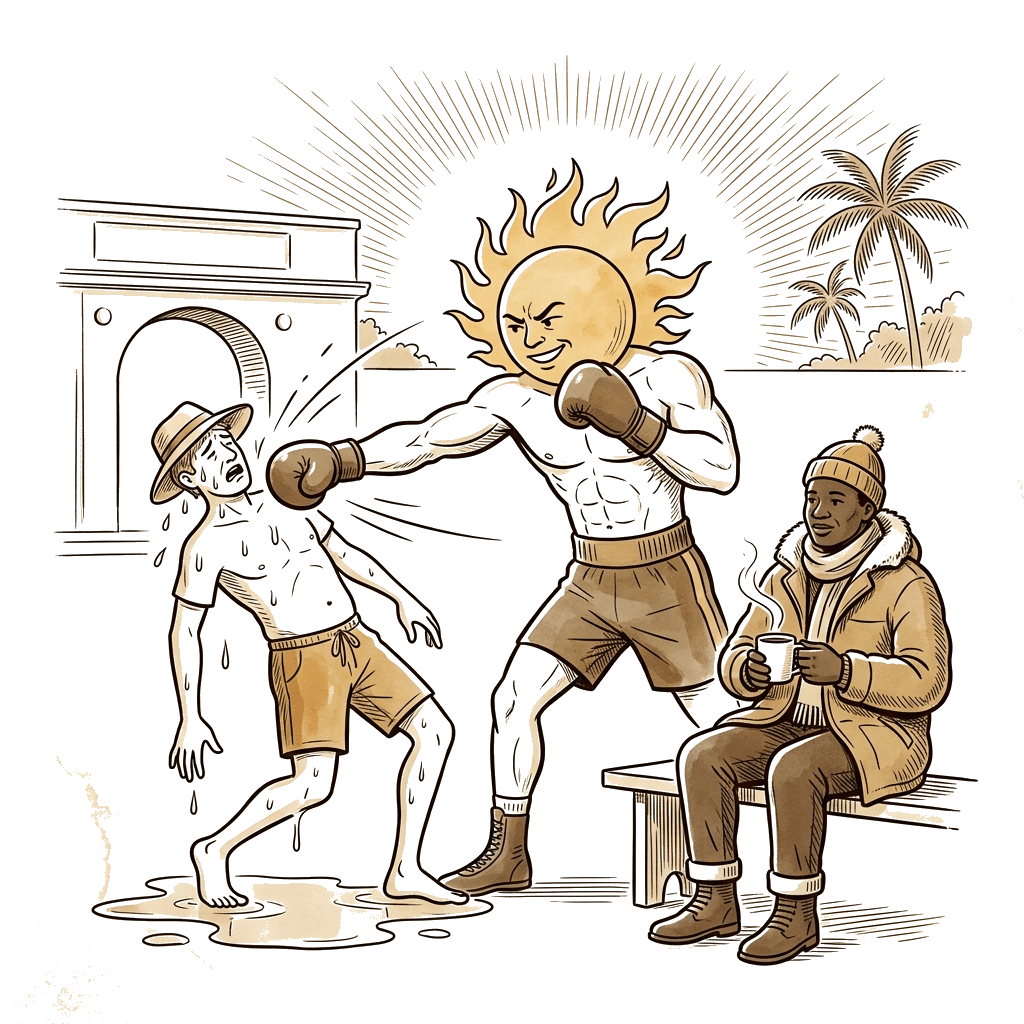
Ouidah sits at five degrees north of the equator, on the Atlantic coast. The climate is tropical - humid year-round, warm every month, and organised around rainfall rather than temperature swings. There's no winter here, but there's a clear best time to visit.
The short answer: November to February. Drier, slightly cooler, and matched the most important cultural event of the year - the Vodun Festival on 10 January.
Ouidah's four seasons
Unlike Europe or North America, Ouidah's year divides not into four temperature seasons but into alternating wet and dry periods.
Long dry season — November to March (the best time)
This is the season shaped by the Harmattan, a dry, dust-laden wind blowing south from the Sahara. It brings lower humidity, cooler nights (20 - 24°C), and a fine dusty haze that sometimes reduces visibility but also produces spectacular sunsets over the Atlantic.
Daytime temperatures stay between 28°C and 32°C. Rainfall is minimal - you might go two weeks without a drop. This is when Ouidah is most comfortable to explore on foot.
January 10 is the national Fête du Vodoun - one of the most significant cultural celebrations in West Africa, drawing practitioners of Vodun traditions from Benin, Togo, and the diaspora. If you can only visit once, this combination of ideal weather and cultural intensity is hard to match.
Short rainy season — April to July (mostly manageable)
The rains begin gently in April and build through May and June, the wettest months. Expect daily downpours of 30 - 90 minutes, usually in the afternoon or evening. The rest of the day is often clear.
This isn't monsoon-season flooding. Rain in Ouidah is usually heavy and brief. The city continues functioning normally. Some roads in lower-lying areas can flood temporarily after sustained rain.
Temperatures during this period climb: 30°C to 35°C in April and May before the rains cool things slightly.
Short dry season — August (brief respite)
A short break between the two rainy seasons. Lower rainfall, slightly lower humidity. This "little dry season" is short and variable - plan for rain anyway.
Short rainy season — September to November (second rains, then transition)
September and October bring another cycle of rains, generally less intense than the May - June peak. November marks the return of drier conditions and the beginning of the Harmattan.
Average conditions by month
| Month | Avg. temp | Rainfall | Conditions |
|---|---|---|---|
| January | 28°C | Very low | Dry, Harmattan dust, Vodun Festival |
| February | 30°C | Low | Dry, warming up |
| March | 32°C | Low | Hot and dry |
| April | 33°C | Moderate | Heat peaks, first rains begin |
| May | 31°C | High | Long rains, humid |
| June | 29°C | High | Peak rains |
| July | 28°C | Moderate | Rains easing |
| August | 28°C | Low | Short dry season |
| September | 28°C | Moderate | Second rains begin |
| October | 29°C | Moderate | Second rain peak |
| November | 29°C | Low | Drying out |
| December | 28°C | Very low | Harmattan returns |
What affects Ouidah specifically
The Atlantic breeze. Ouidah is a coastal city. The ocean moderates temperatures throughout the year - the heat is rarely oppressive the way it can be inland. A few kilometres from the coast, in Cotonou or towards Abomey, it gets noticeably hotter.
Humidity. Even in the dry season, humidity rarely drops below 60%. "Cool" in Ouidah means 24°C at night with a dry breeze - pleasant by West African standards, not alpine.
The Harmattan. Some travellers love it; some find the dust irritating. It can aggravate sinuses and dry eyes. If you have respiratory sensitivities, bring a light scarf for face covering. The Harmattan is entirely regional - it doesn't affect every day equally.
When not to go
May and June are the months with the heaviest sustained rainfall. You won't have a miserable time, but you'll need to plan around afternoon downpours. Outdoor ceremonies and site visits are harder to time.
April combines the year's highest temperatures (up to 35°C) with the beginning of rain. For walkers and outdoor explorers, it's the least comfortable month.
Packing for the season
November - March (dry season):
- Light cotton clothing for the day. A light layer for Harmattan evenings
- Sunscreen (the UV is high year-round at this latitude)
- A scarf or light wrap for Harmattan dust on some days
- Flip-flops or sandals for the beach; walking shoes for site visits
April - October (rainy season):
- Quick-dry fabrics
- A compact rain jacket or packable poncho (not an umbrella - the wind makes them useless)
- Water-resistant sandals or shoes
- Higher SPF - the UV doesn't disappear with cloud cover
Regardless of season, insect repellent with DEET is essential. Malaria is present in Benin year-round.
FAQ
Is January actually the best month to visit Ouidah? For most travellers, yes. The Vodun Festival on 10 January brings exceptional cultural energy, the weather is dry and comfortable, and the Harmattan evenings are pleasant. The only downside: accommodation books early. Reserve well in advance if you plan to visit during Vodun Days - where to stay in Ouidah maps the options.
Does it rain every day in the rainy season? Not every day, but frequently. During the peak (May - June), expect rain on most days - usually in the afternoon. Mornings are typically clear. Planning your major site visits for the morning works well.
How does the humidity compare to somewhere like Bahia, Brazil? Very similar. Ouidah and Salvador share a comparable latitude and coastal tropical climate. The dry season Harmattan has no equivalent in Bahia - that's the distinctive feature. Otherwise, travellers familiar with Northeast Brazil will find the climate largely familiar.
Is it safe to be outside during Harmattan? Yes. The dust is fine but not dangerous for most people. Those with asthma or dust allergies should bring medication and consider a lightweight face covering for windy days.
What is the sea water temperature? The Atlantic at Ouidah is warm year-round: 25 - 28°C. Note that the coastline west of Ouidah towards Fidjrossè and La Bouche du Roy has dangerous currents. Swimming isn't safe at most Atlantic-facing beaches in this stretch of Benin.
Editorial transparency
This content was developed with the assistance of our AI agents.

entrust us with your journey
beninese hospitality is not improvised; it is experienced. let us orchestrate your stay, from hidden sanctuaries to the purest flavors.