Key Takeaways
- The Door of No Return commemorates over one million enslaved Africans who departed from this precise beach between 1671 and 1865 — according to the SlaveVoyages database, Ouidah was one of the largest slave embarkation points in the entire Atlantic world.
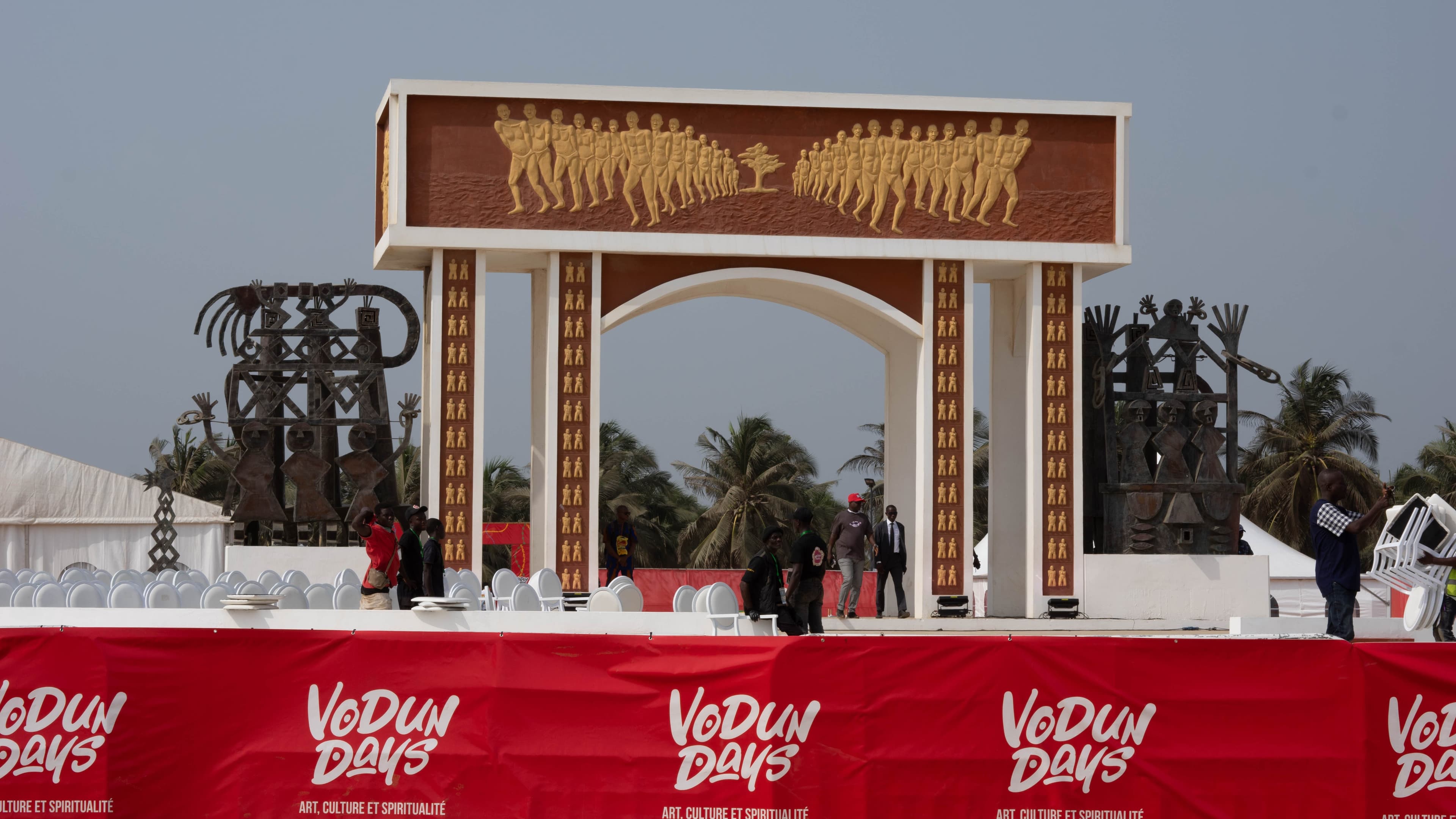
- Built in 1995 by a Beninese architectural team as part of UNESCO's Slave Route Project, the 15-meter concrete arch has no actual door: the opening is deliberate — signifying that the departure was absolute and the historical wound remains open.
- The arch is oriented East — toward the African continent, not toward the ocean. Most visitors stand on the ocean side and miss the intended direction. The monument was designed to be approached from the sea, looking back toward what was left behind.
- Ouidah had no natural harbor: captives were loaded into flat-bottomed pirogues and paddled through violent Atlantic surf to reach European vessels anchored over a mile offshore — the physical crossing began before any ship.
- Every January 10th (Benin's national Vodun Day), Hounon high priests perform libations at the base of the arch; diaspora descendants walk the 3.5-kilometer Slave Route in reverse as the 'Return of the Children' ceremony.
The vegetation thins. The road, still laterite red, loses its edges and becomes a path, then nearly a suggestion. The sound you have been hearing for the last kilometer - a low, distant roar - resolves itself: it's the Atlantic. And then the path opens, the sky widens, and you see it.
A dark shape against the white light. An arch, fifteen meters high. Open.
No door.
You have walked 3.5 kilometers from the center of Ouidah to reach this point. In the 17th and 18th centuries, it took captives four to six hours to cover the same distance, shackled together, under guard. They arrived at this same opening in the vegetation, heard this same roar, and understood - perhaps for the first time with full physical certainty - that the journey they were about to make wasn't reversible.
The Door of No Return Ouidah. The name isn't metaphorical. This was the last piece of Africa under their feet.
The sand beneath your feet absorbed their footsteps. The ocean before you received them. The arch, which didn't exist then, was built in 1995 to mark what the sand and the water already knew.
Door of no return Ouidah Benin: what this place really is
The Door of No Return isn't a monument to the past in the sense of something finished. It's a monument to a wound that's still open - which is, in fact, what the absence of a door is designed to communicate.
Other memorial sites around the Atlantic world share the same name: the Door of No Return on Gorée Island in Senegal, the Cape Coast Castle in Ghana. Each marks a point of departure. Each carries the weight of the trade that passed through it.
But the Door of No Return Ouidah is different in one specific and documentable way: it is the most precisely recorded departure point in the entire Atlantic slave trade. The SlaveVoyages database - the most broad academic record of the transatlantic trade - contains vessel-by-vessel documentation of departures from this beach. We know ship names. We know approximate numbers. We know the Portuguese, French, British, and Dutch companies that operated here and the years they were active. The trade that passed through Ouidah isn't a statistical estimate. It is, as far as human record allows, an enumeration.
That precision is what makes standing here different from standing at any other memorial. You aren't mourning an abstraction. You're standing at a place where historians can tell you, within a reasonable margin, exactly how many people crossed this sand and in roughly which years. Over one million. Between the late 17th century and 1865. Predominantly destined for Brazil, Cuba, and the French Caribbean.
The monument built in 1995 made visible what the beach had always been. The wound it marks wasn't created in 1995. It has been here, on this sand, since the first ship anchored offshore and the first pirogue was paddled through the surf.
The deep history
The port that was not a port (17th–18th century)
The fundamental logistical paradox of Ouidah as a slave port is this: it had no harbor.
Unlike the great slave forts of Ghana - Elmina, Cape Coast Castle - which were built into rocky coastlines with some natural shelter, Ouidah's beach offered nothing. The Atlantic here is violent and open, with heavy surf breaking across a sandbar that shifts seasonally. There was no pier, no jetty, no stone quay. There was only a beach.
European slave ships - Portuguese, French, British, Dutch - couldn't approach the shore. They anchored a mile or more offshore, in the calmer deep water beyond the surf line, and waited. The entire logistics of embarkation were built around this absence of shelter.
Captives, having been marched to the beach in chains after days or weeks in the barracoons, were loaded into flat-bottomed pirogues - canoes manned by the Xweda and Popo boatmen who had an intimate knowledge of the surf conditions, the tides, and the dangerous channels through the breaking waves. These men were specialists. The crossing from shore to ship - a mile of violent ocean in an open wooden canoe - was itself one of the most dangerous moments of the entire journey. Capsizes happened. People drowned in the surf before any ship had a chance to receive them.
For the captives who survived the crossing, the pirogue ride through the Atlantic surf was the first physical manifestation of the passage they were entering. From the moment the canoe pushed off the sand, the African continent receded. By the time they were hoisted aboard the waiting vessel, they were already in a different world.
The Portuguese called this coast Ajudá - "Help" in Portuguese. The name is a phonetic rendering of an indigenous place name, but the irony has never been lost: this was a place where Europeans came to be helped to a supply of human cargo.
The architecture of the trade (1671–1865)
The slave trade through Ouidah operated at industrial scale during the period of its greatest intensity, roughly 1750 to 1850. This wasn't a scattered or occasional commerce. It was systematized, bureaucratized, and continuous.
At its center was the commercial network of Francisco Félix de Souza - the Brazilian-born Chacha, viceroy of Ouidah under King Ghezo of Dahomey - who handled the export of an estimated 10,000 to 15,000 captives per year at his peak. De Souza's organization connected the interior raiding campaigns of the Dahomey army (which supplied the captives), the holding infrastructure of the barracoons (which processed them), the pirogue crossing (which transferred them), and the European vessels (which carried them). He was the logistics layer that made the system function.
The captives came from across the region: from the interior kingdoms raided by Dahomey, from the territories of the Yoruba, the Mahi, the Fon, the Ewe, and dozens of other peoples whose villages were targeted in the systematic wars of supply. They arrived in Ouidah speaking different languages, following different gods, belonging to different lineages - stripped of these affiliations one by one as they moved through the stations of the Slave Route toward this beach.
At the beach, European company surgeons conducted final inspections. Those deemed unfit were left to die on the sand. Those selected were branded - the hot iron mark of the purchasing company seared into skin - and loaded into the pirogues. Historians estimate that of those who left this beach, approximately one in five died during the Middle Passage before reaching the Americas.
The trade continued through abolition campaigns, naval enforcement, and political pressure for nearly two centuries. The last documented illegal slave ship departed from Ouidah for Brazil in 1865 - four years after Abraham Lincoln's inauguration in the United States, sixteen years after the death of Francisco de Souza in Ouidah. The beach was finally, after 200 years, quiet.
The long silence (1865–1992)
For more than a century after the last ship departed, this stretch of beach had no monument. The sand held the memory; the ocean held the dead. But there was no arch, no plaque, no official acknowledgment.
Colonial administration had little interest in commemorating what it had, in various forms, enabled. The population of Ouidah lived with the history the way people live with most overwhelming facts: by continuing, by building, by honoring the dead in private and in ritual, without requiring the state's permission.
The moment that changed everything came in 1992, when Benin's first democratically elected president, Nicéphore Soglo - himself of Ouidah origin - established January 10th as the national Vodun Day holiday and signaled a new approach to Beninese historical memory: one that wouldn't apologize for Vodun, wouldn't minimize the slave trade, and wouldn't pretend that the land didn't carry its history in its soil.
In 1994, UNESCO launched the Slave Route Project - and chose Ouidah as its epicenter. The project wasn't primarily about building monuments. It was about documentation, memory, and the construction of a global narrative of reckoning. The first major international symposium of the project was held in Ouidah that year, with delegations from across the diaspora.
The monument came the following year.
The monument (1995)
Built in 1995 by a Beninese architectural and sculptural team as part of the UNESCO Slave Route Project, the Door of No Return was inaugurated on a date calculated to carry symbolic weight: the 150th anniversary of the abolition of slavery in France.
The arch rises 15 meters above the beach. Its orientation - facing East, toward the interior of the continent - was among the most important design decisions made. The instinct of a visitor is to assume the arch faces the sea. It doesn't. It faces the land. To stand on the ocean side and look through the arch is to see what the departing captives saw in their last moments on African soil: the continent, framed, already becoming a memory.
The bas-reliefs on the arch depict rows of shackled figures moving toward the water - silhouettes, not faces, at distance. Up close, each figure resolves into an individual. At the apex of the arch, egrets take flight. In Fon and Xweda cosmology, the agbasa - the egret - represents the soul departing the body at death. The sculptors placed souls, already airborne, above the procession of chained bodies. The bodies were bound. The spirits were always already free.
The door in the memory tourism landscape
The Door of No Return doesn't belong to the category of monuments that sit behind glass. It belongs to a specific category - memory tourism - that has grown significantly since UNESCO's Slave Route Project was launched in 1994. And within that category, it occupies a singular position.
Most memorials of the transatlantic trade are fortresses: Elmina Castle, Cape Coast Castle, Gorée Island. Stone structures built by Europeans, later repurposed as sites of remembrance. The Door of No Return is different. It was built by Africans, on African soil, in an African architectural idiom, commissioned by an African government, as a deliberate act of self-documentation. It isn't a colonial relic converted into a memorial. It's a memorial built from the ground up, from the position of those whose ancestors were taken.
This distinction matters for how the site is experienced - and for how it fits into the broader world of heritage travel. The Door doesn't ask visitors to imagine what Europeans built. It asks them to stand where Africans stood. The perspective is inverted. And in the growing field of Afro-Atlantic heritage tourism - where diaspora travelers from Brazil, the Caribbean, and North America are increasingly choosing destinations based on ancestral connection rather than leisure - Ouidah's self-authored memorial position is its strongest competitive advantage.
For visitors approaching the Door as part of a deliberate memory tourism practice rather than casual sightseeing, the ethical framework that governs OuidahOrigins' approach to the site is worth reading before arrival: memory tourism isn't dark tourism. It is witness, not spectacle.
The monument today
Stand at the base of the arch in 2026 and look at the sand around your feet.
It is almost never empty. White cloth. Cowrie shells. Small bottles of rum, some uncapped and poured into the sand. Dried flowers. Coins. These aren't debris. This is correspondence - messages left for those whose names were lost to the ocean. Families come here to speak to ancestors they can't otherwise reach. The offerings are left overnight and found in the morning, renewed. The monument isn't a static memorial. It's a living post office.
The structural condition of the arch is stable.
Coastal erosion: the data behind the threat
The erosion threat to the Door of No Return isn't speculative. It is measured, documented, and accelerating.
Benin's Atlantic coastline is retreating at 4 to 10 meters per year - among the fastest erosion rates in West Africa. The primary driver isn't sea-level rise alone but the disruption of natural sediment flow. The construction of the Akosombo Dam on the Volta River in Ghana in the 1960s trapped an estimated 90% of the sediment that historically traveled eastward along the coast, feeding Benin's beaches. Without that replenishment, the ocean has been taking more than it gives for six decades.
At the Door of No Return site specifically, the shoreline has retreated approximately 150 meters since 1995 - the year the monument was built. The beach that once extended far beyond the arch has narrowed to a strip. The Beninese government, with support from the World Bank and French development agencies, has installed stone groynes - perpendicular barriers designed to interrupt longshore drift and trap what sediment remains. These structures have slowed the erosion in the immediate vicinity of the monument but haven't stopped it.
The timeline is uncomfortably precise. At current rates, the surf line reaches the monument's foundation within 30 to 50 years. Engineering interventions - beach nourishment, additional groyne fields, offshore breakwaters - could extend that window. But the fundamental challenge is that the entire Bight of Benin is sediment-starved, and no local intervention can reverse a regional geological shift.
This isn't only a Beninese problem. The same erosion dynamics threaten heritage sites along the entire West African coast - from the slave forts of Ghana to the historic quarters of Grand-Popo and Lomé. Ouidah's Door is simply the most symbolically charged of these threatened sites. Its potential loss wouldn't be a local tragedy. It would be a global heritage event.
The data makes the experience of standing at the monument more urgent, not less. The Door of No Return won't be here forever. The ocean that received the enslaved is coming back for the memorial. There's something in that circularity that the original architects couldn't have designed - and that no visitor should ignore.
Alongside the physical monument, the beach has developed an informal spiritual ecology. The Mami Wata temple nearby - the Mami-Plage - is an active Vodun sanctuary. Devotees come to the water's edge at dusk with offerings for the sea goddess. Fishermen negotiate with the surf. Children play in the sand between the arch's feet. Vendors sell water and small food along the path. The monument exists within a living community, not as a sterile heritage site fenced off from ordinary life.
The diaspora returns
Since Benin's My Afro Origins program was formalized in 2024, the Door of No Return has become not only a memorial of departure but a point of arrival for a new category of visitor: the diaspora pilgrim seeking citizenship, ancestry, or simply the physical experience of standing where ancestors stood for the last time.
The numbers tell part of the story. In January 2025, an estimated 450,000 people attended Vodun Days in Ouidah. A significant portion - organizers estimate 15-20% - were diaspora visitors from Brazil, Haiti, the United States, the Caribbean, and France. The figure for January 2026 was comparable. The Door of No Return is the gravitational center of this gathering: the point toward which the processions move on January 10th, and the point from which the reverse pilgrimage - the Return of the Children - begins.
On January 10th, 2023, a woman from Salvador da Bahia named Ayo walked through the arch from the beach side. She had traveled from Brazil specifically for this moment. She had no documented ancestry that could be traced to Ouidah specifically - only the DNA, the surname, and the tradition of Candomblé in her family going back several generations.
"When I stepped through that arch from the beach side, I felt a shudder go through my entire family tree," she said afterward. "I wasn't just me. I was every ancestor who had been sold. I was bringing us all back home."
Ayo isn't unusual. Every January, thousands of people make this journey - from Brazil, from Haiti, from the United States, from the Caribbean islands, from France. They come as part of organized roots tourism programs, as independent pilgrims, as academic researchers, as artists. Benin's government has built formal structures around this return through the "Voyage de Retour" program, which facilitates the acquisition of ancestral citizenship for those who can prove lineage through DNA testing or documented family history.
The ceremony that anchors this pilgrimage is the "Return of the Children" - Le Retour des Enfants. The name inverts the logic of the original departure. Where captives were walked from the city to the sea against their will, their descendants walk from the sea back to the city by choice. The route is the same 3.5 kilometers. The direction is reversed. The meaning is overturned.
The walk is led by Hounon high priests who pour palm wine and call upon the spirits of those who departed and those who drowned at each of the six stations. The crowd can number in the tens of thousands on January 10th. Diaspora pilgrims walk alongside local Beninese, alongside tourists, alongside officials. The political, the spiritual, and the personal exist in the same procession without resolution.
For many diaspora participants, the most significant moment isn't the ceremony itself but the private one: standing alone at the arch, on whichever side they choose, and staying there. Some face the ocean. Some face the continent. Some can't choose and stand in the middle.
The Vodun dimension
In Vodun cosmology, the sea isn't simply water. It's a cosmological boundary - the membrane between the world of the living and the world of the ancestors.
The Fon and Xweda understood the Atlantic as the liminal zone where the living and the dead coexist most closely. The fish that come from the sea carry messages from the dead. The foam at the wave's edge is the communication zone, the place where offerings poured into the surf travel toward those who receive them. Mami Wata - the water deity whose active temple stands a few hundred meters from the arch - governs precisely this threshold: the beautiful, dangerous, generous, unpredictable goddess who gives everything and takes it back without warning.
It is no theological accident that the Slave Route ends here, at the domain of Mami Wata.
When the captives crossed this beach, they didn't, in Vodun cosmology, simply cross the Atlantic. They crossed the cosmological boundary. They entered the world of the ancestors - which is also, in Vodun thought, where the dead become capable of protection and guidance. In Vodun memory, those who were deported didn't disappear. They passed to the other side of the water. And from the other side, they have continued to speak.
This is the theological foundation of the Tree of Return - the counter-ritual established by captives and sympathetic Vodun priests further up the Slave Route, where men and women circled a tree three times to ensure their souls would find their way back under the Atlantic and re-emerge in the Sacred Forest of Ouidah. The body was sold. The spirit couldn't be. The "No Return" was always, in Vodun logic, provisional.
The egrets at the apex of the arch are the architects' way of saying this in stone: the bodies were chained and loaded. But see - at the top of the frame - the souls were already airborne. They were never captured. They're still in flight.
Every January 10th, Hounon priests pour libations at the base of the arch, calling the names of the unnamed - those who have no descendants to remember them, no archives to record their names, no monuments to their specific lives. The offerings are for them. The palm wine soaks into the sand toward the water. The ancestors, on the other side of the boundary, receive.
The door in comparative perspective
The Door of No Return at Ouidah isn't the only memorial of its name. But it occupies a distinct position among them - one that is often misunderstood by visitors who have seen the others.
Gorée Island, Senegal: The Maison des Esclaves on Gorée features a Door of No Return that is among the most photographed memorials of the trade. Its symbolic power is immense, and its visitor numbers - over 200,000 annually - exceed Ouidah's by a wide margin. But historians have documented that the actual number of captives who passed through Gorée was a fraction of those who passed through Ouidah. Gorée's Door is a symbol first and a historical site second. Ouidah's Door is the reverse: the historical documentation is the foundation; the symbolism rises from it.
Cape Coast and Elmina Castles, Ghana: These UNESCO World Heritage sites are the most architecturally intact slave-trade structures on the continent. Their Doors of No Return are actual doors - narrow stone openings leading directly from dungeon to ship. The physical experience is claustrophobic, immediate, visceral. But these are European-built fortresses. The narrative they tell is structured by colonial architecture. Ouidah's Door was built by Africans as a deliberate counter-narrative: no fortress, no dungeon, no European frame. An open arch on an open beach. The architecture itself makes an argument.
The Whitney Plantation, Louisiana: Outside Africa, the most significant comparative site for the diaspora dimension of the Door is the Whitney Plantation in the United States - the only plantation museum in North America told from the perspective of the enslaved. Its Memorial Wall, listing the names of over 100,000 enslaved people in Louisiana, operates on the same principle as Ouidah's Door: names where names exist, acknowledgment of absence where they don't. The difference is direction: Whitney faces the past through the lens of arrival. Ouidah faces it through departure.
What distinguishes Ouidah in this comparative landscape is the documentary density provided by the SlaveVoyages database. No other major departure point on the African coast has vessel-by-vessel records of comparable completeness. The trade through Ouidah isn't approximated. Within reasonable margins of error, it is counted. That evidentiary foundation - not metaphor, not memorial symbolism, but documentation - is what makes the experience of standing at this particular Door qualitatively different from standing at any other.
Contemporary Ouidah around the monument
The Door of No Return doesn't stand in isolation. The infrastructure around it has transformed significantly since 2020, and understanding what surrounds the monument is part of understanding the site.
The MIME Museum: The Musée International de la Mémoire et de l'Esclavage, inaugurated in 2025, stands approximately 1.5 kilometers from the Door, near the midpoint of the Slave Route. It's the most significant new cultural infrastructure in Ouidah since the monument itself. Where the Door provides the physical endpoint, the MIME provides the interpretive framework - exhibitions, archives, and spaces designed to hold the historical weight that the beach carries in silence. The museum and the monument are complementary: one explains, the other witnesses.
The Dhawa Ouidah Hotel: Opened by the Banyan Group in 2025, the Dhawa is a 4-star hotel situated near the Slave Route. Its presence - international luxury hospitality within walking distance of a slavery memorial - has generated debate. The hotel's defenders point to the economic benefits and the dignity of offering diaspora visitors comfortable accommodation near an emotionally demanding site. Its critics argue that the proximity of a resort to a memorial of mass death is inherently dissonant. The debate itself is part of Ouidah's ongoing negotiation with its identity as a heritage destination.
The Vodun Days Arena: Since 2025, the beach near the Door has hosted the Arena - a large-scale performance space for the annual Vodun Days festival. Every January 8-10, the area around the monument transforms from a quiet memorial into the epicenter of Benin's largest cultural gathering. The coexistence of solemn remembrance and collective celebration on the same stretch of sand isn't a contradiction in Vodun cosmology. The dead and the living share the same space. The festival doesn't desecrate the memorial. It animates it.
The New Door: A second, larger Door of No Return is under construction as part of Ouidah's broader heritage redevelopment. The original arch will remain. The new structure is intended to accommodate the growing scale of diaspora pilgrimage - particularly during January ceremonies, when the crowd around the original arch exceeds what the site was designed for. The relationship between the two Doors - original and new, intimate and monumental - will define Ouidah's memorial landscape for the next generation.
Photographing the door
The Door of No Return is one of the most photographed sites in Benin. It's also one of the most frequently mis-photographed.
The most common error is framing: visitors stand on the city side, shoot through the arch toward the ocean, and capture a striking architectural image that entirely misses the monument's intended orientation. The arch faces East. The photograph that respects the design - and the historical reality - is taken from the ocean side, looking back toward the continent.
Beyond framing, the ethical questions are more complex. The Door is an active sacred site, not a disused memorial. At any given moment, someone near you may be in prayer, in tears, or in the middle of a private offertory act. Before photographing, look around. If someone is engaged with the monument in a way that isn't public performance, lower the camera.
The bas-reliefs can be photographed - they were designed for public viewing. The offerings at the base shouldn't be photographed as curiosities. These are active correspondence with the dead. Treat them as you would treat someone else's letter.
For a more detailed framework, the ethical photography guide for Ouidah covers the full spectrum of situations visitors encounter - from Vodun ceremonies to market scenes to memorial sites.
How to visit
The correct approach: walk
This isn't negotiable. Driving to the beach parking area and approaching the arch from the side is a fundamentally different experience from walking the Slave Route from Place Chacha. The 3.5-kilometer walk isn't exercise. It's the experience.
The road begins in the noise and activity of central Ouidah. It passes the Tree of Forgetfulness, the barracoon sites, the Zomai enclosure. As you move south, the city gradually recedes. The vegetation thickens. The sound of Ouidah - motorcycles, vendors, music - fades. In its place, the Atlantic grows louder. By the time the arch appears, you have been in a state of progressive transition for an hour. That transition is the monument's meaning, not the arch alone.
Allow 90 minutes to 2 hours for the walk at a reflective pace. Bring water and a hat. The laterite road is unpaved and dusty in dry season, muddy in rainy season. Both conditions are intentional encounters with the route's nature.
At the monument
| Element | What to do |
|---|---|
| First approach | Walk to the ocean side first. Look back through the arch toward the continent. That view — Africa framed in an archway you cannot un-walk through — is the complete image of the trade. |
| The two directions | Spend time on both sides. Ocean side: look toward the continent. City side: look toward the ocean. Both perspectives matter and they do not feel the same. |
| The bas-reliefs | Approach closely. The silhouettes of the shackled figures resolve into individual faces at short range. Take time with this. |
| The offerings | Do not disturb what is at the base of the arch. The cloth, shells, and bottles are active correspondence. |
| The beach itself | Walk in the surf if you choose. The ocean that received the departing captives still comes to shore here. |
When to go
January 10th is the most meaningful date - the Return of the Children ceremony, Vodun Day, the Hounon libations. The beach fills with tens of thousands of people. Book accommodation six months in advance; Ouidah at capacity is genuinely full.
Early morning on any day offers the cleanest encounter with the monument - before the midday heat and before tour groups arrive. Late afternoon, when the light is golden and the ocean catches it, is the most visually striking time.
Practical notes
- Access: No entrance fee to the beach or the monument
- Guides: Official guides certified by the Ouidah Museum of History (Portuguese Fort) are available at Place Chacha. For the Route of Slaves, a guide isn't mandatory but changes the experience significantly.
- Photography: General photography is permitted. Don't photograph individuals in private ceremony or prayer without explicit permission.
- What to bring: Water, sun protection, a willingness to walk slowly and stay long.
What few visitors know
The arch faces east — most visitors never notice
The immediate instinct at the Door of No Return is to stand on the land side and look through the arch toward the ocean. It's a powerful image: the open frame, the water, the horizon.
But the arch was designed to be approached from the other direction.
The monument faces East - toward the continent, not the sea. Its intended orientation means that the "correct" approach is from the ocean side, looking back through the arch toward Africa. This is the view the captives had: the continent, already becoming a frame, already becoming past. Walking from the ocean through the arch toward the city is the geometry of the Return of the Children ceremony for precisely this reason - it reverses the original direction and looks at the same framing from the opposite angle.
Most tourists, arriving on foot from the city, experience the monument exclusively from the "departure" side. They see what the captors saw: the ocean, the horizon, the ships. They almost never stand on the ocean side and look back. That view is different. And it is, arguably, the one the monument was built for.
The artists were a collective, not a single name
The monument is commonly attributed in tourist materials and signage to a single architect. The reality is that it was a collaborative work by a team of Beninese artists working under architectural direction - including separate sculptors responsible for the bas-reliefs on the columns, the central arch, and the copper statues that accompany the monument. The simplification of the credit to a single name erases the collective nature of the work.
This matters because the monument is, a work of Beninese artistic self-determination. UNESCO commissioned it, but Beninese artists made every artistic decision - the direction the arch faces, the egrets at the apex, the anonymity of the shackled figures at distance and their individuality up close. To understand the monument fully is to recognize it as art, not only as memorial.
The sand remembers
The sand around the base of the arch is never bare. Return on any given morning and there will be offerings left the night before: white cloth, cowries, rum, flowers, occasionally a handwritten letter in French or Portuguese or English. Some are left by locals. Many are left by diaspora visitors from Brazil, Haiti, the United States.
These offerings aren't tourist gestures. They are what people do when they have no other way to speak to the dead - when the names are lost, the graves are in the ocean, and the only address they have for their ancestors is a stretch of beach in southern Benin.
The sand is the permanent record of this correspondence. Under the arch, where the sun doesn't reach, it is always cool. The foundation of the monument rests in it. The offerings soaked into it. Three centuries of libations and tears and footsteps before the monument existed at all.
If you want to go deeper
The Door of No Return is the end point of the Slave Route and the beginning of everything that happened across the ocean. Standing here, you are at the hinge of the entire story: the African departure, the Atlantic crossing, the Americas, the return.
For those who want to experience this site as more than a destination - for diaspora visitors making an ancestral journey, for researchers seeking documentary depth, for those who want to understand what they're seeing rather than simply see it - OuidahOrigins offers guided access to the full historical and spiritual world of Ouidah, including introductions to the Hounon priests who perform the January 10th libations and curated walks of the complete Slave Route with cultural context that transforms a two-hour walk into a full reckoning.
Plan your journey with our Concierge →
The Door of No Return is the last station of the Slave Route - walk the full six stations to understand the complete sequence. The Mami Wata beach begins where the monument stands - the spiritual geography of this shore is inseparable from its historical one. Vodoun Days on January 10th is when both come together in the largest spiritual gathering in Benin.
Sources & further reading
- Door of No Return, Ouidah — Wikipedia - Architectural documentation and historical context.
- La Porte du Non-Retour — Slaverymonuments.org - Detailed scholarly documentation of the monument's construction and artistic team.
- La Porte du Non-Retour — Atlas Obscura - Visitor accounts and physical description.
- SlaveVoyages Database - Primary academic database; search "Ouidah" under principal place of slave purchase for vessel-by-vessel records.
- UNESCO Slave Route Project - The international program that commissioned the monument and documents the full Slave Route.
- Porte du non-retour — Wikipédia (FR) - French-language documentation with additional historical detail.
- Fondation pour la mémoire de l'esclavage - Memorial foundation documentation of the site.
Editorial transparency
This content was developed with the assistance of our AI agents.
Frequently Asked Questions
Lire aussi
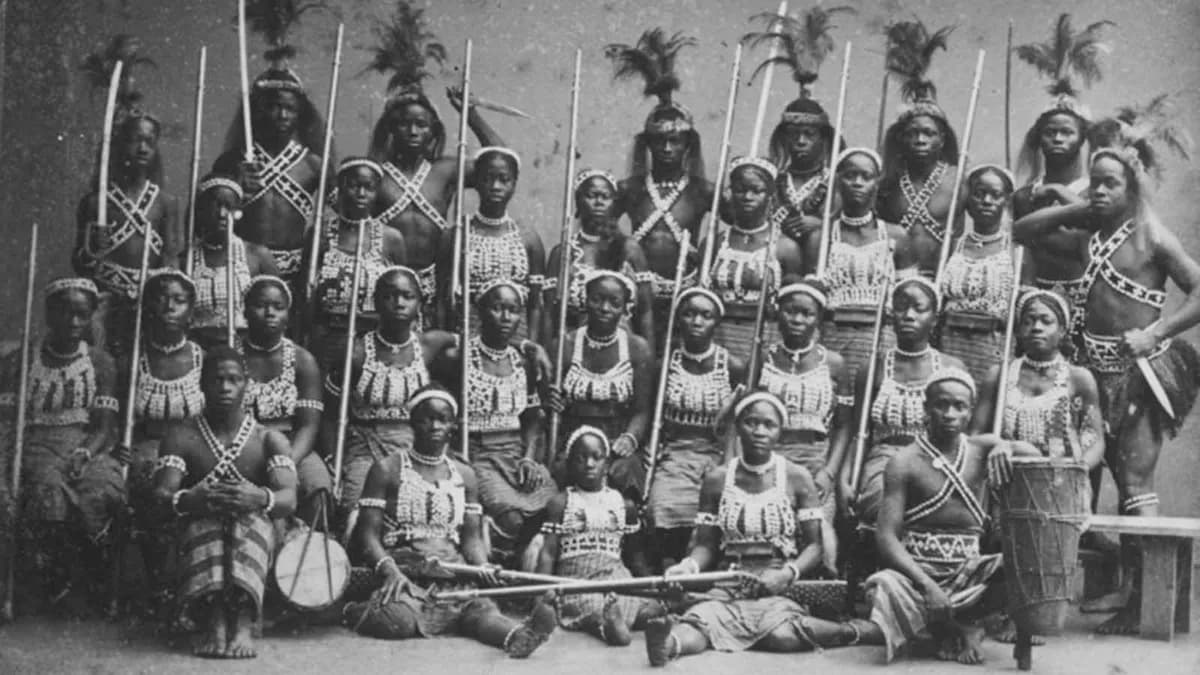
The Agojie
Encountering the Agojie in 1892, the French Foreign Legion met a formidable force. These women were not just warriors; they were a documented army that defied norms and shaped history.

Amulets of the Amazons
The amulets of the Amazons of Ouidah transcend their status as museum artifacts. They testify to a struggle for restitution and an identity renaissance.
Places of Memory and Vodun
Far from being mere attractions, the memory sites in Ouidah are witnesses to a poignant history, where vodun and memory intertwine.
Reading paths
The Slave Route
From the Atlantic slave trade to contemporary memory
Vodoun & Diaspora
How an African religion crossed the Atlantic
- Step 1· 12 minLe Temple des Pythons
Les origines du vodoun à Ouidah