The mausoleum stands at the entrance to a compound in the Gbécon Hounli neighborhood of Abomey. Two caryatides with lion heads flank the door. Two figures with generous forms guard the threshold. Inside, beneath the red earth of Abomey, a painter and sculptor named Cyprien Tokoudagba has rested since May 5, 2012.
He built it himself. Or rather, his family built it for him, in the same way he had built everything: with their hands, with the materials of the land, with the visual vocabulary of a tradition that does not separate the living from the dead, the artist from the work, or the family from the lineage.
The Tokoudagba dynasty is not a metaphor. It is a working structure, still active, still producing, still transmitting something that no museum curriculum has fully captured. To understand it, you need to understand two cities and the distance between them.
Two cities, one lineage
Abomey and Ouidah sit roughly seventy kilometers apart in southern Benin, connected by a road that crosses the flat plateau country of the Fon heartland. They are not interchangeable. Each carries a distinct weight.
Abomey was the capital of the Kingdom of Dahomey from 1625 until the French conquest of 1894. Twelve kings ruled from its palaces, each adding a new court to the complex, each leaving behind bas-reliefs, sculptures, and painted walls that recorded the dynasty's history in images rather than written text. The palaces, now a UNESCO World Heritage site, are the most complete visual archive of precolonial political power in West Africa. They are also, still, a place where the sacred and the historical are not separated. You walk through them and you are inside a living cosmology.
Ouidah, closer to the coast, carries a different charge. It was the primary port of departure during the transatlantic slave trade, a center of the Brazilian-Yoruba Aguda community, and above all, the spiritual capital of Vodun practice in the region. The python temple of Dangbe, the initiatory societies, the Route des Esclaves lined with sacred trees, the annual Fête du Vodun that draws practitioners from across the diaspora. Ouidah is where the invisible world presses closest against the visible one.
The Tokoudagba family emerged from Abomey. Their work spread to Ouidah and beyond. The distance between the two cities, traveled across a lifetime of commissions, exhibitions, and ceremonies, became the map of what they carried.
Cyprien Tokoudagba: the man who knew how to decorate
His father wanted him to become a tailor.
Cyprien Tokoudagba was born in 1939 in Abomey, the city of kings. He was autodidact from the beginning, forming himself not through any school or institutional training but through observation, repetition, and proximity to the sacred. As a young man, he began painting compound walls in his neighborhood. Not for galleries. Not for collectors. For the people who lived there, for the priests who needed their temples decorated, for the divinities that required visual form to be present in the world.
Word spread. The buildings around Abomey began to change through his work: bold figural compositions on whitewashed walls, the symbolic vocabulary of Vodun made visible in public space. Priests commissioned him. Communities recognized him. And then came the initiation that changed everything.
Tokoudagba was initiated into the society of Tôhôssou, the deity of water, the spirit of children who die before birth and return transformed. This was not a biographical detail. It was a structural event. The initiation gave him access to a visual and spiritual register that had been closed to him. It also gave him a responsibility: to represent what he now knew, accurately, durably, and with respect for what the images actually meant.
He once described what had drawn him to this path. As a young man, he had gone to visit a Vodun priest, a master. He looked at the statues and murals and arrived at a thought he carried for the rest of his life: "Even the deaf would understand the murmurs of his statues."
That sentence is a complete artistic philosophy. Art as communication that transcends the limits of language. The visual image as a form of knowledge transmission that functions even when spoken transmission fails. It is also a statement of ambition: to make work that does not require interpretation, that speaks directly through its forms and colors to anyone who stands before it.
His career through the 1970s and early 1980s was built entirely within this local economy of devotion. Temple walls in Benin, Ghana, Togo, and Nigeria. Every commission a negotiation between his growing technical mastery and the precise iconographic requirements of each deity, each lineage, each sacred space.
Keeper of the palaces: the Abomey years
In 1987, the Beninese government appointed Cyprien Tokoudagba as restorer at the National Museum of Abomey. The task was specific and demanding: to replicate the original bas-reliefs on the facade of the new King Glelé royal palace, part of the broader reconstruction of the Royal Palaces of Abomey.
These palaces are not ordinary heritage sites. They are the accumulated visual memory of twelve dynasties, each bas-relief a narrative panel recording a king's victories, emblems, proverbs, and spiritual alliances. The palace walls told Dahomey's history in a visual language that the Fon people could read without literacy. To restore them was to re-enter that language completely, to understand not just the forms but the grammar behind them.
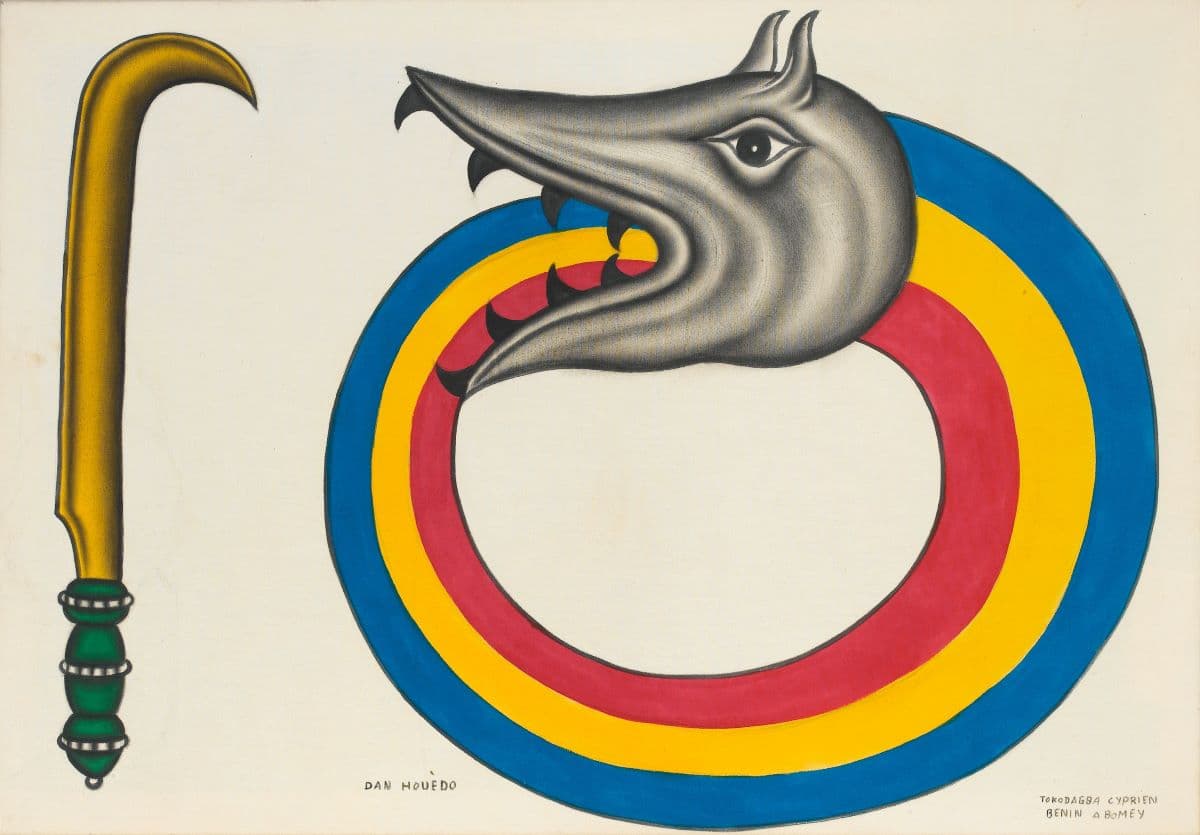
For Tokoudagba, the appointment was a kind of total immersion. Suddenly he had access to the fullest archive of Fon royal iconography: the emblems of King Glelé (the lion), King Guézo (the calabash), King Béhanzin (the shark), and the others, each with its system of symbols, animals, and objects layered into compositions of extraordinary density. He worked in cement, a modern substitute for the original earthen materials, carving it while still malleable, then painting it with synthetic pigments that held their color in the humid Beninese climate.
The work continued the tradition while modernizing its materials. This is a distinction Tokoudagba understood with precision: he was not inventing. He was extending. The forms remained faithful to the originals. The grammar did not change. What changed was the technical vocabulary that made preservation possible.
Legba, the trickster and messenger deity who stands at every crossroads between the human and divine worlds, became a recurring figure in his sculptural work during these years. The rooster and the pottery as offerings. The plant-snake hybrid signifying both medicine that heals and venom that kills. These were not decorative choices. They were exact statements in an iconographic language as precise as any written code.
By the end of the decade, Tokoudagba had become the most complete living interpreter of the Fon visual tradition. He had also begun to ask what he could do with that knowledge beyond restoration.
From the temple wall to the Centre Pompidou
In 1989, curator André Magnin, then working on the exhibition Magiciens de la Terre at the Centre Pompidou in Paris, encountered Tokoudagba's work and included him in the show. It was the first time Cyprien had left Benin.
Magiciens de la Terre was a watershed moment in the history of global contemporary art: the first major Western exhibition to place artists from Africa, Asia, and Latin America alongside canonical Western figures without the framing of ethnography or primitivism. Tokoudagba appeared alongside Jean-Michel Basquiat, Brice Marden, and Louise Bourgeois. The encounter between his Vodun iconography and the international art world was electric.
That same year, he began painting large canvases in acrylic. The move from wall to canvas was significant. A wall belongs to a place, a community, a function. A canvas travels. Tokoudagba understood the difference and used it deliberately: on canvas, he combined the emblems of the Abomey kings, the symbols of the four elements, the objects of his personal cultural universe, into compositions that worked both as Vodun image-systems and as autonomous paintings in the contemporary art sense. He called the result something like a "strange rebus." It was both more and less than that: a visual text in a language that most of his new audience did not know, but whose force they could feel.
The exhibitions followed in rapid succession. The Smithsonian Institution's National Museum of African Art in Washington. The Tate Gallery in Liverpool. The Mori Art Museum in Tokyo. The Hayward Gallery in London. The Centre Georges Pompidou again. The São Paulo Biennale. Biennales in Dakar, Moscow, Sydney. His works entered the Pigozzi Collection, one of the most important private holdings of contemporary African art in the world.
In February 1993, his work appeared at the Ouidah '92 festival, which celebrated Vodun art from Benin and the African diaspora. This return to Ouidah, with a body of work now recognized internationally, completed a circuit: the sacred city had always been present in his iconographic universe. Now the world's gaze moved in the other direction, toward Ouidah, through his work.
His murals at the Temple of Pythons in Ouidah stand as one of his most visible and most visited contributions. Every visitor who enters the compound walks through his visual world: the serpent of Dangbe, the water deities, the emblems of the kingdoms, rendered on walls that are not museum walls but living sacred space. The art is not behind glass. It is breathing.
The Atelier: a Renaissance workshop in Abomey
There is a model for what the Tokoudagba family built, and it comes not from contemporary art practice but from fifteenth-century Florence.
In the workshops of the Italian Renaissance, the master did not work alone. The atelier was a collective enterprise: the master designed, directed, and finished; apprentices and family members executed passages, prepared surfaces, mixed pigments, produced works that bore the master's name because they emerged from the master's vision and method. Authorship was understood differently. The work belonged to the atelier.
Cyprien Tokoudagba built exactly this. His wife Madeleine was a ceramicist and sculptor whose work in clay formed one of the atelier's principal outputs. His son Damien worked on paintings, reproducing and extending the visual vocabulary Cyprien had developed. All of them signed the works "Cyprien Tokoudagba." This was not deception. It was the logic of the atelier: the individual hand in service of a collective vision, a shared aesthetic, a continuous tradition.
The financial structure of this arrangement was practical as well as philosophical. Commissioned works, bas-reliefs for temples, sculptures for compounds and public spaces, paintings for collectors and institutions — all flowed through the atelier as a single enterprise. A Tokoudagba work was a Tokoudagba work, regardless of which hand had executed it.
After Cyprien's death on May 5, 2012, the family built his mausoleum themselves, in the compound where he had worked. The structure is a statement of continuity. Two caryatides with lion heads stand at the entrance, echoing the royal bas-reliefs he had spent years restoring. Two figures with generous, unclothed forms guard the thresholds. Inside, the red earth of Abomey. The mausoleum is signed, in the deepest sense, with everything he taught.
To stand at its entrance is to understand something about the relationship between an artist and a tradition that produces his work but also outlasts him. Cyprien Tokoudagba did not invent Vodun iconography. He was its interpreter, its transmitter, its contemporary form. The mausoleum makes that relationship concrete: the body in the earth, the symbols above the door, the living atelier continuing in the rooms around it.
Élise Tokoudagba: inheritance as reinvention
She grew up in the studio.
Élise Tokoudagba, daughter of Cyprien, began her formation in the family atelier between 1990 and 2000, working under her father's guidance from childhood through early adulthood. She learned by proximity, by watching, by doing. No formal art school. No curriculum. The knowledge came through the hands, through daily contact with the materials and the iconographic systems that structured everything the family made.
What she kept and what she transformed tells its own story.
Her primary medium is red clay, the laterite earth that colors the roads and compounds of Abomey. She models it, fires it, and paints it with car oil paint, an industrial material repurposed into something entirely her own: a surface that holds color with a particular depth and saturation, that makes her ceramics glow with an intensity that acrylic cannot produce. The choice is not incidental. Where Cyprien worked on walls and canvas, vertical surfaces made for distance and scale, Élise works in three dimensions, in objects that can be held and turned, that occupy physical space.
Her subjects are the subjects of the dynasty: the kings and warriors of ancient Dahomey, the divinities and demi-gods, the social life of the Fon people. But she adds something her father's work did not always foreground. The women of Dahomey are present in her pantheon: the goddesses, the Amazons who formed the royal military corps of the kingdom, the heroines of daily life. In a tradition where the major figures are overwhelmingly male, kings and male divinities occupying the center of the iconographic field, Élise's insistence on female presence is both a personal statement and a historical recovery.
She has spoken about what it means to be a woman artist in this tradition: a space historically structured around male initiation, male sacred knowledge, male artistic authority. Her presence in the atelier, her formal recognition, her exhibitions, represent a navigation of that terrain that is neither denial nor confrontation but a patient, continuous assertion of her own position within it.
In 2025, the Galerie Vallois in Paris devoted its first solo exhibition to her work, in dialogue with the graphic novel artist Mèdéssè Nathalie Sagbo, whose Tassi Hangbé: L'Amazone, Reine du Danxomè depicts the legendary queen of Dahomey. The pairing was deliberate: two women artists, two different media, one shared subject. The heroines of the Dahomey kingdom, made visible again, in clay and ink, in the twenty-first century.
The exhibition's title, "Les Héritières du Dahomey" — The Heiresses of Dahomey — named something the art world had not yet fully acknowledged: that the tradition does not die with its most visible male figures. It continues through the people who grew up inside it, learned it from the inside, and chose to carry it forward in their own form.
Élise is clear about what she is doing. Her pieces, she says, speak of the kings and warriors of ancient Dahomey. They represent the divinities. They describe the social life of the inhabitants. The continuity with her father's project is direct and acknowledged. What she adds is her own reading of that inheritance: in clay rather than cement, in small and large formats rather than monumental murals, in the female figures that the tradition had kept at the margins.
What the Tokoudagba atelier tells us about cultural transmission
There is a version of cultural preservation that operates through institutions: museums, archives, universities, heritage designations. The Royal Palaces of Abomey have UNESCO status. The works of Cyprien Tokoudagba are in the Pigozzi Collection and the Smithsonian. This is not nothing. Institutional recognition creates visibility, resources, and a form of protection against erasure.
But there is something institutions cannot do. They cannot transmit the knowledge of how to see, how to choose, how to read a sacred image well enough to produce one. That knowledge lives in the body and the hand. It is passed through proximity, through the daily practice of working beside someone who carries it. It dies when the chain of proximity breaks.
The Atelier Tokoudagba is a model for keeping that chain intact. Not a school, not a foundation, not a documentation project. A working studio in a compound in Abomey, where the same materials, the same iconographic grammar, the same relationship between the sacred and the aesthetic continue to be practiced every day.
This is also what visitors to Ouidah sometimes sense without being able to name. The Vodun tradition in southern Benin has survived not because it was preserved at a distance but because it was lived continuously. The python temple is not a reconstruction. The Fête du Vodun is not a reenactment. The temples that Tokoudagba painted are not exhibitions. They are functional sacred spaces that happen to contain extraordinary art.
The Tokoudagba dynasty embodies this logic at the level of the family. Cyprien did not write a treatise on Fon iconography. He built an atelier where the knowledge could be practiced rather than merely recorded. Élise did not attend lectures on Vodun symbolism. She grew up surrounded by it, working with it from childhood, transforming it through her own hands and sensibility.
What survives is not the documentation. What survives is the practice.
FAQ
Who was Cyprien Tokoudagba? Cyprien Tokoudagba (1939-2012) was a Beninese painter, sculptor, and bas-relief artist from Abomey, Benin. An autodidact initiated into the Vodun society of Tôhôssou, he became the most internationally recognized interpreter of Fon visual culture, exhibiting at the Centre Pompidou, the Smithsonian, the Tate, and major biennales worldwide. He is best known for his murals in Vodun temples across West Africa, his restoration of the bas-reliefs at the UNESCO Royal Palaces of Abomey, and his acrylic paintings combining Dahomean royal emblems with Vodun iconography.
What is the connection between Cyprien Tokoudagba and Ouidah? Though based in Abomey, Tokoudagba's work has a deep presence in Ouidah. He painted the murals of the Temple of Pythons, one of the city's most visited sacred sites. His work was featured at the Ouidah '92 festival, which celebrated Vodun art from Benin and the African diaspora. The visual vocabulary he developed, rooted in Fon and Vodun iconography, is inseparable from the spiritual culture that Ouidah represents.
Who are the other artists in the Tokoudagba family? The family worked as an atelier in the Renaissance sense. Madeleine Tokoudagba, Cyprien's wife, was a ceramicist and sculptor. Damien Tokoudagba, their son, worked on paintings and continues the family's artistic practice. Élise Tokoudagba, their daughter, is an autodidact painter and sculptor who works primarily in red clay, creating ceramic sculptures of Vodun divinities, Dahomean kings, and female figures including the Amazons of Dahomey.
What makes Élise Tokoudagba's work distinctive? Élise works in locally sourced red clay painted with car oil paint, producing ceramic sculptures with a visual intensity distinct from her father's acrylic and cement work. While her iconographic subjects remain rooted in the Fon tradition — divinities, kings, warriors — she foregrounds female figures, including goddesses and Amazons, that were less central in Cyprien's work. Her 2025 exhibition at Galerie Vallois in Paris marked her first major solo institutional recognition in Europe.
Where can visitors see Tokoudagba's work in Benin? The murals at the Temple of Pythons in Ouidah are among his most accessible works, visible to all visitors to the site. The Royal Palaces of Abomey, where he served as restorer, display bas-reliefs he worked on directly. The family compound in the Gbécon Hounli neighborhood of Abomey, where his mausoleum stands, is the heart of the atelier tradition he founded.
What is the Royal Palaces of Abomey and why does it matter? The Royal Palaces of Abomey are a complex of twelve palace compounds built by the kings of the Kingdom of Dahomey between 1625 and 1900. Listed as a UNESCO World Heritage Site, they contain bas-reliefs, sculptures, and architectural elements that constitute the most complete visual archive of precolonial Fon political and spiritual history. Tokoudagba's work as their restorer placed him at the center of this archive, shaping both his artistic vocabulary and his understanding of how images carry historical memory.
Conclusion: the practice that outlasts the practitioner
Cyprien Tokoudagba used to say he wanted even the deaf to understand his statues. He spent a lifetime making that true: in temple murals in four countries, in palace bas-reliefs that hold a kingdom's history, in canvases that traveled from Abomey to Tokyo, in an atelier where his wife and children worked beside him, learning through proximity what cannot be learned any other way.
He did not leave behind a school or a doctrine. He left behind a practice and the people formed by it.
Élise Tokoudagba shapes red clay in Abomey today, painting it with the same care for iconographic accuracy, the same knowledge of what each color, each attribute, each figure's posture means. Damien continues the paintings. The atelier continues.
In Ouidah, the murals at the python temple are still visited by thousands of people each year, most of whom do not know the name of the man who painted them. That would not have bothered Tokoudagba. He painted for the people who lived with the images, not for the people who catalogued them.
The dynasty persists in the way dynasties always have: not in monuments alone, but in the living transmission of what to look at, how to see it, and why it matters.
- Cyprien Tokoudagba was a central figure in transmitting Vodun art from Abomey to the world.
- The Tokoudagba family functions as a Renaissance-style atelier, continuing the tradition.
- Élise Tokoudagba innovates the legacy by creating clay sculptures that center women in Dahomey's history.