Key Takeaways
- The Houxwe Dynasty has held the title of Daagbo Hounon continuously since 1452 — predating the Portuguese arrival on the Bight of Benin, the Kingdom of Dahomey, the slave trade, French colonization, and Beninese independence. No external power has broken the succession in 574 years.
- The Daagbo Hounon is the supreme priest of Avlekete — a specific Vodun deity who commands the energies that separate water from earth, governs the movement of waves, and whose principal temple is at Ouidah. The Daagbo Hounon does not govern 'Vodun in general' — he governs the ocean's spiritual force from the city where the ocean changed history.
- His pontifical authority is recognized by 50 million Vodun followers worldwide — in Benin, Haiti, Brazil, Cuba, Louisiana, and the Caribbean. His compound at Houxwe Palace is painted with murals by artists from Haiti, Cuba, and Brazil: a living visual map of the diaspora inside the palace walls.
- When the 22nd Daagbo Hounon died in March 2004 at age 90, Vodun followers from Haiti, Brazil, Trinidad and Tobago, Cuba, the United States, and Europe came to Ouidah to mourn him — the most significant demonstration in recent memory that this title commands genuine global spiritual authority.
- The current Daagbo Hounon II chose a pontifical name with a specific meaning: 'A river cannot be measured against the sea.' The authority he holds is the sea. Everything else — every other spiritual or temporal power — is the river.
Every year on January 10, at the Grand Vodun Ceremony of the Vodun Days on Avlekete beach, a specific moment occurs that visitors who have witnessed it describe with striking consistency. The ceremony is at its height - drums, white-clad devotees, the ocean behind, tens of thousands on the sand. And then, from somewhere in the crowd, a movement begins.
People step back. The drums change. Women in white bow. Dignitaries lower their heads.
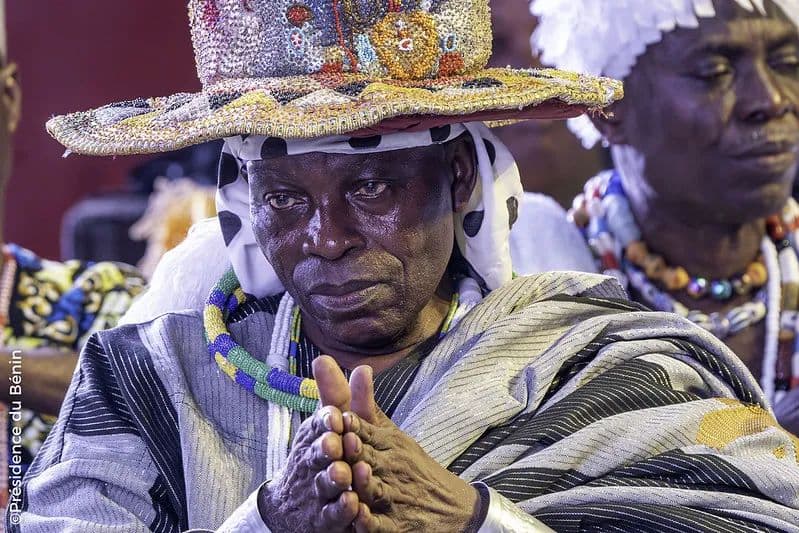
A figure moves through the space that opens before him - multicolored headdress, shimmering cloth, rows of beads that catch the January light. He walks toward the sea.
This is the Daagbo Hounon. And the deference around him isn't protocol or performance. It's the recognition, felt viscerally by everyone present who understands what they're watching, that they are in the presence of something that has been here far longer than any of them.
The Houxwe Dynasty has held this title since 1452. The Kingdom of Portugal was still finding its way down the West African coast. The Kingdom of Dahomey wouldn't conquer Ouidah for another 275 years. The Atlantic slave trade hadn't yet begun. And the Daagbo Hounon was already in his palace in Ouidah, presiding over the spiritual governance of the ocean's edge.
What this institution really is
Most visitors to Ouidah - even those who arrive well-informed - think of the Daagbo Hounon as the spiritual equivalent of a religious head of state: important, impressive, but comprehensible within familiar categories. A kind of Pope, a kind of Patriarch.
The comparison is useful up to a point and misleading beyond it.
The Daagbo Hounon isn't primarily an administrator of a faith. He is the supreme priest of Avlekete - a specific Vodun deity who commands the energies that separate water from earth, governs the movement of waves, and whose principal temple is at Ouidah. In the Vodun cosmological system, his authority isn't organizational. It is elemental. He governs the spiritual force that governs the ocean.
This matters because Ouidah isn't simply a coastal city with a Vodun tradition. It's the city where the Atlantic changed history - where the ocean was made into a trade route for human beings, where millions crossed from this shore into an unknown world, and where the spiritual reckoning with that history continues every day. The Daagbo Hounon presides over the spiritual force that governs that ocean. He doesn't govern the memory of the slave trade. He governs the element through which it operated.
"I am of water," he has said. "My mythical ancestor is in the sea, just like the tohio of the Houeda people, Houeda Dangbe, commonly known as the python."
The institution he represents carries a responsibility that no other spiritual authority in the world carries in quite this way: guardianship of the ocean that was both crime scene and, for the diaspora, highway of return.
The deep history
Before the ships: the Houxwe arrive (1452)
The Houxwe Dynasty's arrival in Ouidah in 1452 places them at the site well before any of the forces that would define the city's global significance. The Portuguese were still mapping the West African coast. The Kingdom of Dahomey was an interior power without access to the sea. The Hueda Kingdom - the coastal people who built Ouidah before the Fon conquest - was at its height, and the Houxwe were embedded in it as the guardians of the water Vodun.
Their specific domain was Avlekete - the deity who controls the energies at the boundary between water and land, who governs the movement of waves, who presides over the threshold where the ocean touches the earth. In the Vodun cosmology of coastal Benin, this wasn't a minor portfolio. The entire relationship between the community and the sea - the fishing, the weather, the tides, the spiritual meaning of the ocean - was the Daagbo Hounon's domain.
For 275 years before the Fon conquest, the Houxwe exercised this authority in a relatively stable political environment. The Hueda Kingdom traded with European merchants - the Portuguese from the early 16th century onward, then the Dutch, the English, the French - but maintained sovereignty over its spiritual life.
The Fon conquest of 1727 — and the absorption
In 1727, the Kingdom of Dahomey under King Agaja swept down from the interior and conquered the Hueda Kingdom. It was a catastrophic political rupture: the Hueda king fled, the coastal administration was destroyed, and Ouidah came under Dahomey's control.
The Daagbo Hounon didn't flee.
The Fon kings made a choice that reveals something essential about how power operates in Vodun cosmology: they didn't attempt to extinguish or replace the spiritual authority of the Houxwe. They absorbed it. The Daagbo Hounon's authority over the water Vodun and over Avlekete was recognized by the new Dahomean administration. The pontificate survived the conquest because the conquerors understood that the spiritual governance of the ocean couldn't be replicated or transferred - it belonged to the lineage that had held it for 275 years.
This pattern - external political powers recognizing and working around the Daagbo Hounon's authority rather than attempting to displace it - would repeat itself across the centuries.
The slave trade era (1727–1865)
For the next 140 years, the Daagbo Hounon presided over a Ouidah that was simultaneously the spiritual capital of the water Vodun and the most active slave-trading port on the Bight of Benin. More than a million human beings were processed through the city and its port. The ocean that the Daagbo Hounon's lineage governed spiritually was being used as a commercial highway for human cargo.
The moral weight of this proximity - the supreme guardian of the ocean's spiritual force in the same city where that ocean was being instrumentalized for the slave trade - isn't resolved by historical distance. It is part of what the Daagbo Hounon institution carries.
What the historical record does show is that the institution didn't collaborate with the trade in any formal sense, and that it continued to function throughout this period. The spiritual governance of the ocean didn't require the approval of the slave traders. The ocean had its own authority. The Daagbo Hounon maintained that authority while everything around it was being organized around commercial violence.
The enslaved people who crossed from Avlekete beach - the beach over which the Daagbo Hounon presided - carried the memory of the ocean's spiritual sovereignty with them to the Americas. When Mami Wata became Lasirèn in Haiti, when she became Iemanjá in Brazil, the theological root they were drawing on was the same tradition the Daagbo Hounon was maintaining in Ouidah.
French colonization and survival (1894–1960)
The French formalized colonial control over Dahomey in 1894. Like the Fon before them, they encountered the Daagbo Hounon as an authority they couldn't simply displace. The French colonial administration classified Vodun practice broadly as "superstition" and worked to undermine traditional spiritual authority across the colony. Missionaries of multiple denominations applied additional pressure.
The Daagbo Hounon's authority contracted during this period - reduced in its public expression, limited in its official recognition - but the succession continued. The lineage didn't break. The Houxwe Dynasty continued to hold the title through the entire colonial period, transmitting it internally according to customary law while external powers attempted to redefine the city's spiritual landscape.
The contrast with what was happening to Vodun communities across the diaspora during the same period is instructive. In Haiti, Vodou had already survived the Code Noir, the Haitian Revolution, and decades of official suppression by Catholic-influenced governments. In Brazil, Candomblé had survived police raids, forced closures, and legal prohibition well into the 20th century. The diaspora branches of the tradition maintained their practices under sustained institutional pressure.
Meanwhile, in Ouidah, the source maintained its pontificate. The building was still there. The dynasty was still there. The succession continued. Whatever the colonial government said in Cotonou had no effect on the line of transmission from the 15th Daagbo Hounon to the 16th to the 17th.
By the time Dahomey gained independence in 1960, the Daagbo Hounon was still in the same palace in Sogbadji where the dynasty had been since 1452.
The Marxist suppression (1972–1990) — and the underground
The most severe test of the institution came not from European colonialism but from a Beninese government. General Mathieu Kérékou's Marxist-Leninist regime, which took power in 1972 and lasted until 1990, classified Vodun as "superstition" incompatible with scientific materialism. Traditional religious authorities lost official recognition. Initiation ceremonies were driven underground. Sacred sites fell into disrepair.
The Daagbo Hounon's authority was formally unrecognized by the state for nearly two decades. The institution operated in the shadows of a government that denied its legitimacy.
The succession continued.
When the Marxist regime collapsed in 1989-1990 and democratic governance was restored, the Daagbo Hounon emerged - the same dynasty, the same palace, the same title, the same claim to authority. Whatever the state had said for eighteen years hadn't changed the underlying reality: the institution had outlasted the government that denied it.
The 22nd pontiff — and the world's mourning (2004)
The previous Daagbo Hounon - the 22nd of the lineage, known as Hounan - died in the night of March 11-12, 2004, in Ouidah, aged approximately 90.
What followed was the most vivid demonstration of the title's global reach in recent memory. Vodun followers from Haiti, Brazil, Trinidad and Tobago, Cuba, the United States, and Europe came to Ouidah to mourn him. The city received an international delegation for a funeral that was also a pilgrimage - people crossing the Atlantic to bury the man who had, in spiritual terms, presided over the ocean they crossed.
He was buried after a ten-hour ritual - a ceremony that compressed centuries of pontifical tradition into a single day and night of collective mourning.
Before his death, the 22nd Daagbo Hounon had made two gestures that defined the international dimension of his pontificate. In 1993, he met Pope John Paul II during the Pope's visit to Benin - a meeting between the leaders of two global spiritual traditions that was understood by both sides as a moment of mutual recognition. And he traveled to Haiti, visiting the Vodou communities who practice the diaspora descendant of the tradition he governed in Ouidah, affirming in person that the connection between the source and its diaspora expressions was alive, specific, and maintained.
The current pontificate (2006–present)
The current Daagbo Hounon - Tomadjlèhoukpon Hounwamènou Mètogbokandji II - was enthroned on June 25, 2006, under President Boni Yayi. He is the son of the ninth Daagbo Hounon of the Houxwe Dynasty.
The detail most often noted about his life before enthronement: he was a court clerk in Benin's justice system. An ordinary professional with an office, files, and a salary. And then the Dynasty Council designated him, and he became the supreme spiritual authority of 50 million people.
His pontifical name encodes a theological position: "A river cannot be measured against the sea." Every temporal power - the state, international organizations, other religious bodies - is the river. The Vodun ocean, and its supreme guardian, is the sea. The comparison is the point.
He has articulated his mission directly: "We need to prove to the world that Vodun has nothing satanic or evil. Vodun is tolerance, sharing, love, generosity, peace." The centuries of colonial misrepresentation - Hollywood voodoo, missionary condemnation, Marxist suppression - are the target of this statement. The restitution of Vodun's dignity in the global imagination is his pontificate's most public project.
The institution's governance today
The scope: 50 million followers across four continents
The figure cited consistently for the Daagbo Hounon's global constituency is 50 million Vodun followers - a number that, if accurate, places Vodun among the world's major religious traditions, comparable in scale to traditions far better known in the global North.
These 50 million are distributed across Benin, Togo, Ghana, Nigeria, and broader West and Central Africa. Across the Caribbean (Haiti, Cuba, Trinidad and Tobago, Martinique, Guadeloupe); across Brazil (particularly Bahia, São Paulo, and Rio de Janeiro); and across North American cities with significant African-American and Caribbean communities (New Orleans, New York, Miami, Boston).
Each of these communities practices a specific local form of the tradition - Haitian Vodou, Brazilian Candomblé, Cuban Santería, West African Vodun - with their own priests, their own liturgical calendars, their own governance structures. None of them report to the Daagbo Hounon in any administrative sense. But all of them recognize, with varying degrees of formality, that the theological origin of their practice is on this coast, in this city, presided over by this title.
When the Daagbo Hounon makes a statement about Vodun - about its meaning, its values, its relationship to the world - it carries weight in Port-au-Prince as well as Cotonou. When he presides over the January 10 ceremony, diaspora members who have traveled from Brazil or the United States aren't attending a foreign ceremony. They're attending the ceremony of the tradition's source.
The court structure
The Houxwe Palace in Sogbadji isn't simply a residence. It's a governance structure with state-like precision. The court around the Daagbo Hounon includes members holding specific spiritual and temporal functions, each transmitted through lineage:
- Kpatenon: First attendant during ceremonies
- Dagbe Non: Oversees the Python Temple
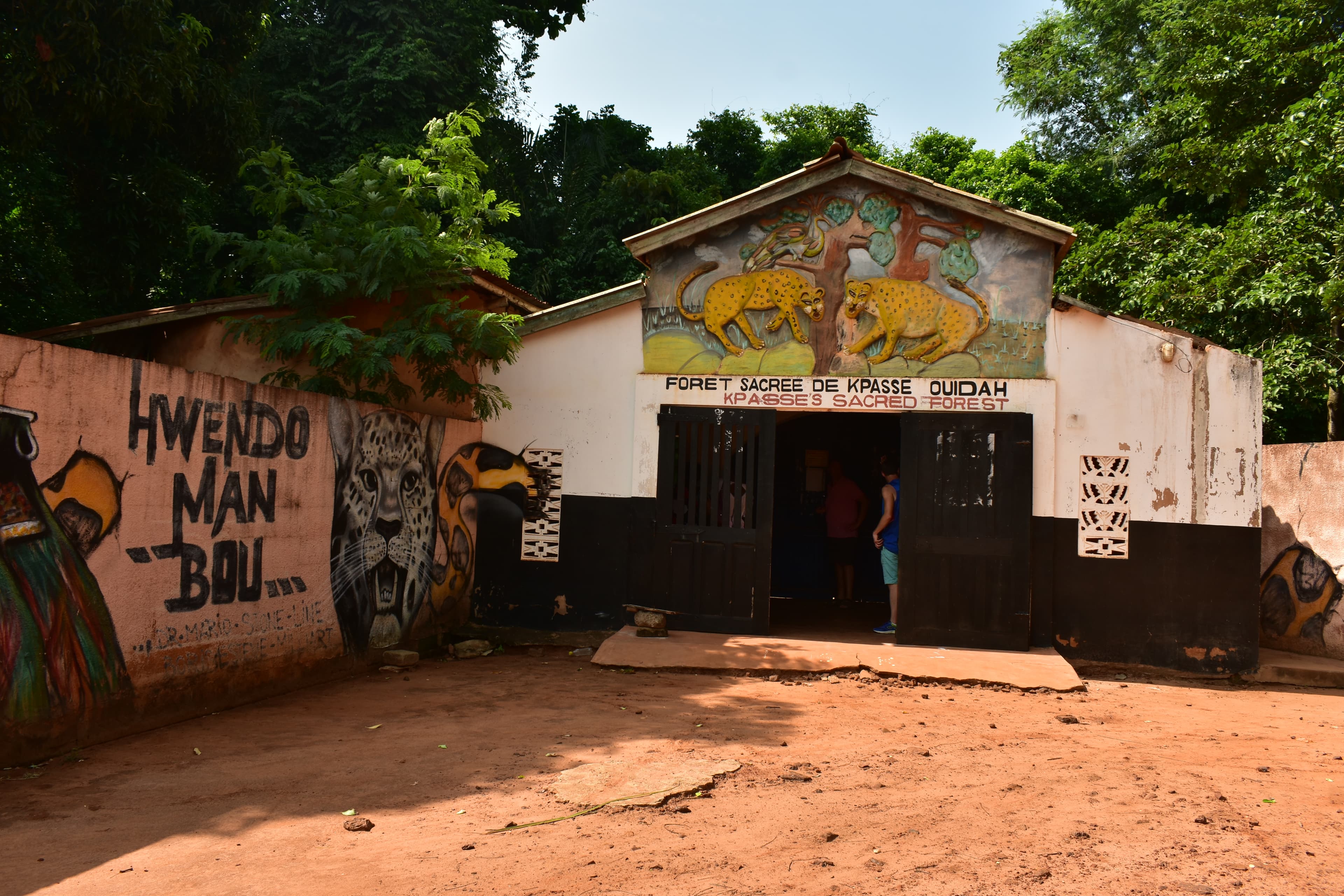
- Kpasse Non: Oversees the Sacred Forest of Kpassè
- Zon Non: Supervises convents of the Hevioso (thunder deity) across Ouidah
Every function is inherited, codified, and transmitted across generations. The Daagbo Hounon doesn't govern alone. He governs through a court whose institutional memory extends as far back as the dynasty itself.
Pontifical authority
When the Daagbo Hounon issues a pontifical bull on matters of Vodun practice, it carries weight throughout the Atlantic spiritual world. This authority is moral and theological, not administrative - individual communities in Haiti, Brazil, and Cuba maintain their own governance. But the symbolic recognition of Ouidah as the origin point, and of the Daagbo Hounon as its guardian, shapes how decisions about the tradition are made and legitimized across the diaspora.
The Beninese government recognizes him formally as one of the country's most important spiritual leaders. Presidents maintain regular ties with him. The transformation of January 10 into the multi-day Vodun Days festival - now drawing 740,000 participants from 56 countries - happened with his active support and participation.
The diaspora dimension
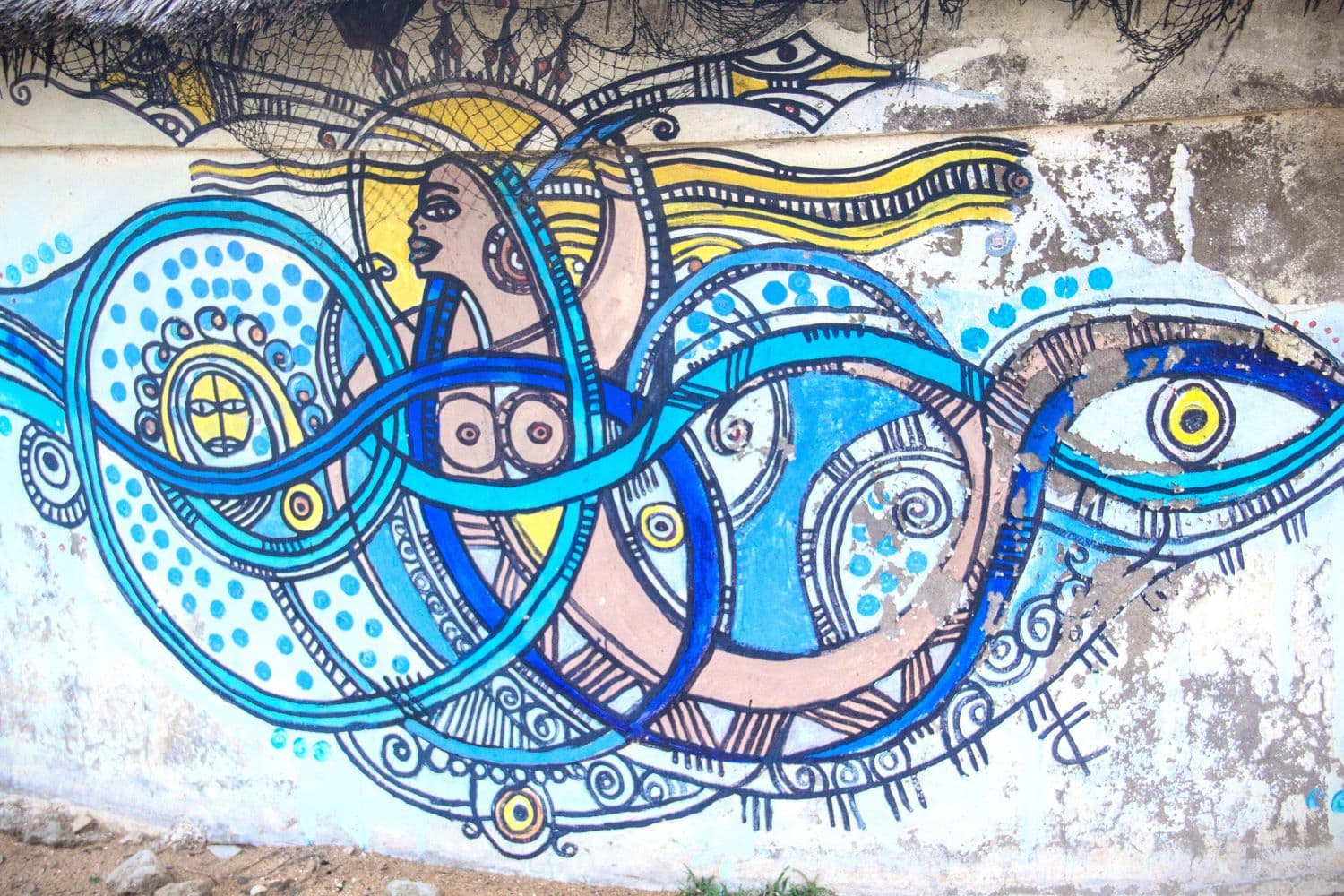
Inside the Houxwe Palace, the walls of the compound carry murals painted by artists from Haiti, Cuba, and Brazil - a living visual map of the diaspora within the palace itself. When a visitor from Port-au-Prince or Salvador enters and sees imagery from their own tradition on these walls, the abstract claim that Ouidah is the origin point of their spiritual practice becomes concrete. The source and its descendants are in conversation, in paint, in the same building.
The Daagbo Hounon has described his mission in explicitly transatlantic terms: he represents "all Vodun spirits who exist and thrive on both sides of the Atlantic." This is a theological claim of unusual breadth - a spiritual authority that doesn't stop at the coast of Benin but extends, in principle, to every place the ocean carried the tradition.
His predecessor's visit to Haiti - the supreme guardian of Vodun traveling to the community that preserved the most intact diaspora version of the tradition - was an act of recognition that worked in both directions. The Daagbo Hounon acknowledged Haiti's Vodou as a legitimate descendant. Haiti acknowledged Ouidah as the source. The relationship between the two traditions was confirmed not through scholarship but through a living ceremonial exchange between their leaders.
"Our brothers who were deported left Vodun in Ouidah," he has said. "That is why Ouidah is the world seat of Vodun."
This statement isn't a claim to ownership of the diaspora's traditions. It's a claim to origin - the acknowledgment that the source and its descendants are the same thing seen from different ends of the same timeline. The Vodou practiced in Port-au-Prince isn't a copy of Ouidah's Vodun; it's what Ouidah's Vodun became after five centuries of Atlantic passage, Caribbean slavery, Haitian revolution, and persistent transmission under impossible conditions. The Daagbo Hounon is the guardian of the beginning of that story.
This understanding gives the Vodun Days festival its specific emotional weight for diaspora visitors. They aren't attending someone else's ceremony. They're attending the ceremony their own tradition was built on. The specific prayers may be different; the specific deities may have been renamed; the specific ritual objects may have been adapted. But the theological structure - the relationship between the living and the dead, between the community and the forces that govern the elements, between the priest and the deity - is the same. And the person who presides over its source is here, walking to the sea, recognized by everyone present.
The current Daagbo Hounon has supported the expansion of the Vodun Days festival explicitly as a mechanism for this reunion - the annual moment when the source and its diaspora descendants are in the same place, under the same January sky, hearing the same ocean.
"Today, I am very happy to hear people speak of Vodun Days. The days of Vodun have truly improved," he said in January 2025.
What few people know
The Daagbo Hounon's specific theological domain - Avlekete - isn't simply "water" in a generic sense. Avlekete is a Vodun who commands the energies at the boundary between water and earth: the transition zone, the threshold, the moment when the ocean becomes land and the land becomes ocean. In Vodun cosmology, this boundary is one of the most charged spiritual spaces - it's where different worlds meet, where the living and the dead most easily communicate, where the power of transformation concentrates.
The beach at Avlekete - named for this same deity - is the principal ritual site of the Daagbo Hounon's pontificate. The boundary between ocean and land. The spot where the enslaved crossed from one world to another. The spot where the diaspora returns. The boundary where everything happened.
The Daagbo Hounon presides over this specific threshold. His title isn't coincidentally located here. It is located here because the spiritual governance of the threshold - the zone between worlds - is the governance of the most significant geography in Atlantic history.
"Once you breathe air, you are a child of Vodun. Once you drink water, you are a child of Vodun. Once you walk on Sakpata's earth, you're already a child of Vodun."
He doesn't claim the diaspora. He says the elements claim everyone.
How to visit
During Vodun Days (January 8–10)
The most accessible moment to witness the Daagbo Hounon in his full pontifical function is the Grand Vodun Ceremony on January 10, when he presides over the beach ceremony at Avlekete. His entrance is announced by drums. He walks to the sea. Tens of thousands are present, including diaspora delegations from four continents.
This is a public ceremony - accessible to all visitors present in Ouidah for the festival.
At Houxwe Palace
The palace receives visitors outside the festival season, but protocol is essential:
- Contact in advance: Through a trusted local guide or the OuidahOrigins Concierge
- Dress: White or neutral colours; modestly
- Footwear: Remove shoes at the courtyard gate
- Offering: Kola nuts, local gin, or what your guide recommends
- Protocol: Wait to be invited to speak; don't initiate photography; if you have ties to diaspora Vodun practice, mention them - the Daagbo Hounon pays particular attention to the diaspora
- Patience: Palace time isn't tourist time
The audience hall is arranged around the pontiff's throne, surrounded by objects of spiritual significance, photographs of predecessors, and - notably - flags of Haiti and Brazil. These flags are a statement: the diaspora is expected, recognized, and welcomed.
Address: Sogbadji quarter, Ouidah. Ask your guide; GPS mapping doesn't always locate the palace accurately.
Concierge access
A visit to the Houxwe Palace without preparation is a visit to an exterior wall. The encounter - the introduction, the protocol, the moment when the institution opens to receive a visitor properly - requires the community relationships and cultural knowledge that come with local accompaniment.
OuidahOrigins organizes protocol-respectful visits to Houxwe Palace as part of cultural itineraries in Ouidah. For diaspora members - particularly those from Haiti, Brazil, Cuba, or the United States with Vodun spiritual practice in their background - this visit has a specific intensity that we can prepare you for.
The 22nd Daagbo Hounon went to Haiti. The institution has been moving toward the diaspora for decades. The diaspora is invited to move toward the institution.
Further reading
- Wikipedia: Daagbo Hounon (FR) - Historical documentation of the title and lineage.
- La Gazette France: Daagbo Hounon — highest Vodun authority - Profile of the current pontiff.
- Haiti Libre: Supreme Vodun Leader Visits Haiti - Documentation of the diaspora visit.
- Wikipedia: West African Vodún - The broader spiritual system the Daagbo Hounon presides within.
- Wikipedia: Kingdom of Whydah - The Hueda Kingdom in which the Houxwe Dynasty was founded.
- Related articles: Mami Wata · Vodoun Days · The Sacred Forest · The Python Temple · The Slave Route
Editorial transparency
This content was developed with the assistance of our AI agents.