Key Takeaways
- Mami Wata is the Vodun sovereign of the Atlantic Ocean — and her central ritual site in Ouidah, the Mami-Plage Temple on Avlekete beach, sits at the exact geographic point where enslaved Africans entered the ocean and where diaspora members return. This is not metaphor. It is the same sand.
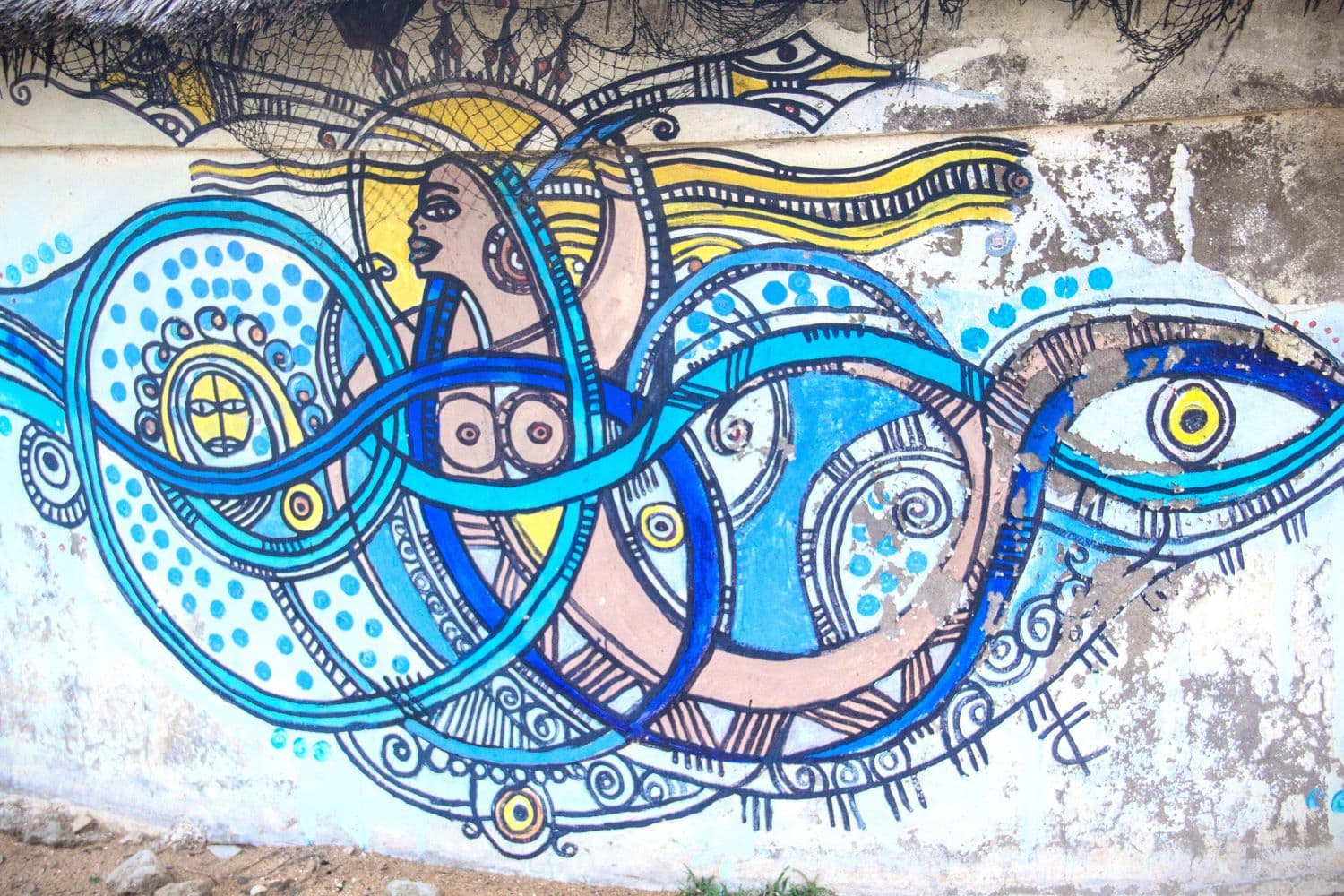
- Her iconography is deliberately cosmopolitan: she absorbed a 1887 German chromolithograph of a Samoan snake charmer, Hindu goddess imagery introduced by Indian traders in the 1930s, and European mermaid motifs from 15th-century Portuguese traders. Mami Wata is a deity that incorporates what arrives from the sea — including the cultures that came to exploit it.
- Across the Atlantic diaspora, she is Lasirèn in Haiti, Iemanjá in Brazil (Candomblé and Umbanda), Yemayá in Cuba (Santería), and Watramama in Suriname — the same spiritual force governing the same ocean, renamed and adapted but structurally unchanged across five centuries of separation.
- Mami Wata's offerings are distinctively modern: mirrors, combs, perfume, imported cloth, jewellery. She is a deity of commerce, beauty, and desire as much as of water — her domain covers not just the ocean but the world of goods that travel across it.
- Every January 10 during the Vodun Days, tens of thousands of devotees process to Avlekete beach for the Grand Vodun Ceremony. Mami Wata devotees dressed in white enter the ocean in trance. The diaspora stands on the same shore from which their ancestors departed. The ocean receives them both.
Before dawn on the beach of Avlekete, before the Vodun Days crowds arrive, before the stage is set and the drums begin, the Atlantic is simply itself.
The waves come in without urgency. The horizon offers nothing but water. The sand is the same sand that has been here for centuries - the same sand that received the footprints of those being marched to ships, the same sand that now receives the feet of their descendants coming back.
In the Vodun cosmology of Ouidah, this ocean isn't a neutral geography. It isn't simply the body of water that separates continents. It's a territory, inhabited, governed, alive. And the being who governs it has a name.
Mami Wata.
She isn't a local deity worshipped only on this coast. She is the spiritual sovereign of the Atlantic itself - the ocean that was made an instrument of one of history's greatest atrocities and that simultaneously, in the Vodun understanding, was never entirely in the hands of those who used it. Mami Wata was there when the ships came. She was there in the water beneath the Middle Passage. She is there now when the diaspora returns to the shore.
This beach is her throne. Avlekete is her address. And understanding who she is changes what you see when you stand here.
What Mami Wata really is
Most visitors who encounter Mami Wata for the first time categorize her quickly: a water goddess, a mermaid figure, a local spirit. The category is technically accurate and entirely insufficient.
Mami Wata is one of the most geographically extensive spiritual presences in the world - worshipped from coastal West Africa to Congo, from Haiti to Brazil, from Cuba to Louisiana, from Suriname to the French Caribbean. Scholars at the Fowler Museum at UCLA, which mounted a landmark exhibition on her in 2008, described her as a pan-African and Atlantic phenomenon, the most widely distributed single water spirit in the African and Afro-Atlantic world.
In the Vodun system of coastal Benin, she is intimately linked to the Huendo tradition - the water deity lineage that the Daagbo Hounon, Ouidah's supreme spiritual authority, presides over. The connection between the ocean, the supreme priesthood, and Mami Wata isn't incidental. In this cosmology, whoever governs the sea governs the most powerful force on this coast - and the sea has governed everything here for three centuries.
Her domain is broader than water alone. She governs wealth, beauty, fertility, health - the full spectrum of what the ocean made possible and what the ocean took away. She is beautiful and she is dangerous. She rewards sincere devotees and she tests and ruins those who approach her with greed or deception. Her relationship with human beings isn't simple benevolence. It's a relationship with terms.
The deep history
Water spirits before the Atlantic (pre-15th century)
Long before European ships arrived on the Bight of Benin, the Fon-Xweda people of the Ouidah coast had a sophisticated cosmology of water spirits - forces that governed the sea, the lagoons, the rivers, and the rain that sustained agriculture. The ocean was understood as a living territory with its own sovereign forces, as real and as requiring of respect as any human authority.
In this pre-Atlantic cosmology, the water spirit had no fixed iconographic form. It was present in the behavior of the water itself - in the tides, in the abundance or scarcity of fish, in the storms that broke ships apart or the calm that allowed safe crossing. The spirit communicated through these phenomena. Priests and priestesses who could read the ocean's language held significant social authority in coastal communities.
This was the theological foundation on which everything that followed was built. When the Atlantic trade arrived, it didn't encounter a spiritual vacuum. It encountered an already elaborated understanding of the ocean as a sacred space - and that understanding shaped how West African communities interpreted what was happening to them.
The cosmopolitan transformation (15th–19th century)
What makes Mami Wata unlike almost any other major deity in any tradition is the specificity of her iconographic history - and what it reveals about the relationship between the West African coast and the global economy.
From the earliest Portuguese arrivals in the late 15th century, European sailors and traders brought with them their own visual culture: images of mermaids, of sea monsters, of the ocean's supernatural inhabitants as European imagination had constructed them. West African communities on the coast encountered these images and did something extraordinary: they absorbed them.
An African carver - probably from Sierra Leone, probably Sapi, working between 1490 and 1530 - created a double-tailed mermaid figure for a visiting Portuguese client. The image he produced reflected both the European iconographic model and the West African understanding of the water spirit. This early encounter is documented in museum collections today. It's the beginning of a process that would continue for four centuries.
The most dramatic transformation came in the late 19th century. Around 1887, a German printing house in Hamburg produced a chromolithographic poster depicting a snake charmer - a woman named Maladamatjaute, described as Samoan, holding two large snakes. The image was vivid, exotic, beautiful in the visual vocabulary of the era. It traveled to West Africa via sailors and merchants.
By 1901, the image had already been incorporated into water spirit headdresses in the Niger River Delta region of Nigeria. West African communities had recognized in this foreign image something that corresponded to their own understanding of the water spirit - beautiful, dangerous, associated with serpents - and had absorbed it. A German poster of a Samoan woman had become, in the hands of West African spiritual practitioners, a representation of their ocean deity.
Then, in the early 20th century, Indian and Lebanese traders began arriving along the West African coast, carrying with them images of Hindu goddesses - Durga with her serpents, Lakshmi with her abundance, the water deity Ganga. These too were absorbed. By the 1930s, Mami Wata shrines could contain African traditional objects, European mermaid imagery, and Hindu chromolithographs, all understood as representations of the same spiritual presence.
This isn't syncretism in the sense of confusion or compromise. It is something more deliberate: a deity whose nature it is to incorporate what arrives from the sea - including the cultures, the images, and the economic systems that came to exploit the coast. Mami Wata absorbed the visual economy of the Atlantic and made it sacred. That's one of the most precise theological statements about colonialism ever made.
The Atlantic crossing
When enslaved people were taken from the Bight of Benin through Ouidah and across the Atlantic, they didn't leave Mami Wata behind. She was in the water beneath them for the entire crossing.
In the Vodun understanding, the ocean is her domain. The Middle Passage wasn't a space outside her sovereignty. It was her territory - and those who crossed it had, in some theological sense, entered her realm. What happened in that realm - the death, the violence, the erasure - wasn't Mami Wata's work. But she was present. And the enslaved people who arrived in the Americas carried her with them in the only form she could travel: memory and theology.
In Haiti, she became Lasirèn - the siren of the depths. In the Vodou pantheon, Lasirèn is associated with the ocean, with beauty, with secrets, with the power of water to transform. She is one of the most important lwa in the Haitian Vodou system, closely associated with Erzulie Freda - the goddess of love and beauty who shares her blue and white colors.
In Brazil, the transformation was even larger. The Yoruba water deity Yemoja - river goddess of the Ogun River in Nigeria, whose cult traveled across the Atlantic with enslaved Yoruba people - merged in the New World with Mami Wata energies to become Iemanjá, the great sea goddess of Candomblé and Umbanda. On February 2nd every year, hundreds of thousands of Brazilians gather on the beaches of Salvador da Bahia to offer flowers, perfume, and small boats to the sea in her honor. This is the same offering pattern - white, blue, mirrors, perfume, floating gifts - that Mami Wata devotees in Ouidah bring to Avlekete beach. The ceremony separated by five centuries and six thousand kilometers of ocean, still recognizably the same.
In Cuba's Santería tradition, she is Yemayá - ruler of the sea, protector of sailors, mother of the Orishas. In Suriname, Watramama. In the French Caribbean, Maman de l'Eau. Each name is a transformation, each tradition an adaptation, each ceremony a descendant of what began on this coast.
Mami Wata in Ouidah today
The Mami-Plage Temple
On the beach of Avlekete - the same beach where the Door of No Return stands - the Mami-Plage Temple has been active for generations. It isn't a large or imposing structure. It doesn't need to be. Its power comes from its location: at the exact point where the land ends and the Atlantic begins, where the historical geography of departure and the spiritual geography of return coincide.
Devotees come to the Mami-Plage Temple year-round. They bring the offerings Mami Wata prefers: mirrors (she is associated with self-reflection and the surface of water), combs (beauty, the care of the self), perfume (imported, expensive - she favors goods that have traveled), white and blue cloth, jewellery, and sometimes small boats or rafts laden with gifts to float out to sea. The distinctive modernity of her offerings is theologically precise: Mami Wata governs wealth and commerce as well as water. Her domain includes what travels across the ocean, not just the ocean itself.
The priests and priestesses of the Mami-Plage Temple - primarily women - conduct ceremonies throughout the year. Consultations for healing, fertility, business blessing, and protection are available to devotees and, with appropriate introduction, to visitors.
The Vodun Days ceremony
The most visible public ceremony takes place each January during the Vodun Days festival. On the evening of January 9th and the morning of January 10th, the Grand Vodun Ceremony brings tens of thousands of people to Avlekete beach. The procession moves from the city center down the Slave Route - three and a half kilometers in the same direction as the historical forced march, but with an entirely different destination in mind.
At the beach, Mami Wata devotees form a semi-circle facing the ocean. Dressed in white, adorned with blue and white bead strings, some carrying mirrors that catch the dawn light, they are the visual center of a ceremony that is simultaneously ancient and charged with contemporary meaning.
Some enter the ocean in possession trance - Mami Wata speaking through their bodies, their movements different from their ordinary selves, their voices changed. They go into the water. The same water. The water that received the enslaved people who boarded the ships from this beach. In the Vodun cosmology, this is an act of reclamation: returning to the sovereign of the Atlantic to affirm that the relationship continues, that the people are still here, that the ocean's authority includes the authority to receive the living as well as the dead.
For diaspora visitors standing on the sand watching this ceremony - Brazilians who know Iemanjá, Haitians who know Lasirèn, Americans from New Orleans who know the water traditions of the Delta - this moment is often described as the most disorienting experience Ouidah offers. They recognize what is happening. In their own traditions, they've seen versions of this ceremony. But they have never seen it here, at the source, in the ocean it came from.
The Mami Toligbé convent
Beyond the beach, Mami Wata has a dedicated urban sanctuary: the Mami Toligbé convent in central Ouidah. This is a living Vodun convent - a space of initiation, ceremony, and the transmission of the full theological knowledge associated with the water deity. It isn't a museum or a tourist site; it's a functioning sacred institution, currently undergoing rehabilitation as part of the Beninese government's program for the Route of Vodoun Convents.
The annual ritual Agbandotô - a great ceremony of offerings to Mami Wata - is held each year at the convent. Hundreds of devotees gather. Diaspora members increasingly participate, seeking the specific reconnection with practices their ancestors carried across the Atlantic without always being able to name their origin.
The diaspora dimension
The map of Mami Wata's Atlantic presence is also a map of the slave trade's reach from the Bight of Benin - and it's the most complete surviving demonstration that what the trade tried to take didn't stay taken.
In Haiti: Lasirèn is one of the most beloved lwa in the Haitian Vodou system. She lives in the sea, carries a mirror and a comb, governs music and beauty. Her ceremonies take place near water. Her devotees wear white and blue. The offerings - mirrors, perfume, floating gifts - are identical to those given to Mami Wata in Ouidah. Scholars who have compared the two traditions find structural correspondences that are too precise to be coincidental: they are the same theology, adapted to different islands.
In Brazil: Iemanjá is celebrated on February 2nd on the beaches of Salvador da Bahia - the same city where tens of thousands of Africans from the Bight of Benin arrived in chains. On that day, white-clad devotees bring flowers, perfume, and miniature boats to the sea. The ceremony is almost identical in structure to what happens at Avlekete beach on January 10th. The two festivals have never been formally connected, but the people who attend them are connected - by blood, by ocean, by the five-century-old thread of a theology that survived the Middle Passage.
In Cuba: Yemayá is the Orisha of the sea in Santería - mother of the other Orishas, ruler of the ocean's depths, protector of all who sail. Her colors are blue and white. Her number is seven. Her offerings include watermelons, molasses, and fish. She is depicted as a mermaid or as a beautiful dark woman rising from the sea. Her feast day in the Santería calendar is September 7th. She is one of the most widely venerated Orishas in Cuba, Puerto Rico, and the Cuban diaspora in the United States.
In Suriname: Watramama - "water mother" - carries the same governing authority over water, wealth, and the spiritual realm that connects the living with the dead who have crossed the ocean.
What unites all these figures isn't a shared name or a shared iconography. It's a shared theological position: the understanding that the ocean is governed by a feminine sovereign who demands respect and offerings in exchange for safe passage, abundance, and healing - and who keeps the connection between the living and the departed through the medium of water.
The iconographic paradox
Here is the fact about Mami Wata that most completely changes how you understand the Vodun tradition's relationship with the Atlantic world:
The most widely reproduced image of Mami Wata - the one that has been reproduced in posters, shrines, and devotional objects across West Africa, Central Africa, and the diaspora for over a century - is based on a German chromolithograph of a Samoan woman.
The poster, produced in Hamburg around 1887, depicted Maladamatjaute, described as a Samoan snake charmer, holding two large snakes. The image was part of the visual vocabulary of colonial-era "exotic" representation - women of non-European origin portrayed with animals for the consumption of European audiences.
The poster traveled to West Africa via sailors and colonial trade routes. And West African communities, encountering it, recognized in its visual logic something that corresponded to their own understanding of the water spirit: a woman of extraordinary beauty, associated with serpents, radiating a power that was both attractive and dangerous.
They absorbed it. They incorporated it into Mami Wata shrines and processional headdresses. By 1901, the image had been integrated into water spirit iconography in Nigeria. It became one of the most important devotional images in West African Vodun practice.
This isn't cultural naivety. It is cultural sovereignty. A West African spiritual tradition encountered the visual production of the colonial economy - the images that capitalism and empire used to represent "exotic" others - and decided what those images meant. The colonial gaze, turned into an object, was reinterpreted by those it was supposed to objectify, and made into a vehicle of the sacred.
Mami Wata didn't become colonial. She made the colonial image hers.
What the ocean knows
Stand at Avlekete beach as the Vodun Days ceremony is ending. The crowd is beginning to thin. The drums are slower. The devotees who entered the ocean have returned to the shore. The offerings - floating flowers, small boats, ribbons of white cloth - are somewhere in the Atlantic.
The ocean in front of you has received them all. It received the enslaved people who were marched here. It received those who died in the Middle Passage. It receives the diaspora members who come back. It receives the offerings of devotees who have never left.
In the Vodun cosmology, this ocean doesn't distinguish between these arrivals. It is Mami Wata's domain, and she is present in all of it: in the departure and the return, in the grief and the offering, in the January ceremony and in the February one in Salvador, in the Haiti that remembers Lasirèn and the Ouidah that remembers Mami Dan.
The Atlantic isn't a border. It's a connection governed by a specific presence. And that presence has never left this beach.
How to visit
Avlekete beach
Location: Avlekete beach, approximately 4km south of central Ouidah, at the foot of the Door of No Return. Coordinates: 6.32400°N, 2.08940°E.
When to come:
- January 10 (Vodun Days): The Grand Vodun Ceremony is the most powerful public manifestation of the Mami Wata tradition in Ouidah. Arrive early - by 8am the beach is filling. Devotees in white begin the procession from the city center.
- Year-round: The beach and the Mami-Plage Temple are active outside the festival. Friday mornings are reliable for offerings and prayers at the temple.
- Sunset: The light over the Atlantic at Avlekete in the late afternoon is among the most beautiful in West Africa - and the geographical weight of the place is most palpable in the quiet that precedes dark.
Protocol at the temple:
- Dress in white or neutral colours
- Don't photograph without permission - the Mami-Plage Temple is a working sacred space, not a photo opportunity
- If you bring an offering (perfume, a mirror, white cloth), present it to the priest or priestess
- Remove your footwear if asked
- A guide who has relationships with the temple's community will make a real encounter possible
Mami Toligbé convent
In central Ouidah, the Mami Toligbé convent is the Mami Wata tradition's urban sanctuary. Currently undergoing rehabilitation as part of the government's Vodun Convents Route programme. Access requires a guide with community relationships; the interior remains reserved for initiates, but the surroundings and exterior are part of the historic city circuit.
What few visitors know
The Agbandotô ceremony at the Mami Toligbé convent - the annual great offering to Mami Wata - isn't widely documented in tourist materials. It takes place outside the January festival season, making it inaccessible to visitors who only come for Vodun Days. It's a more intimate ceremony than the beach spectacle of January 10th, attended primarily by devotees rather than pilgrims and tourists. Diaspora members who return specifically for Agbandotô describe it as the more spiritually complete encounter - the ceremony designed for the faithful rather than for the audience.
Access requires advance notice, a trusted local guide, and appropriate protocol.
Concierge access
Avlekete beach during Vodun Days is, in a sense, already accessible to anyone who arrives in Ouidah in January. But the specific encounter - the consultation at the Mami-Plage Temple, the Agbandotô ceremony at Mami Toligbé, the introduction to the priests and priestesses who maintain this tradition year-round, the ability to bring an offering and have it received properly - these require the preparation and community connections that OuidahOrigins can provide.
Mami Wata receives those who approach her with sincerity. That sincerity requires knowing how to approach.
Further reading
- Wikipedia: Mami Wata - broad overview of the deity, her iconographic history, and her Atlantic diaspora.
- Fowler Museum at UCLA: Mami Wata — Arts for Water Spirits in Africa and Its Diasporas - The landmark scholarly exhibition documenting the full iconographic and theological range of Mami Wata.
- Wikipedia: Iemanjá - The Brazilian manifestation in Candomblé and Umbanda.
- Wikipedia: Lasirèn - The Haitian Vodou lwa descended from the same tradition.
- Wikipedia: Yemayá - The Cuban Santería manifestation.
- Oxford Research Encyclopedia of African History: Mami Wata - Peer-reviewed scholarly entry.
- Related articles: The Door of No Return · The Slave Route · Vodoun Days · The Daagbo Hounon · The Python Temple
Editorial transparency
This content was developed with the assistance of our AI agents.