Key Takeaways
- The Fondation Zinsou, inaugurated on November 11, 2013 inside the 1922 Villa Ajavon, is Sub-Saharan Africa's first museum of contemporary art — and one of the very few major cultural institutions on the continent that offers free admission as a fundamental principle, not a promotional offer.
- In its first nine years, 4.6 million people participated in Fondation Zinsou activities across all its programs — a remarkable figure for a city of 90,000, made possible by a deliberate model that refuses to treat access to art as a privilege.
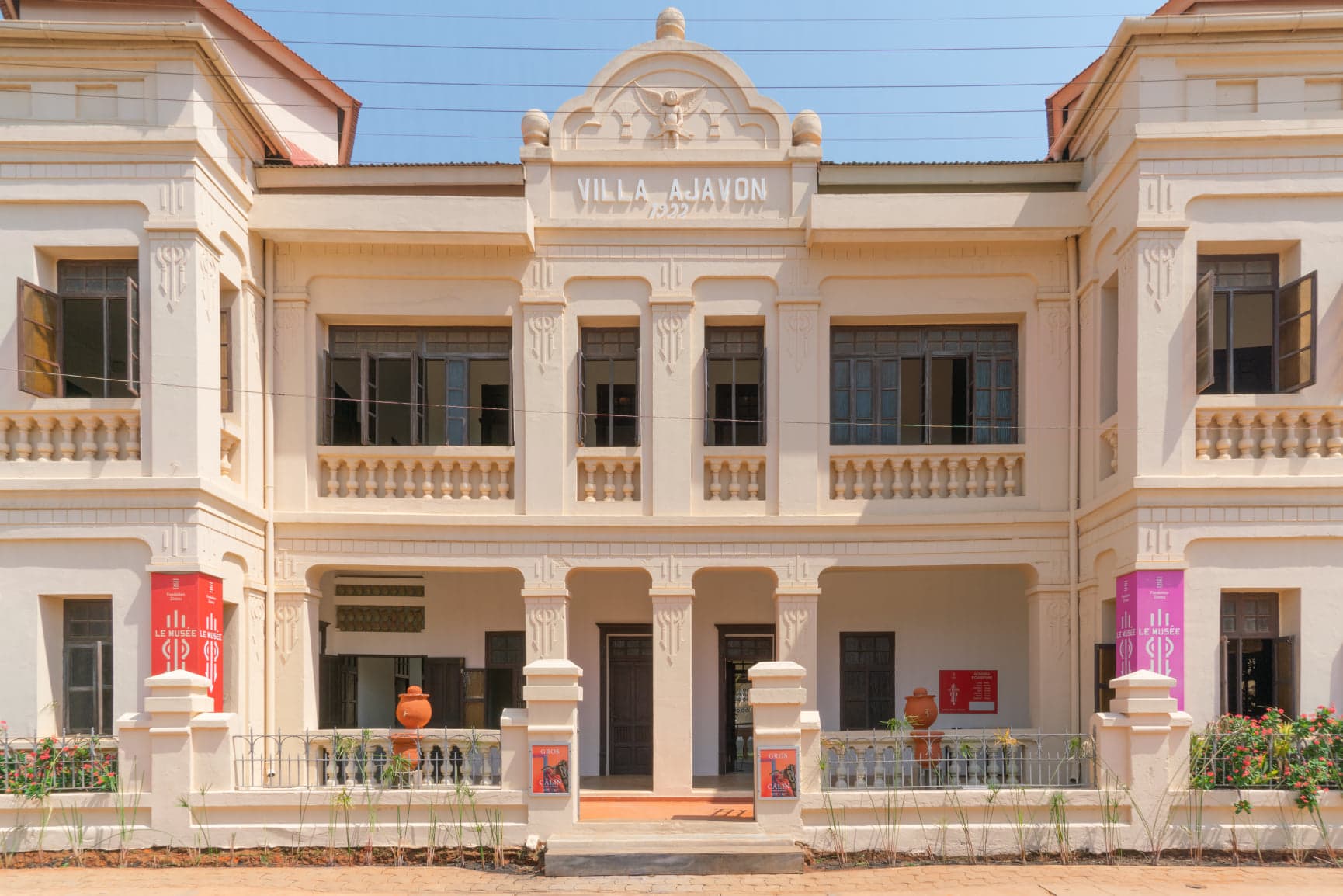
- The Villa Ajavon is a 1922 Afro-Brazilian building — part of the architectural vocabulary brought to Ouidah by freed Africans returning from Bahia. It combines baroque European ornament with African spatial logic, and its very existence is part of the transatlantic story the museum tells.
- The Foundation's inaugural exhibition in 2005 featured Romuald Hazoumè — Benin's most internationally recognized contemporary artist, whose work is held at the British Museum — and Cyprien Tokoudagba (1939–2012), the artist who painted and restored the Vodun frescoes of the Abomey royal palaces.
- In 2021, Marie-Cécile Zinsou became the first woman to preside over the board of the Villa Medici in Rome — one of France's most storied cultural institutions. The same year, France returned 26 Beninese royal treasures to Cotonou, opening a new chapter in the restitution debate she had been central to.
There's a building in central Ouidah that stops visitors cold on their first encounter - not because of its scale (it is modest by European museum standards) but because of a sign posted at its entrance that feels, in this context, quietly radical: free admission.
No asterisks. No "free for children under 12." No "free on the first Sunday of the month." Free. Always. For everyone.
In a city whose history was built on the commercial extraction of human beings, a cultural institution that has made the unconditional free access to art its founding principle isn't a small thing. The Fondation Zinsou - housed in the cream-and-pink Villa Ajavon, a 1922 Afro-Brazilian building just behind the Basilique de l'Immaculée Conception - is Sub-Saharan Africa's first museum of contemporary art. And it has never charged a single visitor to walk through its doors.
In its first nine years, 4.6 million people participated in Fondation Zinsou activities. In a city of 90,000.
What this place really is
Most cultural institutions in Africa - those that exist - are structured for international visitors, for the diaspora with purchasing power, for the academic and the already-initiated. The Fondation Zinsou was built on a different premise.
Its founder, Marie-Cécile Zinsou, is a Franco-Beninese art historian born in 1982. Her position has been stated with consistent precision: "Culture is not a luxury, it's a right." The Fondation Zinsou is the institutional expression of that conviction. Not a gallery for the elite. Not a cultural tourism destination. A museum for the people of Ouidah and Benin - and, by extension, for everyone who comes through this city with the attention it deserves.
This matters in Ouidah specifically because of what the city is. It's a city whose most famous landmarks are memorials to one of history's greatest atrocities. The Slave Route, the Tree of Forgetfulness, the Door of No Return - these are sites of rupture, of departure, of the systematic erasure of human identity. The Fondation Zinsou places itself in this landscape as something different: a site of accumulation rather than extraction, of presence rather than departure. A place where African art isn't shipped to European and American museums but kept here, shown here, interpreted here, for the people here.
That's a geopolitical act as much as a curatorial one.
The deep history
Ouidah before the museum
To understand what the Fondation Zinsou means, you need to understand what Ouidah looked like before it existed.
For most of the 20th century, the cultural heritage of Ouidah and the surrounding region - Vodun artifacts, royal treasures, contemporary artworks - left West Africa through predictable channels: colonial collection, commercial export, gifts and acquisitions that ended up in European and American museums. The British Museum, the Quai Branly in Paris, the Smithsonian - significant holdings of West African art are in institutions whose primary audiences aren't West African.
The Beninese royal treasures were the most extreme example: the 26 royal objects seized during the French conquest of Dahomey in 1892 - thrones, recades (scepters), asens - were housed in the Musée du Quai Branly in Paris for 130 years while the debate over their restitution ground through diplomatic and legal channels.
Into this landscape, in 2005, Marie-Cécile Zinsou founded the Fondation Zinsou in Cotonou with a stated mission: keep African art in Africa, and make it accessible to Africans. Not as an archive. Not as a nationalist monument. As a living cultural institution where contemporary artists could show work, where children could encounter art for the first time without being told it wasn't for them, where Benin's own creative production could be experienced on its own terms.
The choice of Ouidah
In 2013, the Foundation chose Ouidah as the site of its permanent museum - a decision that wasn't merely logistical but conceptual.
Ouidah was the obvious choice because of what it was: the city where the history of forced departure was most physically documented, the city where the spiritual traditions that survived that departure were most alive, the city where the Afro-Brazilian architecture of the return was most visible. A museum of contemporary African art in this city wouldn't be decorative - it would be in necessary conversation with everything around it.
The building they chose - the Villa Ajavon - amplified that conversation from the first day.
The Villa Ajavon (1922)
The Villa Ajavon was built in 1922 by a wealthy merchant named Ajavon, originally from neighboring Togo, who had settled in Ouidah and built a prosperous business in palm oil and textiles. He was a representative of a German trading company operating on the West African coast, and when he built his family home in Ouidah, he drew on the architectural vocabulary that the Aguda - the Afro-Brazilian returnees - had brought to the city.
The result is one of the finest surviving examples of Afro-Brazilian architecture in West Africa: a single-storey building with an imposing symmetrical facade organized around a large number of openings, baroque ornamental details, tall ceilings designed to hold the coastal heat at bay, and the distinctive spatial logic that the returnees had carried from Bahia. It's also a building that synthesizes influences beyond its Brazilian vocabulary: it carries marks of colonial European architecture and of the endogenous Beninese building traditions that shaped how the returnees adapted what they brought back.
The Villa Ajavon is therefore not simply a beautiful building. It's a material archive of the transatlantic exchange - a structure whose every architectural choice reflects the movement of people, styles, and cultural memories between West Africa and Brazil across the 19th and 20th centuries. To show contemporary African art inside this building is to place that art inside one of the most compressed physical expressions of the Atlantic story that Ouidah embodies.
The museum was inaugurated on November 11, 2013. Entry: free.
The collection and the mission
Keeping art in Africa
The Fondation Zinsou's permanent collection is built on a principle that sounds obvious but is, in practice, genuinely rare: African art held in Africa, interpreted for African audiences first.
The Foundation refuses to treat its collection as a diplomatic resource or an export commodity. Works acquired for the collection stay in Ouidah. Exhibitions travel - the Foundation has collaborated with institutions in Europe and North America - but the primary relationship is between the art and its local audience.
This has made the Fondation Zinsou's collection increasingly significant as a reference point in the international debate about restitution and the location of cultural heritage. When France returned 26 Beninese royal treasures in November 2021 - the first major restitution of African art by a European colonial power - the question of where the returned objects would be housed and interpreted was inseparable from the longer conversation about institutions like the Fondation Zinsou that had been arguing, for years, that Africa had both the infrastructure and the will to care for its own heritage.
Marie-Cécile Zinsou was a significant voice in that debate. Her appointment in October 2021 as the first woman to preside over the board of directors of the Villa Medici in Rome - the Académie de France's most prestigious cultural institution, which has shaped French cultural policy for centuries - was widely understood as a recognition that the arguments she had been making from Ouidah were being heard at the highest levels.
The artists
The Foundation's programming has consistently centered Beninese artists alongside work from across the continent, with the explicit position that "contemporary art in Africa" isn't a single aesthetic but a continent of 54 countries producing work as diverse as any other global region.
Romuald Hazoumè inaugurated the Foundation's first exhibition space in June 2005. Born in Porto-Novo, Hazoumè is known as one of Africa's most significant contemporary artists - his gasmask assemblages, made from discarded Nigerian petrol smugglers' containers, are held at the British Museum and shown in major international exhibitions. That the Foundation's first exhibition was his was a statement: the starting point of this institution would be the most uncompromisingly contemporary, internationally relevant work available.
Cyprien Tokoudagba (1939 - 2012) was the other foundational figure. Originally trained to paint the royal palaces of Abomey - restoring and creating the frescoes that document Vodun deities and scenes from the reigns of the Dahomey kings - Tokoudagba brought an encyclopedic knowledge of Vodun cosmology to his work. When the Beninese royal treasures were returned from France in 2021, the Foundation's response included an exhibition of Tokoudagba's paintings - art that made the cosmological context of those objects legible to audiences who mightn't have had access to it otherwise.
Other artists shown by the Foundation over its first decade include George Lilanga (Tanzania), Samuel Fosso (Cameroon), and dozens of artists whose work the Foundation has helped bring to Beninese audiences for the first time.
The Cosmogonies exhibition
One of the Foundation's landmark projects has been the Cosmogonies exhibition - a travelling show of the Zinsou collection that has reached international venues including the MoCo in Montpellier, France. Its title is precise: cosmogonies, origin stories, the accounts different cultures give of how the world came to be and what it is made of.
The works in Cosmogonies engage directly with African spiritual traditions - Vodun cosmology, ancestral theology, the relationship between the visible and invisible worlds - but they do so through the language of contemporary art practice rather than ethnographic documentation. The result is an exhibition that neither exoticizes nor academicizes its material, but treats it as the living, generative, culturally specific framework that it is.
When Cosmogonies traveled to France in 2022, it did so partly in the context of the restitution debate - demonstrating, in a French museum, that the Beninese institutions and public had both the appetite and the curatorial capacity to hold and interpret their own heritage. It was a diplomatic statement made through art rather than through diplomacy.
Free entry as philosophy
The decision to make all activities free isn't primarily a marketing strategy. It's the clearest expression of the Foundation's actual theory of change.
Zinsou's argument is straightforward: the legacy of extraction - colonial and commercial - in West Africa means that cultural institutions that charge for access are, in effect, replicating the logic of the trade in another register. If the history of this region involved systematically taking things from people, the cultural institution that responds to that history should be organized around giving things to people, unconditionally.
In practice, this means the museum's audience is genuinely the full population of Ouidah and the surrounding region - not a curated subset of those who can afford a ticket. School groups, elderly residents, local families, traders from the market a block away - the Villa Ajavon receives them all. The 4.6 million participants in the Foundation's first nine years isn't a tourist statistic. It's a Beninese statistic.
The Foundation has received the Praemium Imperiale grant from the Japan Art Association - one of the world's most prestigious international arts prizes - recognizing the Fondation Zinsou among the most significant young arts organizations globally. This recognition hasn't changed the model. The entry price remains what it has always been.
Inside the Villa Ajavon
Walking into the Villa Ajavon for the first time, most visitors are struck not by the art immediately visible but by the quality of the light.
The building's numerous openings - the windows that wrap the facade and continue on all sides - fill the interior with a diffuse, coastal brightness that is neither the cool darkness of a European museum nor the full heat of the West African exterior. It's a specifically Afro-Brazilian quality of light: the kind that the sobrado architecture was designed to produce, adapted to a climate where the distinction between inside and outside is always more permeable than Northern European architecture assumes.
The ceilings are tall enough to hold the heat at bay even in the dry season, and the interior temperature, once you have stepped inside from the sandy street outside, drops perceptibly. This physical quality isn't incidental to the experience of the art - the Villa Ajavon was built to be a place where people could think clearly, work and live without the enervation that the coastal heat otherwise imposes. It's still doing that work, now in the service of contemporary art rather than domestic life.
The galleries themselves are a sequence of rooms that the building's original domestic layout has shaped into something neither formally institutional nor casually residential. The transitions between spaces - the thresholds, the changes of ceiling height, the moments where natural light shifts - create a viewing experience that is structurally different from a purpose-built white-cube gallery. The art in the Villa Ajavon is in conversation with the architecture that holds it. That conversation is part of what makes the Fondation Zinsou unlike any other contemporary art museum on the continent.
The 2026 horizon
The Fondation Zinsou's 2026 programming reflects a specific historical consciousness. In September 2026, Benin will have been independent for exactly 66 years - the same length of time as the colonial period. This symmetry isn't lost on the Foundation, which is preparing a major exhibition around the question of what 66 years of colonization and 66 years of independence have respectively made of Beninese daily life, material culture, and artistic production.
The exhibition's framing - freeing the present from the weight of the colonial period by fully examining it - is consistent with the Foundation's broader approach: that the correct response to difficult history isn't silence or spectacle but rigorous, accessible, living cultural engagement.
For visitors arriving in Ouidah in 2026, the Foundation's programming will be in explicit conversation with the full historical world of the city - the Slave Route memorials, the Vodun temples, the Afro-Brazilian buildings - presenting contemporary artistic responses to questions that those sites pose but can't, by themselves, answer.
The building's conversation with the city
The Villa Ajavon doesn't stand in isolation. It is in a specific geographic relationship with the rest of Ouidah's sacred and historical landscape - a relationship that is worth understanding before you walk through its doors.
Behind the Basilique: The Villa Ajavon sits just behind the Afro-Brazilian Cathedral, the neo-Gothic church whose patronage by the Aguda families made it a monument to the same transatlantic return that the Villa represents architecturally. The two buildings are close enough to be in permanent conversation about what the Brazilian Legacy of Ouidah actually is.
Near the Python Temple: The Python Temple - Ouidah's oldest and most sacred Vodun site - is a few minutes' walk. The Foundation's permanent collection includes works that engage directly with Vodun cosmology and imagery. Seeing both in a single afternoon produces a specific kind of double vision: the living sacred practice and the contemporary artistic interpretation of the same spiritual heritage.
On the Slave Route axis: The route from Place Chacha to the Door of No Return passes near the Villa Ajavon's neighborhood. The Foundation's programming doesn't avoid this proximity. Exhibitions that address the Atlantic slave trade - its mechanisms, its aftermath, the cultures that survived it - are a recurring thread in the Foundation's curatorial programme.
What few visitors know
The Foundation's work extends well beyond the Villa Ajavon museum. Its DAN XOME programme - a major research and publication initiative - documents and publishes Beninese cultural heritage that has no institutional home elsewhere: oral traditions, craft techniques, spiritual practices, historical records that exist in living memory rather than in archives. The Foundation understands that its role isn't only to show art but to create the documentary infrastructure that ensures Benin's cultural production is preserved and accessible to future generations.
The Foundation has also established residency programmes for artists working at the intersection of Beninese tradition and contemporary practice - providing not just exhibition space but the time, support, and institutional connection that allows artists to develop work that wouldn't otherwise exist.
And its educational programmes - school workshops, community outreach, art education for children who have never been inside a gallery - reach tens of thousands of people annually who don't come to the Villa Ajavon as tourists but as participants in the cultural life of their own city.
Visiting the Fondation Zinsou
Address: Central Ouidah, just behind the Basilique de l'Immaculée Conception, coordinates approximately 6.36100°N, 2.08500°E.
Hours: Open daily (check fondation-zinsou.org for current hours and exhibition schedules).
Entry: Free - always, for everyone, no exceptions.
What to see:
- The permanent collection: works by Romuald Hazoumè, Cyprien Tokoudagba, and a rotating presentation of African contemporary art
- The Villa Ajavon itself: read the building as an architectural document - the facade, the window proportions, the ceiling height, the courtyard logic
- The rotating exhibitions: check the Foundation's site before visiting. Programming changes regularly and may include works directly responding to Ouidah's historical landscape
Best combined visit: The Fondation Zinsou is most powerful when visited in the context of the full Ouidah circuit - the Python Temple and the Basilique nearby, followed by the Slave Route in the afternoon. The art you see inside the Villa Ajavon will reframe what those sites mean, and those sites will reframe what the art means.
Time needed: Minimum one hour; two hours if the current exhibition warrants it. The Foundation isn't designed for rushed consumption.
Concierge access
The Fondation Zinsou's public programming is exactly that - public and free. But for visitors who want to go deeper - a conversation with a curator about the Foundation's acquisition and restitution positions, access to the DAN XOME archive, or a combined itinerary that weaves the Foundation's collection into the broader historical world of Ouidah - OuidahOrigins can provide the context and introductions that turn a museum visit into a more complete encounter.
The Foundation is the most contemporary layer of Ouidah's story. It belongs in the same conversation as everything else.
Further reading
- Fondation Zinsou — official site - Exhibitions, programmes, and the Foundation's full mission.
- Wikipedia: Marie-Cécile Zinsou - The founder's biography and cultural advocacy work.
- France 24: Marie-Cécile Zinsou — "Culture is not a luxury, it's a right" - Interview on restitution, access, and the Foundation's mission.
- Wikipedia: Villa Ajavon - Architectural history of the building.
- L'Œil de la Photographie: Benin — Africa's First Contemporary Art Museum - Profile of the museum at opening.
- Praemium Imperiale — Grant for Young Artists 2014 - International recognition of the Foundation's work.
- Related articles: The Brazilian Legacy · The Aguda Community · The Afro-Brazilian Cathedral · The Python Temple · The Slave Route
Editorial transparency
This content was developed with the assistance of our AI agents.